
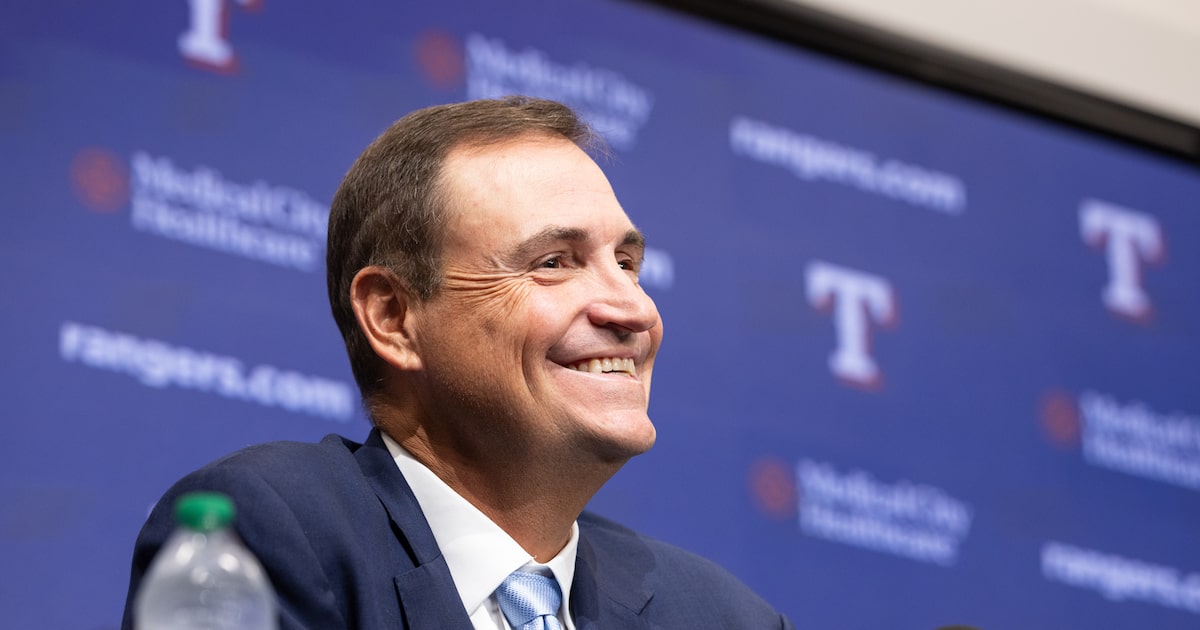
LAS VEGAS — Chris Young still does not know exactly what payroll constraints the Rangers have this offseason. Nor does he particularly care.
It won’t be $240 million again is all that is certain.
Whether it winds up at $220 million or $200 million or even a couple of million below, Young said Wednesday the Rangers will put together a “very good team.”
“I just don’t feel sorry for ourselves that our payroll is going to be smaller than it was,” Young said Wednesday during his media availability during the GM meetings at The Cosmopolitan Hotel and Casino. “I don’t think it’s going to inhibit us. I’ve been on a team [the 2010 San Diego Padres] that had a $30 million payroll and was a game away from making the playoffs and lost to the World Series champion. I’m a competitor. It doesn’t deter me. It means we better be better at our jobs. And that’s what I expect to do.
Rangers
“I think the biggest thing that we need to do is play up to our expectations. This past season and the year before, we did not do that. If we play up to our expectations, I’m confident that the roster we build will be good enough to compete for a playoff spot.”
Strong words and conviction. Now comes the hard part: Figuring out how.
We’ve been over the math before, but it’s worth reiterating that no amount of creativity can turn a roster currently at $190 million in commitments and lacking at least seven or eight roster spots into a contender at $200 million without a significant rearranging of the finances.
That is the Rangers conundrum as winter free agency season begins. Forget the official date, but it doesn’t really start until agent Scott Boras sets up his makeshift soap box and his Boras Corporation backdrop and starts pedaling puns related to his clients and potential suitors. That happened Wednesday morning.
And even that sent a pretty stark sign that not even Boras expects the Rangers to be big bidders in free agency for a client list that includes pitchers Dylan Cease (he pitches “on a level where others Cease to exist”), Zac Gallen (“if you want to fill a pitcher, why not a Gallen?”) and Ranger Suarez (whose command makes him the “zone Ranger”) and hitters like Pete Alonso (a whole punch of “P” alliteration) and Cody Bellinger (many Top Gun references).
Boras didn’t workshop any Rangers-related material into his 40-minute set. When asked about the club potentially scaling back payroll and its impact on his two high-profile clients on long-term deals with the Rangers (Corey Seager and Marcus Semien) all he could offer was this:
“Whenever I’m asked about payrolls, I have to say “When don’t you advance? And why don’t you advance?” Boras said. “I don’t think anybody wants to announce what they are going to do at this point, because they want it to be a surprise.
“But I also have to think that in this business, like any great business, you don’t move in response to an internal, subjective payroll. A few years ago, I sat down with [Young] and I said, we have two players that we think that if you sign these players, you are on a very short track to the World Series. They signed both, went way over budget and were rewarded a year later with a world championship. So, if you’ve to first, and foremost, look at talent and what advantages are for your team, but the word ‘budget’ is a barrier to success in sport.”
What it lacked in puns, it made up for in substance.
Which brings us back to Young and the Rangers’ situation. Semien is making $25 million a year and Seager $32 million. Those are just the Boras clients at the $25 million level. To get the full figure, you have to include Jacob deGrom at $37 million and Nathan Eovaldi at $25 million. That’s almost $150 million on four players.
Would Young consider trading any of them to get some financial flexibility to fill multiple needs with the extra resources?
“Do scenarios exist in which we can get better by moving those [players]?” Young repeated a question presented to him Wednesday. “Probably, yes. Is that our goal? No. Is it something we’re actively pursuing? No. But we have an obligation to always be open-minded. So, we want to find any way we can to make this team better.”
It leaves some room for interpretation. A definitive no? Not quite. Nor was it any kind of an acknowledgement the Rangers are open for business.
Asked another way, if the Rangers could hold on to all the contractual obligations and still finish off a contending team under the financial constraints, Young maintained focus on only one thing: Contending.
“We won a World Series in 2023 with those contracts, and I don’t see why we can’t do it again, but we’ve got to do a better job of building a roster that complements one another, that can play the game in a way that’s going to result in and wins that allow us to hopefully win the division and then compete in the playoffs,” he said. “The guys we paid big money to are great players, and they’re important pieces for our success, and we need those guys to be at their best, but we’ve got to build out the rest of a complete roster.”
In other words, no excuses. Whatever the constraints, the challenge remains the same: Win.
Texas Rangers announce new coaching staff members under manager Skip SchumakerEven after the trade, study shows Luka Doncic remains among trendiest pet names in Dallas
Find more Rangers coverage from The Dallas Morning News here.
Click or tap here to sign up for our Rangers newsletter.