
LAS VEGAS — Just days after federal prosecutors alleged two big leaguers rigged their pitches as part of a betting scheme, Major League Baseball officials convened this week in a packed Las Vegas casino for the sport’s annual general managers’ meetings. As they scurried to discuss potential free-agent signings and player trades, top decision-makers from all 30 teams weaved past blackjack tables and a sports-betting parlor — an irony that wasn’t lost on at least one longtime executive.
“It’s become a bigger challenge now, when on your phone you’ve got access to it,” Jed Hoyer, the Chicago Cubs’ president of baseball operations, said of sports betting. “It’s probably not the last time that we’re going to be addressing this because of the ease of gambling, as we sit here in a casino.”
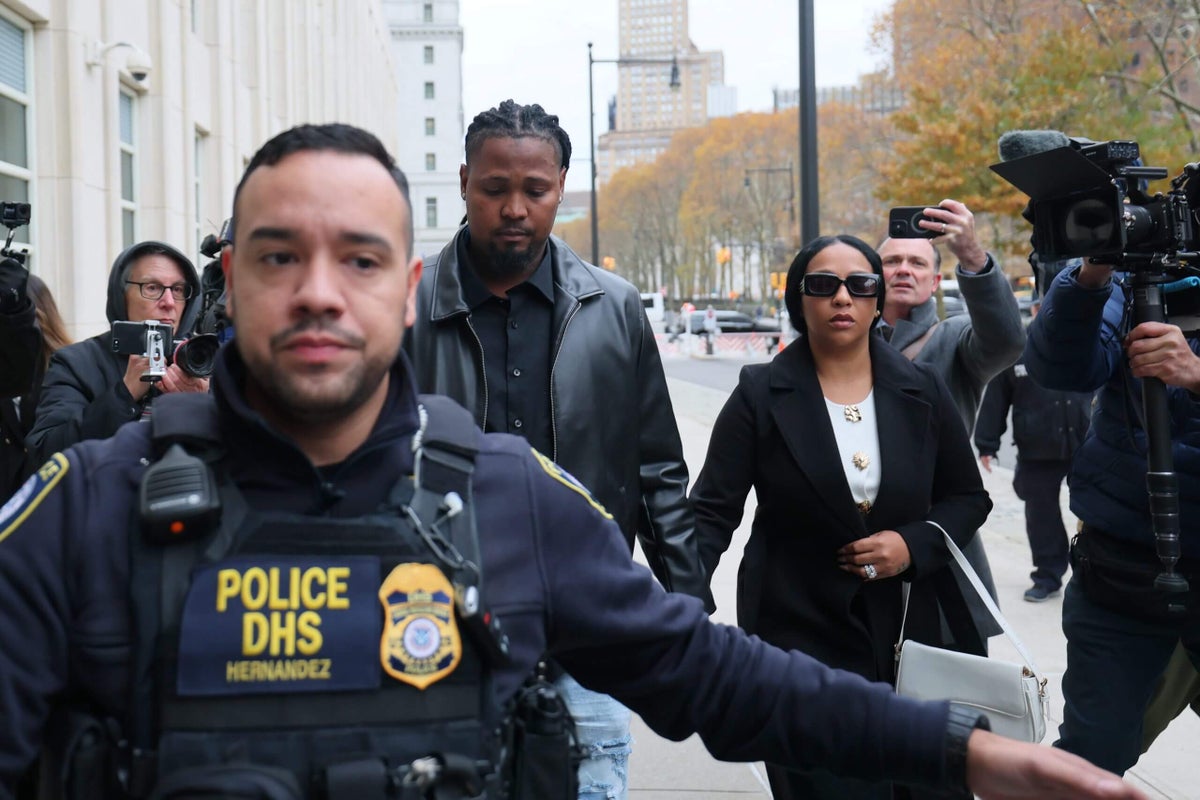
Cleveland Guardians pitchers Emmanuel Clase and Luis Ortiz allegedly received thousands of dollars to predetermine how they would throw certain pitches, including some tossed wildly in the dirt, helping bettors to win more than $460,000. Attorneys for the pitchers have denied the charges, which were brought by the Eastern District of New York and unsealed on Sunday, when Ortiz first appeared in court in Boston. Ortiz was arraigned in New York Wednesday, and Clase is scheduled to be arraigned Thursday, also in New York.
Some officials this week appeared to acknowledge the dangers produced by sports betting’s proliferation. Besides threats to the integrity of competition, bettors have sometimes harassed players and their families.
“I just want rules and regulations that protect our players, our umpires, our coaches and front office,” said Texas Rangers president of baseball operations Chris Young, who was once a high-ranking official in the commissioner’s office. “We’ve got such a great game, and you’d hate to have anything that can come in and soil it the way sort of this gambling thing has.”
Red Sox chief baseball officer Craig Breslow echoed that stance: “The threats that players are facing, and clearly some of the inducements that players are facing, are real and need to be dealt with.”
Yet through two days of meetings and interviews with reporters at the Cosmopolitan hotel, GMs mostly shied away from suggesting substantive remedies, despite an indictment that U.S. Attorney Joseph Nocella Jr. said “damages the public trust in an institution that is vital and dear to all of us.”
“I just don’t want to touch the topic,” Atlanta Braves president of baseball operations Alex Anthopoulos said, in one example. “Let other people answer that.”
“It’s unfortunate that’s where we’re at,” said Los Angeles Dodgers GM Brandon Gomes, a former pitcher, in another. “But for me personally, I haven’t spent a ton of time on that.”
It was a leading player agent, Scott Boras, who took the most direct position in Las Vegas: prop bets, which are based on player- or play-specific outcomes, should be entirely banned, he said.
“If a guy throws a damn pitch in the dirt, there’s going to be an integrity question about that,” Boras said. “You can’t have that.”
To Boras, a recent step MLB took to limit such wagers did not go far enough. One day after the indictment was unsealed, MLB announced that it was “proactively” introducing safeguards on “pitch-level” prop bets. MLB’s partner sportsbooks — a group the league says accounts for 98 percent of the U.S. market — now must cap wagers on individual pitches at $200, and also cannot allow such bets to be included in parlays, a type of wager that links multiple bets for the possibility of a higher payout.
“It doesn’t matter (the amount),” Boras said, “you have to eliminate all that.”
Winter is here pic.twitter.com/OgRdKkjh3q
— Chandler Rome (@Chandler_Rome) November 12, 2025
MLB declined comment Wednesday. The league said earlier this week that bets on individual pitches “present heightened integrity risks because they focus on one-off events that can be determined by a single player and can be inconsequential to the outcome of the game.”
Four American League executives on Wednesday declined to take a position when asked by The Athletic whether prop bets should be fully eliminated. One of them was Chris Antonetti, the Guardians president of baseball operations, who is preparing for the 2026 season as though Clase and Ortiz will not play. “It’s a really complicated issue,” he said of prop bets.
“I do not have an opinion on that,” said Baltimore Orioles president of baseball operations Mike Elias, “but certainly gambling and working in professional baseball, that is not something that should be mixed.”
The Supreme Court overturned a federal ban on sports wagers in 2018. Since then, gaming companies have aggressively pursued new customers, partnering with leagues and player unions while simultaneously taking out ads during game telecasts and with media companies like The Athletic, which has a partnership with the sportsbook BetMGM.
Rob Manfred, baseball’s commissioner, has often said that the league’s sportsbook partnerships are important because they provide access to data that helps catch irregularities and wrongdoers. But as betting has spread, so too have a host of problems, from gambling addictions amongst bettors to death threats sent to players.
“In sport, what we do on the mental-health side really needs to be ramped up,” Boras said. “You have to have immediacy for the families and the player so that when it occurs, they know how to immediately manage it. They also want it to be done confidentially. It is one thing if it comes at a player, another thing if it’s directed at his loved ones, children. We have gotten kidnapping threats. We’ve gotten all forms of things.”
This past season, pitchers Liam Hendriks and Garrett Whitlock of the Boston Red Sox both discussed the harassment they and their families have received. “And certainly they’re not alone,” Breslow said.
Well before this week, presidents and GMs have long acknowledged the importance of educating their players on the sport’s gambling rules.
“If you were discussing this as a response, you probably missed the opportunity to influence the behavior to some degree,” Breslow said of the indicted pitchers. “All of the rules, we take them incredibly seriously … to the point that we’ll read them to our players.
“We just have to realize that it’s a bit of a different world that we live in right now.”
That world, Hoyer of the Cubs said, is one where today’s youth are constantly seeing ads for sports betting. Sports betting revenue in 2024 reached about $13.8 billion, according to the American Gaming Association, a trade group that lobbies on behalf of casinos. Americans legally bet about $150 billion on sports in 2024, per the group’s website.
“We push gambling websites on our kids constantly,” Hoyer said. “This is something they’re going to grow up with. When I was a kid, maybe someone had a bookie at the local coffee shop or whatever. But now it’s on your phone and it’s something we have to address a lot more frequently. Gambling is just a part of our kids’ lives going forward. It’s not going to change.”
Team GMs, however, don’t necessarily see the issues as their individual responsibility.
“This is being handled at all kinds of levels overall,” Anthopoulos said. “And I think every club is aware of the risks involved. But from our standpoint, our focus is on the team right now.”
With reports from The Athletic‘s Sahadev Sharma and David O’Brien