
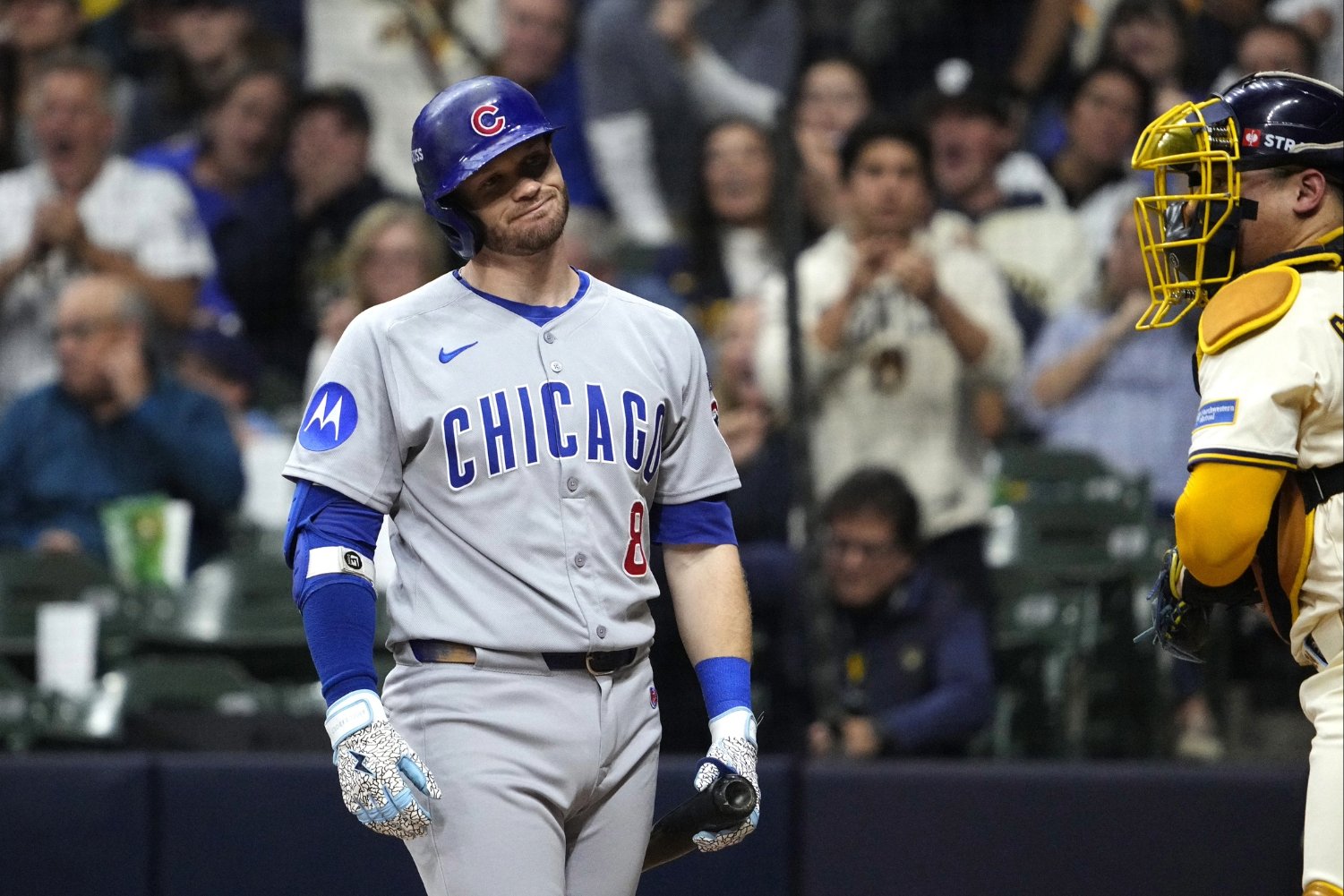
Ian Happ is so much more than just the longest-tenured member of the Chicago Cubs. He’s now a four-time reigning Gold Glover in left field, a remarkable achievement considering the team had no idea where to put him for the first five seasons of his career. He’s also got a career 116 wRC+ and 20.6 fWAR to his name, not to mention a few clutch postseason hits that span across the last relevant Cubs core and this one.
In a vacuum, Happ is one of the most consistent players in the sport. He’s been above average at the plate without fail, posting a wRC+ figure between 106 and 132 in every season of his career. Narrow the scope to just the last four seasons, and that margin becomes impossibly thin; Happ’s wRC+ hasn’t fluctuated more than six points since the start of 2022, sitting between 116 and 122. He’s also been worth a reliable amount of WAR in that span, contributing between 2.8fWAR and 3.7fWAR to the cause every season.
On the surface, he’s as dependable as it gets. He plays 150-plus games per campaign—a mark he hasn’t fallen below since 2021, when he played in 148 contests. He walks a ton, working a 13.2% free pass rate since 2023. He plays quality defense in left field. He’s no superstar, but he’s the kind of franchise “glue guy” that puts in the work and gets the job done on an annual basis, no questions asked.
Except, if you know anything about Happ, you know he’s really one of the streakiest hitters in the sport. On just a month-to-month basis in 2025, his performance looks like what the main character would achieve in a C-student’s high school interpretation of Jekyll and Hyde on a baseball diamond:
March/April: .722 OPS, 108 wRC+
May: .684 OPS, 98 wRC+
June: .779 OPS, 115 wRC+
July: .638 OPS, 86 wRC+
August: .835 OPS, 134 wRC+
September: .892 OPS, 148 wRC+
October (Postseason): .490 OPS, 31 wRC+
If you were to get even more granular and take a look back at his individual games and series, the contrast would be even more stark and unnerving. Seriously, go and look through North Side Baseball’s repository of Happ-related articles—it won’t take long before you find two diametrically-opposed pieces using equally-valid evidence to support extreme hypotheses about Happ. Here’s one from Aug. 10 reassuring Cubs fans that everything would be all right after a disastrous July, and here’s one literally two weeks later vouching for Happ to be benched for top prospect Owen Caissie.
Over the course of a 162-game season, you can live with peaks and valleys if the end result is reliable and predictable. In the one-mistake-and-you’re-out environment of the playoffs, though, it’s harder to swallow that pill. Happ may have hit two (seemingly, at the time) crucial home runs against the Brewers in the NLDS, but he also struck out in 39.4% of his plate appearances in October. That just won’t fly.
However, that’s not necessarily the reason the Cubs should consider trading Happ this winter. Nor is the fact that top prospects Owen Caissie and Kevin Alcantara (who is out of minor league options) are banging on the door and in need of playing time in a crowded outfield picture. This is purely an argument about long-term planning, which the Cubs haven’t done the best job of in recent years.
As things stand, the only guaranteed money on the books after the 2026 season is the remaining $81 million on Dansby Swanson‘s contract. Yes, there are various options and players bound to earn millions of dollars via arbitration, but the only payout the Cubs will be forced to make in 2027 as of this moment is for Swanson. That obviously means that there’s plenty of room for a long-term contract or two or three to be added to the payroll this offseason, but it also means the Cubs aren’t taking any risks when it comes to the impending 2027 lockout. They’ve structured the roster in a way to ensure that, no matter what happens in next year’s CBA negotiations, they won’t be caught off guard.
In a pragmatic sense, what that amounts to is the fact that a vast majority of the veterans on this roster are due to become free agents in a year’s time. Right now, that list includes:
C Carson Kelly (mutual option)
C Reese McGuire
2B Nico Hoerner
LF Ian Happ
RF Seiya Suzuki
SP Jameson Taillon
SP Matthew Boyd (mutual option)
SP/RP Colin Rea (club option)
That’s a comical amount of talent to lose in one offseason, and you can be sure the team will at least broach the extension conversation with a number of those players. But, seeing as everyone on that list besides Hoerner is already at least 30 years old, it might be time to start consolidating the roster. The Milwaukee Brewers have been pulling this trick for ages — they’ve traded Corbin Burnes, Yovani Gallardo, Devin Williams, and now potentially Freddy Peralta when they were one year out from free agency — and have made it out unscathed every time. And each of those players were dominant pitchers in their prime, a decidedly more valuable asset than Happ is right now with his one year of control remaining at a $19 million salary.
It doesn’t have to be Happ of course. I maintain my belief that trading Jameson Taillon while the iron is hot after his second-half performance could yield long-term dividends, Hoerner is probably too valuable to move thanks to his defense and contact skills, but Suzuki could bring in a nice return from a team in need of power if the Cubs don’t mind purging all of the Japanese talent from their roster in the same offseason.
And this doesn’t have to be the path the team takes. They can commit to this roster for 2026 and go all-in on their last year of certainty before the CBA expires. But, that would require a level of commitment that this team hasn’t been accustomed to in quite some time—it’d be several steps further than how they treated 2025 with the Kyle Tucker trade.
Given his inconsistencies and the team’s directionless path forward, trading Happ may be a necessary evil. The Cubs wouldn’t need him to bring back top prospects in a deal (they’d certainly prefer major-league-ready talent, especially on the pitching side), and his excellent defense, switch-hitting prowess and season-long reliability would tempt a lot of other teams in trade talks, especially given how barren the outfield market is in free agency after Tucker and Cody Bellinger.
It feels wrong to suggest given his importance to Chicago as the last remaining piece from 2017 and before, but Ian Happ might be better suited as a trade chip than a Cub this offseason.