
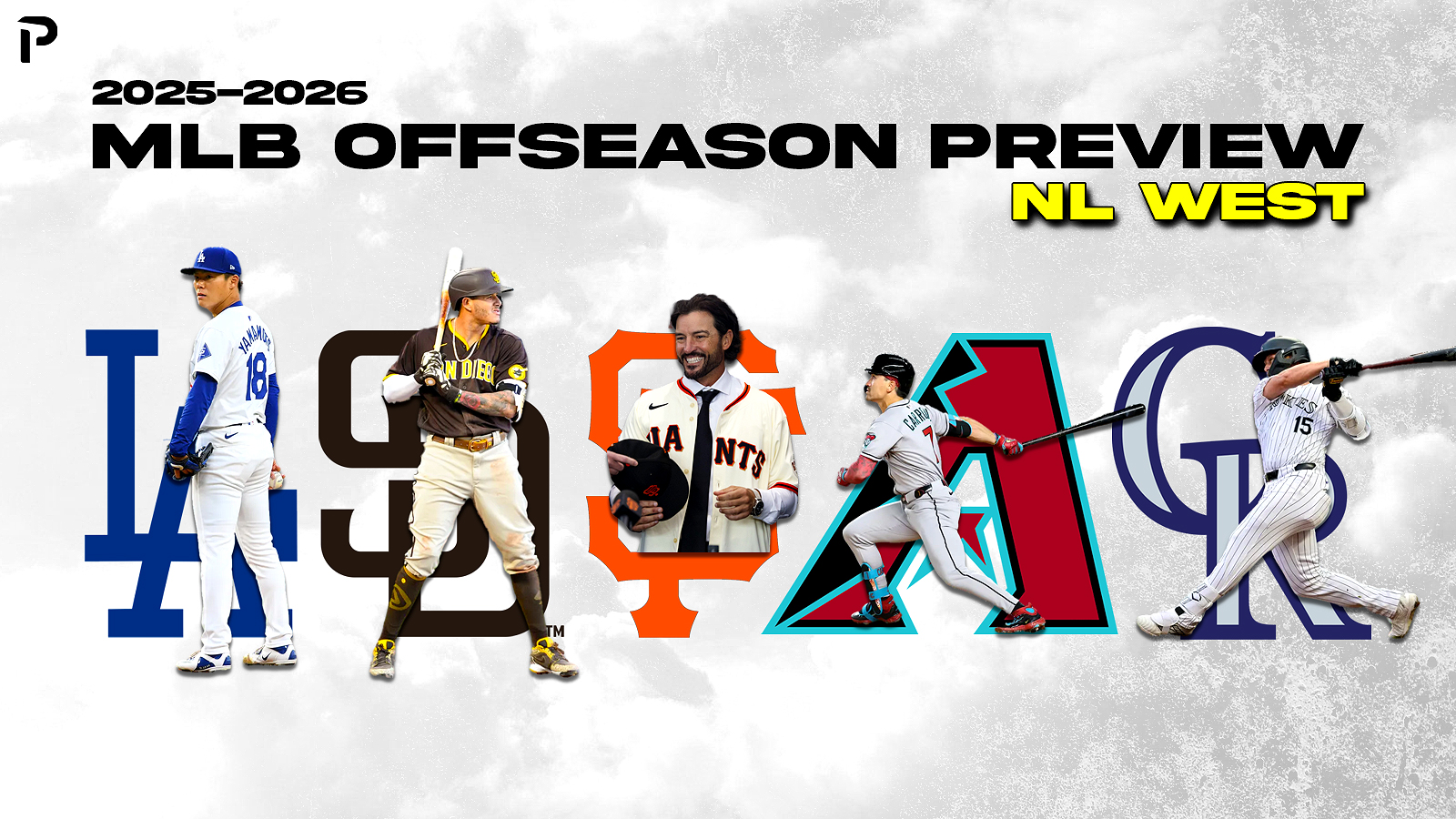
It is a game of King of the Hill in the NL West. Until someone knocks them off their pedestal with force, the Los Angeles Dodgers will continue to run the division. The San Francisco Giants tried in 2021, ending the Dodgers’ run of eight straight titles, but L.A. responded by reeling off the last four division crowns and now back-to-back World Series championships. The San Diego Padres have been their biggest challenger the last two years, but they are now facing their own challenges. The Arizona Diamondbacks toppled the Dodgers in the 2023 playoffs en route to a World Series appearance, but have taken a step back. And let’s not even talk about the Colorado Rockies.
2025 record: 93-69 (first place)
Postseason: Won second straight World Series. Defeated Cincinnati Reds 2-0 in NL Wild Card Series, Philadelphia Phillies 3-1 in NL Division Series, Milwaukee Brewers 4-0 in NL Championship Series and Toronto Blue Jays 4-3 in World Series.
What went right: Well, let’s just say that things coalesced at the right time for the Dodgers. The regular season was bumpier than expected for a team sporting a record-high payroll, but the Dodgers won the division for the 12th time in 13 years and became the first team since the 1998-2000 New York Yankees to repeat as World Series champs. Shohei Ohtani did Ohtani things, which is to say a lot of things no one has seen done by a single player before. He won his third straight MVP and fourth in five years on the strength of his offensive feats, smashing 55 homers, driving in 102 and scoring an MLB-high 146 times. But then he also came back from Tommy John surgery, working his way back with what were essentially rehab outings in regular-season MLB games to build up his arm strength in pitch count. In 14 regular-season starts, he had a 2.87 ERA and struck out 62 in 47 innings. Despite some late-season injuries, catcher Will Smith was the second-best offensive player. Mookie Betts‘ full-time move to shortstop was a strength as he provided defense that earned him a top-three finish in Gold Glove voting. First baseman Freddie Freeman had some midseason hitting woes, yet still was productive and was in the neighborhood of his career averages. The regular season of right-handed starter Yoshinobu Yamamoto was much better than his first year in MLB, which was limited to 18 games, as he finished third in NL Cy Young Award voting. Then, October Yamamoto showed up and showed there is another level he can get to.
What went wrong: The offense was inconsistent. That starts with Betts, who dealt with an undisclosed illness at the beginning of the season and caused him to lose more than 20 pounds from his 180-pound frame. While his defense didn’t suffer, his offense did. He put up a career-worst slash line of .258/.326/.406 with 20 homers and 82 RBIs, while still hitting in the top two spots in the lineup. A far cry from his .290/.369/.512 career line. Left fielder Michael Conforto was a nonfactor with his .199/.305/.333 slash line, but he still accrued 486 plate appearances. The starting rotation was a mish-mash throughout the regular season, which made the postseason run by that group even more surprising. Left-hander Blake Snell, a two-time Cy Young Award winner, and right-hander Tyler Glasnow combined for just 29 starts due to injuries, while prized rookie acquisition Roki Sasaki struggled in the final three of his eight regular-season starts before going on the injured list with a right shoulder impingement. He didn’t return to the major-league roster until two relief appearances the final week of the regular season, which set the stage for his role in the postseason. That forced a lot of different arms into the rotation, with varying degrees of success.
What needs to be done: Let’s start with the subtractions. Probable first-ballot Hall of Famer Clayton Kershaw ($7.5 million), Conforto ($17M), reliever Kirby Yates ($13M). starter Tony Gonsolin ($5.4M) and reliever Michael Kopech ($5.2M) come off the books, as does Enrique Hernández, who will re-sign for something in the neighborhood of the $6.5 million he made in 2025. The Dodgers also save $4.5 million on third baseman Max Muncy, who made $14.5 million in 2025 and had a $10 million option for 2026. That is around $52 million they spent in 2025 that they can spend for 2026. There certainly will be an addition or three in the bullpen, which was porous much of the regular season and even the postseason (remember that Yates and Tanner Scott and his $12.8M salary were left off the roster during the key postseason rounds). But back to what needs to be done. The Dodgers, believe it or not, have an outfield hole. Will they make a play for the top free-agent bat in Kyle Tucker? Or will they have a reunion with Cody Bellinger? Maybe someone else like Harrison Bader or a trade could be another way to fill that gap. Otherwise, the rotation is pretty set. Adding a second baseman could move Tommy Edman to left field.
2025 record: 90-72 (second place, 3 GB)
Postseason: Lost to Chicago Cubs 2-1 in NL Wild Card Series.
What went right: As any contender should have, the Padres had a tremendous bullpen. Easily the best in MLB in ERA and WHIP and second in strikeouts. That group was led by closer Robert Suarez (2.97 ERA, 0.904 WHIP) and his 40 saves, right-hander Jason Adam (1.93, 1.148) and left-hander Adrian Morejon (2.08, 0.896), the bolstered by the splashy trade for right-hander Mason Miller (0.77, 0.729 with Padres). The starting rotation had its bright spots in right-handers Nick Pivetta (13-5, 2.87 ERA), Randy Vasquez (3.84 ERA) and Michael King (3.44 ERA in 15 starts). Third baseman Manny Machado was pretty much on his career slash line when he posted .275/.335/.460 with 27 homers and 95 RBIs, while right fielder Fernando Tatis Jr. Jr. went .268/.368/.446 with 25 homers, 71 RBIs and 111 runs scored in his best season since getting popped for performance-enhancing drugs in 2022. Tatis also added his second NL Platinum Glove in three seasons. Otherwise, they played fairly consistently after putting up their longest winning and losing streaks of the season (7-0 to start the season, six-game skid in May) early on.
What went wrong: A 90-72 record is nothing to scoff at, but it feels like the Padres left a lot of meat on the bone. That includes the early exit from the playoffs. The Dodgers weren’t as dominant as many projected and, in late August, the Padres were tied for first after taking two of three from L.A., but a 3-4 stretch in mid-September sealed their fate as a wild-card team. Much of the Padres’ faults were due to an underperforming offense by the cast around Machado and Tatis. Luis Arraez failed to win a fourth straight batting title, with his .292 batting average looking much better thanks to a .352 mark in September. Center fielder Jackson Merrill experienced a sophomore slump. Two key rotation pieces, right-handers Dylan Cease and Yu Darvish, also were disappointing. Cease, the subject of trade rumors last offseason and even during 2025, posted a 4.55 ERA after a 3.47 in 2024, while Darvish didn’t make his season debut until July following inflammation in his right elbow that was discovered in spring training. Darvish was a shell of himself while registering a 5.38 ERA in 15 starts. After the season, Darvish had an internal brace surgery and will be out all of 2026. It is very possible that the 39-year-old Darvish has thrown his last pitch in MLB, although he is under contract through 2028.
What needs to be done: The Padres were the most surprising team to hop onto the managerial carousel. That was because Mike Shildt, citing his health and threats from bettors, decided to retire from managing the Padres. He was replaced by Craig Stammen, a former Padres reliever who was working in the team’s front office. Surprising mainly because pitchers don’t usually become managers, but he knows the team from this front-office role. But player-wise, the Padres need to address their rotation with Cease and King becoming free agents (and receiving qualifying offers) and Darvish not returning from surgery until 2027. There are no prospects breaking down the door, either on pitching or hitting side, so the Padres will have to spend to plug the roster vacancies. That also includes Arraez, a defensive liability, and infielder Jose Iglesias. While right-hander Joe Musgrove will return from Tommy John surgery, one solution for the rotation would be to move Morejon or Miller from the bullpen (both seem unlikely). Miller is more likely to assume closer duties with Suarez now a free agent. Gavin Sheets can easily replace Arraez at first as well as see time in left field, freeing up a rotation at designated hitter, while adding Freddy Fermin at the deadline could stabilize the catching position, hoping for a bit more offensive production.
2025 record: 81-81 (third place, 12 GB)
Postseason: None (since 2021).
What went right: There is no doubt that pitching is where the Giants hung their hat in 2025. Right-hander Logan Webb and left-hander Robbie Ray are a very good 1-2 punch at the top of a rotation, while Justin Verlander was pretty good as a 42-year-old, posting a 3.85 ERA while only going 4-11 in 29 starts. Right-hander Landen Roupp proved in 22 starts to be another reliable rotation piece with a 3.80 ERA. The bullpen was pretty good, too, despite revolving roles and familiar faces shipped out at the deadline. Right-hander Randy Rodríguez was a standout in that group with his 1.78 ERA in 50 games. Camilo Doval and Tyler Rogers were also big out of the bullpen, but were gone by the trade deadline as the Giants were seemingly out of contention. After being briefly in first place in mid-June, the Giants stuck around in the wild-card chase, only to be eliminated in the final week. Shortstop Willy Adames, the prized free-agent signee of the team’s offseason, became the first Giants player to hit 30 homers since Barry Bonds in 2004. Center fielder Jung Ho Lee stayed healthy and produced a .266/.327/.407 slash line.
What went wrong: The Giants pulled a stunning trade when they dealt for Rafael Devers on June 15 following his displeasure with the Boston Red Sox’s front office. Expected to be an offensive jolt for a team much in need of that exact thing, Devers turned out to be a drain. While he did hit 20 of his 35 homers with the Giants, Devers did seem to suffer from aftershock, putting up a .236/.347/.460 slash line in San Francisco, a far cry from his career .279/.349/.510 ledger in Boston. While Heliot Ramos followed up his 22-homer 2024 with 21 homers in 36 more games, his other numbers were mainly down in his second full season in the majors. As a team, the Giants had a .697 OPS, which ranked 22nd and in the company of teams with much poorer records.
What needs to be done: Hoping to provide a little spark, the Giants made the unconventional move of hiring a college coach, Tony Vitello, to manage the team after Bob Melvin had lackluster results in his two seasons. How Vitello transitions from the college game to MLB without any experience at any professional level and is able to communicate and implement his (and the front office’s) plan will be the ultimate test from his rah-rah days at Tennessee, which was run much like a fraternity. Devers is surely working on becoming a reliable defensive first baseman. His bat certainly plays there when it is right. One source of offense could be first baseman-outfielder Bryce Eldridge, the Giants’ top hitting prospect who struggled mightily while making his MLB debut in September. If Devers is the first baseman and not the DH, Eldridge needs a position unless the Giants pencil him in at DH. He has limited outfield experience, but something that could be worked on during the offseason to make him serviceable. Catcher Patrick Bailey is elite defensively, having just won his second straight Gold Glove, but if he can squeeze more offense (.230/.287/.340 slash line, averaging seven homers per season), that would certainly help. If they Giants do want to contend, a middle-of-the-rotation starter is needed (something better than a rumored pickup of Max Scherzer, though). Second base is also a spot where the Giants could use an upgrade over Casey Schmitt. Making the bullpen a lockdown unit would also be beneficial
2025 record: 80-82 (fourth place, 13 GB)
Postseason: None (since 2023).
What went right: There was a lot to boast about offensively from the D’backs. Second baseman Ketel Marte (145 OPS+), third baseman Eugenio Suárez (142 OPS+) and right fielder Corbin Carroll (140 OPS+) led the charge, with shortstop Geraldo Perdomo (136), first baseman Josh Naylor (123) and outfielder-first baseman Pavin Smith (120) also having an OPS+ of 120 or better. Catcher Gabriel Moreno wasn’t far behind at 117. Not surprisingly, the D’backs ranked fifth in team OPS and sixth in runs scored. Carroll increased his homers from 25 and 22 in his first two full MLB seasons to 31 in 2025 as part of a 30-30 season. Despite some things we will get into in a moment, the D’backs were a threat in the NL wild-card chase up until the final days of the season, which says something about the fight in this team.
What went wrong: The pitching staff was decimated by injuries. Right-hander Corbin Burnes, the biggest offseason acquisition with a six-year, $210 million contract, was really good in his first 11 starts (2.66 ERA), but blowing out his elbow at the beginning of June and needing Tommy John surgery, which will sideline him all of 2026. Similarly, right-hander Justin Martinez and left-hander A.J. Puk, key late-inning relievers, had elbow surgeries and will miss most of next season. Right-handed reliever Kevin Ginkel made it to August before his shoulder gave out. Of the pitchers who didn’t get hurt, right-hander Zac Gallen, right-hander Brandon Pfaadt and left-hander Eduardo Rodriguez all had ERAs above 4.80. That led to the prudent decision to trade impending free agents Suarez, Naylor and right-hander Merrill Kelly (3.22 ERA in 22 D’backs starts) at the trade deadline.
What needs to be done: This is still an interesting roster, but with a few significant holes. Smith seemingly will get the first chance at first base, while former top shortstop prospect Jordan Lawlar should get a long look at third base to see if he can stick there. Left fielder Lourdes Gurriel Jr. opted to stay, but has a knee injury that will delay the start to his 2026. But the real question will be the rotation. At the moment, that consists of Pfaadt, Rodriguez and right-hander Ryne Nelson. Prospects Kohl Drake, a left-hander acquired in the Kelly deal with the Texas Rangers, and Cristian Mena, a right-hander, are the top minor-league options, but Mena is coming back from a significant shoulder injury and will probably be eased into 2026. That means some heavy work needs to be done to not only build a rotation, but depth for when those inevitable injuries hit, as well as restocking the bullpen.
2025 record: 43-119 (last place, 265 GB)
Postseason: None (since 2018).
What went right: Well, at least the Rockies didn’t have a worse season than the 2024 Chicago White Sox, who went 41-121 to set the record for most losses in a season. It took a drastic change to make that happen as the Rockies fired manager Bud Black on May 11. After the season, general manager Bill Schmidt stepped down, allowing for new voices to lead an organization that has finished more than 32 games out of first place in every full season (17 games out in 2020) since making the playoffs in 2018. There some good on-field wins, too. Catcher Hunter Goodman emerged as a power threat with 31 homers while posting a .278/.323/.520 slash line. Right fielder Mickey Moniak, the No. 1 overall pick of the 2016 draft who was released by the Los Angeles Angels after last season, seemed to find himself in Colorado with a slash line of .270/.306/.518 with 24 homers and 68 RBIs, the only other player besides Goodman to have an OPS of at least 100. However, Moniak did accrue a minus-0.6 bWAR.
What went wrong: Where to begin. You name it, it was likely bad (or very bad) for the Rockies. The Rockies had a 5.97 ERA, the worst in MLB by 0.62. They gave up 251 homers, 28 more than the next team. They struck out the fewest batters, with the next team 116 ahead of them. Even offensively, playing half their games at Coors Field, the Rockies ranked 25th in homers, 27th in OPS and 29th in runs (46 behind No. 28). We won’t get into individuals because this was more than a one-player situation.
What needs to be done: Rockies fans have a glimmer of hope with the front-office and managerial changes. But in typical Rockies fashion, they threw a wet blanket over at least one of those. Paul DePodesta, known in MLB circles from his days with the “Moneyball” Oakland A’s, was brought back to baseball after a decade with the NFL’s version of the Rockies, the Cleveland Browns, to lead the front office after a couple candidates declined the position. DePodesta will be the latest to try and figure out what can work at Coors Field. With some young hitters, that side of the ball should be the first to flourish. Top pitching prospect Chase Dollander will have to overcome his rookie struggles, but the rotation options are slim after that. The Kris Bryant contract continues to be an albatross and that doesn’t figure to improve based on the current condition of the 34-year-old’s back. Unlike the White Sox, who spun off a few valuable pieces in exchange for key prospects in trades as they hit rock bottom, it will take years for the Rockies to dig out of this mess — that is, if it doesn’t get worse under DePodesta.