
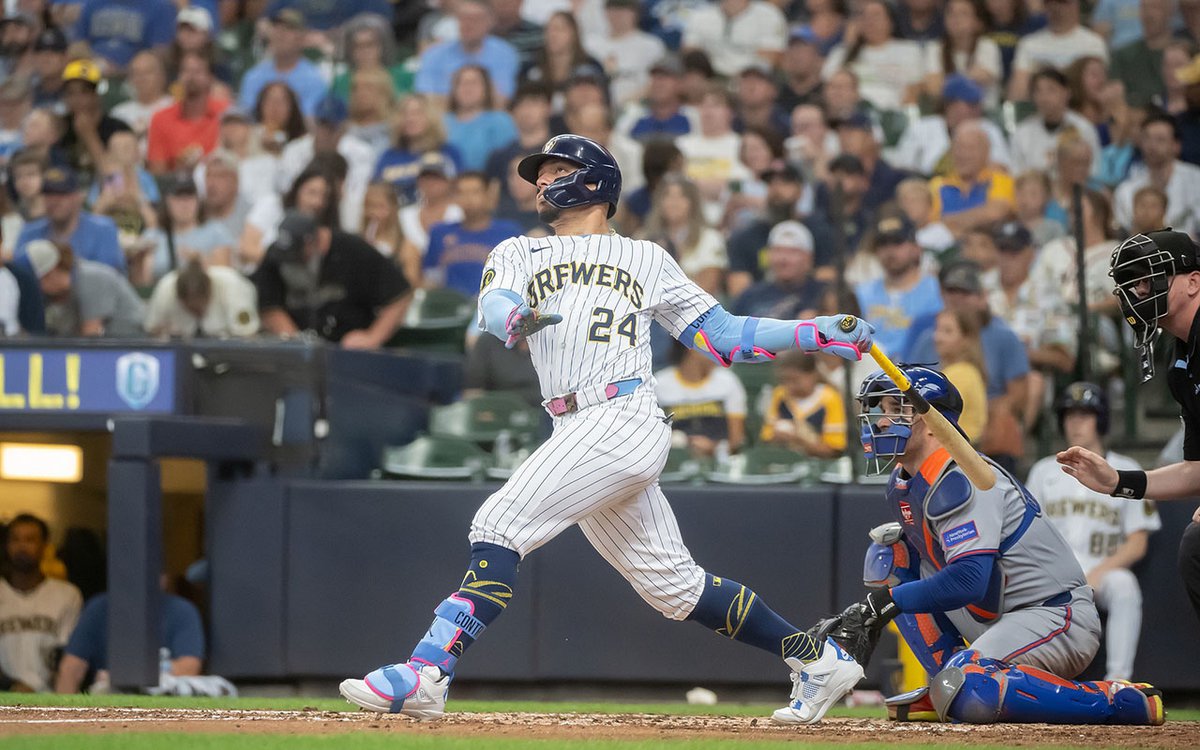
The Brewers have one of the most productive offensive catchers in franchise history in William Contreras, and he’s come along at the right point in history to maximize his value.
Contreras played some or all of 128 games behind the plate in 2025, the seventh most in franchise history and the most by any Brewers catcher in more than a decade. He also caught 108 games in 2023 and 120 in 2024, when he led all NL catchers in putouts. During that time, however, he’s gotten stronger in each season’s later months. Despite taking a beating behind the plate across a long season Contreras has a career .864 on base plus slugging from the All Star break through the end of the season as compared to a .760 mark before. This flies in the face of historic trends for players at his position.
Contreras is not the only or even the most notable catcher racking up a major workload this season. One of 2025’s biggest storylines was Mariners’ catcher Cal Raleigh hitting 60 home runs, the most ever for a Mariner, catcher or switch hitter. Raleigh also batted over 700 times in games where he was catching this season, the most since Reds legend Johnny Bench. Raleigh had a 1.030 OPS and ten home runs in September.
Catchers Playing More
Catching remains arguably baseball’s most demanding everyday job, but one respected baseball analyst has a theory on why catchers are better offensively now than at any point in the recent past. Mike Petriello of MLB.com pointed to the “one knee down” catching stance, which is now nearly universally adopted. Petriello’s piece features quotes from all kinds of catching experts, but the proof is in the numbers: FanGraphs’ version of Wins Above Replacement shows 2025 as the best season ever for catchers and the second best for catcher offense. The reason is simple: Primary catchers are playing more. The fact that they’re squatting less might be one reason they’re able to do it.
 Stay on top of the news of the day
Subscribe to our free, daily e-newsletter to get Milwaukee’s latest local news, restaurants, music, arts and entertainment and events delivered right to your inbox every weekday, plus a bonus Week in Review email on Saturdays.
If this trend is going to hold, then it might make a difference in how teams like the Brewers construct their rosters going forward. As recently as earlier this decade the “everyday catcher” seemed close to extinct, and teams were largely sharing time at the position. If this mechanical shift makes it possible for teams to have a near-everyday catcher again, then it opens the door for teams to have “bat first” backup catchers that can pinch hit like the Brewers did with Gary Sanchez two seasons ago, or to simply have a veteran backup in more of an emergency/veteran mentor role. Either way it makes it even harder for the Brewers to determine what to do with AAA catcher Jeferson Quero, one of their top position player prospects, who doesn’t have a place to play in the majors if Contreras is going to be behind the plate most days.
For both Contreras and Quero, however, a change in catcher workload and durability could have a significant impact on their value. In the past when catcher workloads were diminishing it created an argument against teams investing in an elite player at that position: If even the game’s best catchers were going to need to miss a third of their team’s games, then it made more sense to use resources to trade for or sign a player of similar value at another position. Now, however, a team pursuing Conteras (either via trade or as a free agent following the 2027 season) would be acquiring a near-everyday player who has batted .276 with a .362 on-base and .441 slugging across the last three seasons. That’s a lot of value to get from a catcher, and his next contract will likely reflect it.
Challenge System
With that said, baseball’s catching environment is set to experience another change next season. With MLB’s decision to add a challenge system for ball and strike calls it’s possible that the formula for estimating catcher defensive value will shift. The one knee down approach has gained popularity at least in part because of its role in “pitch framing,” the practice of receiving pitches in a way that is more likely to lead to a called strike. Presumably, some of the called strikes a catcher gets this way will now be reversed back to balls. At the same time, baserunners are attempting more steals in response to recent rule changes about pickoff attempts and base size. If the value of pitch framing decreases and the value of controlling the running game increases, then it’s possible catcher tactics will shift in response.
For now, however, the Brewers have one of the best offensive catchers in baseball at a time when the impact of a big bat at that position is the most valuable. By FanGraphs’ estimates the Brewers were two wins better than the median MLB team in 2025 based on value from that position alone. With two more arbitration-eligible seasons remaining William Contreras is one of the most valuable assets in baseball.

Kyle Lobner covers the Milwaukee Brewers in the Shepherd Express’ weekly On Deck Circle column. He has written about the Brewers and Minor League Baseball since 2008.
Nov. 17, 2025
2:36 p.m.