
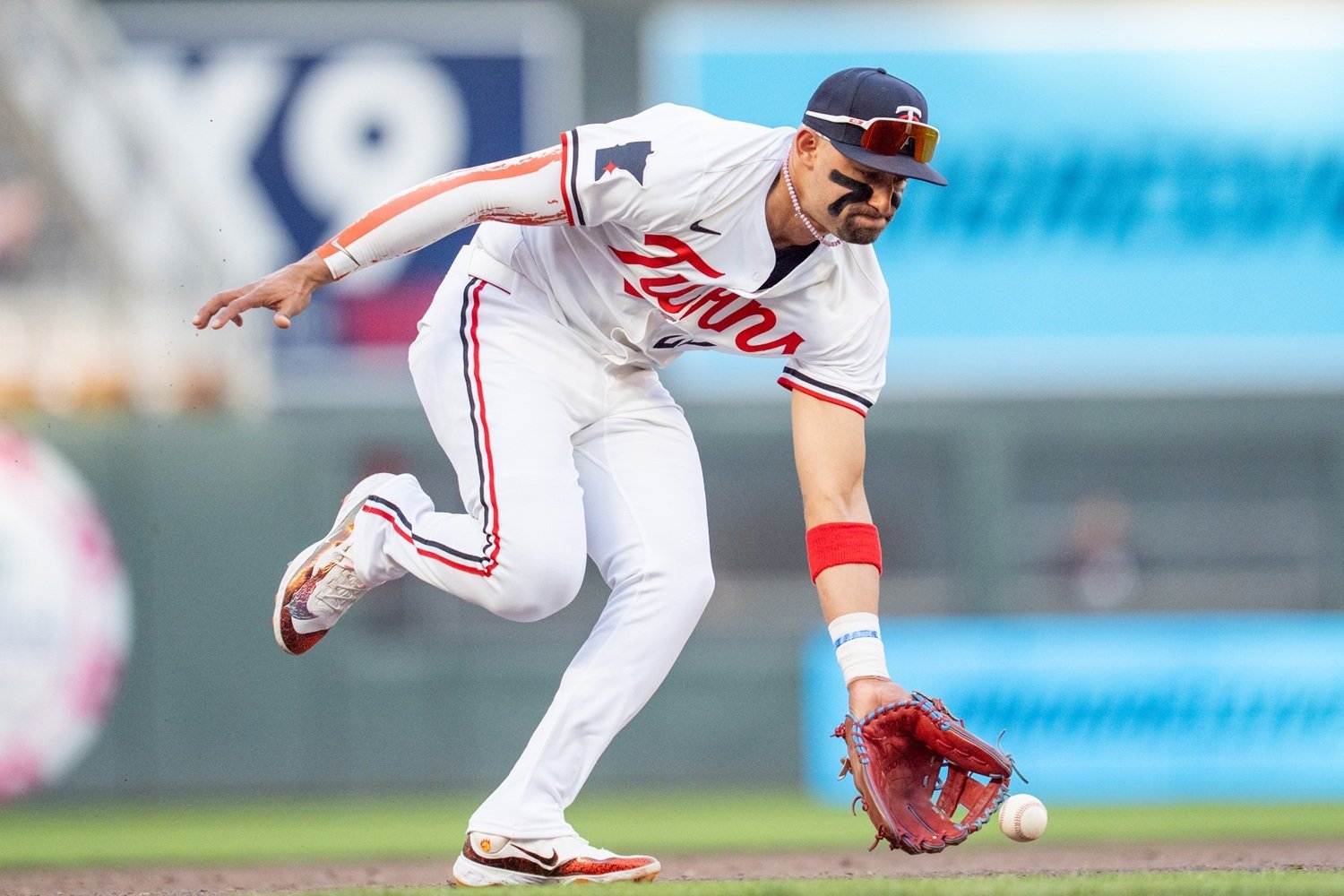
Last season, when I approached this series, the Twins’ roster was in a very different place. Minnesota looked like a playoff contender for much of the 2024 season, before an epic collapse. In 2025, the fall came much earlier, and the front office dealt away multiple core pieces at the trade deadline. It’s tough not to wonder if the winning window has abruptly shut on the current core.
As the Minnesota Twins gear up for the 2026 season, the focus shifts to the core group of players who form the backbone of the roster. Some players have cemented their place as long-term building blocks, while others could be valuable trade assets. In this article, we rank the Twins’ most important pieces at the big-league level, considering their impact and the likelihood of them being traded before the 2026 season.
10. RP Cole Sands
Pros: Sands emerged as one of Minnesota’s most reliable bullpen arms in 2025, giving the team late-inning stability at a time when it desperately needed it. His splitter was worth seven runs, and his 6.4% walk rate was among the best quartile in the league. With three years of team control remaining, Sands offers cost-effective value at a position that constantly turns over.
Cons: The Twins have limited options for the bullpen, so it seems unlikely that the front office will trade another reliever. While Sands was a needed bright spot, his track record is still inconsistent. As the Twins showed at the deadline, teams often look to sell high on relievers, and middle reliever is a high-volatility, non-premium role. A club searching for bullpen help could view Sands as an appealing second piece in a larger deal. His limited ceiling compared to other controllable pitchers also factors into Minnesota’s long-term roster building.
Trade Likelihood: Low
Minnesota values the role Sands fills, and unless a trade package specifically targets him, it is hard to see the team pushing him out the door.
9. 3B Royce Lewis
Pros: When healthy, Lewis remains one of the most dynamic talents in the organization. Last season, I ranked him at the top of this list, but his 2025 performance dropped him. The Twins hoped that his early-career offensive performance would make him a franchise cornerstone. Even in 2025, Lewis showed improved defense at third base, with one OAA. Offensively, his 73.6 bat speed was in the 72nd percentile, and the rate at which he pulled the ball in the air (24.5%) continued to rank well.
Cons: Durability remains the defining question. Multiple significant injuries have kept Lewis off the field, and Minnesota must evaluate how much they can count on him. Even with this season’s improvements, his defensive future is unclear, and depending on roster construction, the Twins may question whether he fits best at third base, designated hitter, or somewhere else entirely. If the front office believes another club is willing to pay full value for his upside, the door is at least cracked open.
Trade Likelihood: Medium
While the Twins are far from eager to move Lewis, he is one of the few players who could be traded to shake up the team’s offensive core. That keeps the possibility in play.
8. SS Brooks Lee
Pros: Lee took over the team’s starting shortstop role after the club dumped Carlos Correa at the trade deadline. His athletic ability is worse than Correa’s at shortstop, but he can hold down the position, with -1 OAA in nearly 600 innings. Before his big-league debut, scouts praised him for his ability to control the zone, hit for average, and produce tough, professional at-bats. This season, he ranked in the 74th percentile or higher in both avoiding strikeouts and squaring up the ball, thereby getting the most out of his bat speed. The Twins have no other options for shortstop, so they would need to be blown away by a trade offer for Lee. With five years of control remaining, Lee looks like a core piece in the making.
Cons: His ceiling may not be as high as some of Minnesota’s other young hitters, and that could make him expendable in the right deal. If another club views Lee as a ready-made solution at a premium position, the Twins might have the opportunity to address a glaring organizational need. There is also the looming question of where Lee fits long-term if the front office believes he can’t stick at shortstop.
Trade Likelihood: Low
The Twins have little incentive to trade Lee, and would require a significant return to even consider it.
7. SP Bailey Ober
Pros: Entering last season, Ober looked like he had established himself as a dependable mid-rotation starter. He had impressive strike-throwing ability and a track record of durability. His size, delivery and command make him uniquely difficult for hitters to time. Last year, his walk rate, chase rate, and extension toward the plate at release ranked in the 93rd percentile or higher. With two years remaining in team control, he continues to be cost-effective.
Cons: Ober’s margin for error remains thinner than that of the typical front-line starter. He struggled with a hip injury last season, which seemed to throw off his mechanics. When his fastball command wavers, hitters can elevate against him and produce damage quickly. His stuff is more solid than electric, which may make him more replaceable in the long term as top prospects move closer to the majors.
Trade Likelihood: Medium-Low
The Twins like what Ober brings, but as they reshape the rotation, they could listen if a team makes a compelling offer. However, his trade value might be at an all-time low.
6. OF Matt Wallner
Pros: Like many Twins hitters, Wallner struggled in 2025—but he was still among the team’s best hitters, with a 110 OPS+. According to Baseball Reference, he was worth 6, relative to an average batter. He has game-changing power, with his Barrel rate, bat speed, and walk rate ranking in the 84th percentile or higher. His elite arm adds to his defensive value. When he is locked in, Wallner looks like the type of middle-of-the-order bat that Minnesota has been desperate to develop internally.
Cons: His track record still contains peaks and valleys. Wallner’s offensive success relies heavily on his ability to maintain strike-zone discipline, and slumps get especially ugly. For instance, before going down at the end of the year, Wallner batted just .163/.293/.347 in September. With Minnesota’s growing outfield depth and the emergence of other left-handed bats, the front office must decide whether Wallner fits the long-term puzzle or represents one of their best trade chips. A club looking for controllable power could push for his inclusion.
Trade Likelihood: Medium
Wallner remains part of the Twins’ plans, but his combination of upside and uncertainty makes him a realistic trade candidate, depending on the team’s offseason priorities.
The Twins have a strong core for 2026, but that doesn’t mean they won’t explore trades to reshape the roster. Lee and Wallner are young, foundational players the team will probably build around, while others like Sands, Ober, and Lewis could be moved to fill other needs. The offseason will be critical, as the front office balances improving the team without disrupting its future success.
Will any of the players above be traded this winter? Which player is the most critical building block? Leave a comment and start the discussion