
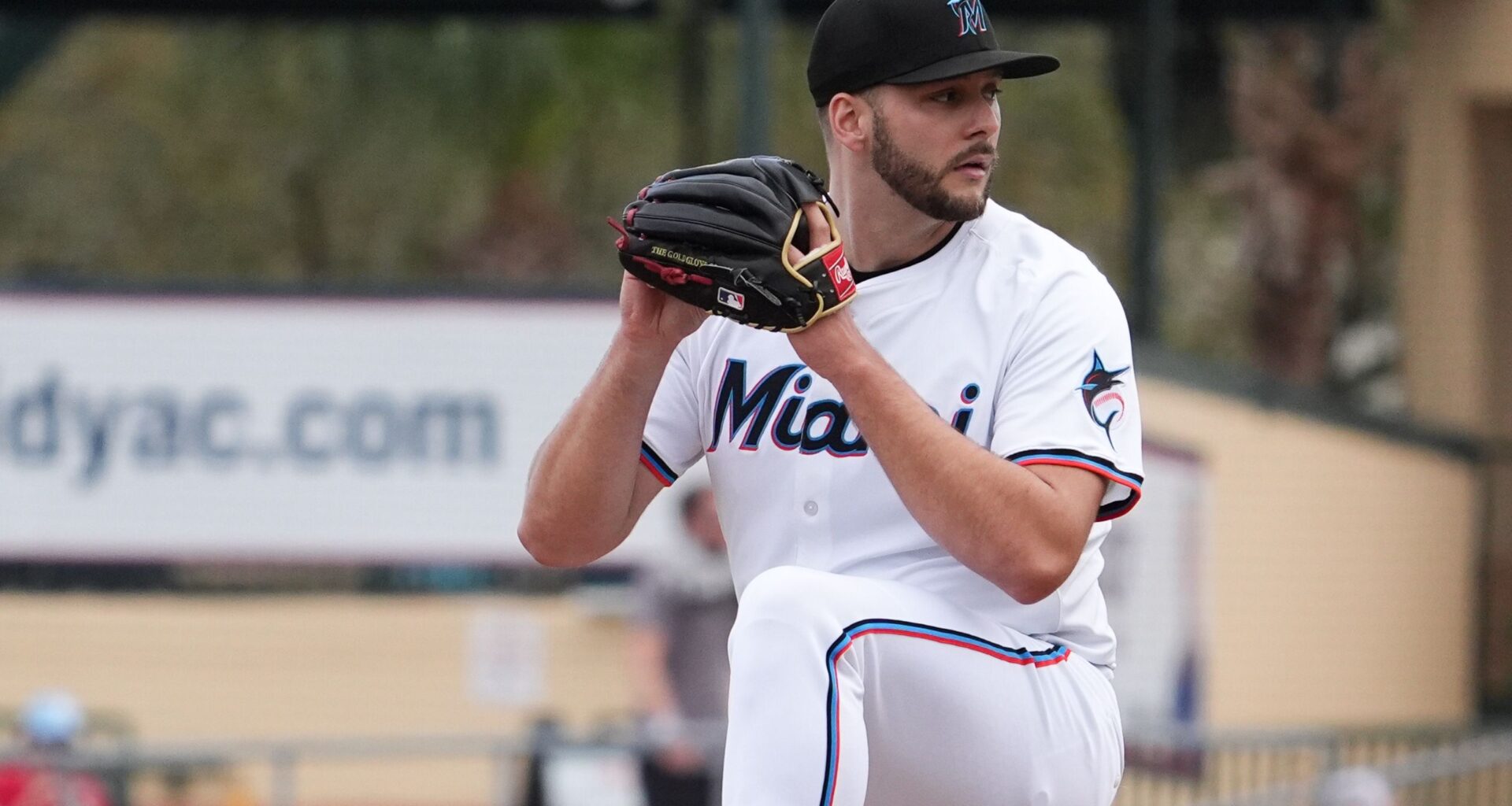
With MLB’s 40-man roster protection deadline having passed, Baseball America’s initial preview of the 2025 Rule 5 draft is here. Contributors include J.J. Cooper, Geoff Pontes, Jacob Rudner, Carlos Collazo and Ian Cundall.
The preliminary list below is the first installment of what will be a lengthy work in progress, so stay tuned as we continue to add players in future preview updates ahead of the Dec. 10 draft. Last year’s initial preview was led by Shane Smith, who ended up being one of the most productive Rule 5 picks of the decade.
As a reminder, players picked in the MLB Rule 5 draft must be carried on the selecting team’s active MLB roster without being optioned to the minors for the entire following season. Teams pay $100,000 to select a major league Rule 5 pick. If they offer the player back to his original team, that team has the option of accepting the player’s return and giving back $50,000 of the Rule 5 fee.
Matt Pushard, RHP, Marlins
Pushard fits the Rule 5 target profile as a late-blooming, Triple-A-tested righthander coming off his age-27 season. He logged a 3.61 ERA with 73 strikeouts to 23 walks over 62.1 innings and held steady with a fastball that sat 94-96 mph and touched 97 while producing a 34% miss rate and 42% chase rate. He leans on a sweepy slider and a curveball with occasional changeups and cutters mixed in.
Pushard ended his year on a high note with 11.1 scoreless innings during Jacksonville’s run to a Triple-A title, reinforcing his appeal as a plug-and-play relief option.
Andrew Pintar, OF, Marlins
Pintar fits the Rule 5 archetype as a speedy center fielder with defensive value and a clear edge against lefthanded pitching. He hit .269/.338/.384 with four homers and 24 steals for Triple-A Jacksonville in 2025, and his platoon gap was stark—a .679 OPS against righties and .924 against lefties. His strikeout rates followed the same pattern, with far fewer whiffs against lefthanders.
The bat remains the variable. Contact issues and an inability to lift the ball have kept his above-average raw power from showing consistently in games. He now presents an interesting decision on whether his speed, defense and production against lefties merit a major league roster spot.
Kyler Fedko, OF, Twins
Fedko does not fit the normal profile of a Rule 5 pick. He’s a righthanded-hitting outfielder in an era when Rule 5 picks are almost always pitchers or premium defenders. But Fedko could be interesting for a rebuilding team who views his 2025 season as a sustainable breakout.
Fedko hit 28 home runs between Double-A Wichita and Triple-A St. Paul this season to go with 38 steals in 46 tries. While his tools are a bit more modest than his stats may appear, Fedko has above-average contact skills and doesn’t get fooled out of the strike zone. His exit velocities are solid, not spectacular, but he does an excellent job getting to the very most of his power. He pulls the ball in the air consistently, which led to his power surge. Fedko is an above-average runner who makes the most of his opportunities on the bases.
Defensively, he’s stretched in center field as anything more than a fill-in, but he can play both corner outfield spots and even first base to a fringe-average level. He has a below-average arm.
Fedko is a 26-year-old who projects as a role player. That’s not a normal Rule 5 profile, but with upper-level time, he could be an inexpensive addition for a team looking for an outfield bat.
Blake Burkhalter, RHP, Braves
The Braves drafted Burkhalter out of Auburn with the 76th pick in 2022. He was one of the better college relievers in the country at the time.
His 2023 season was wiped out because of Tommy John surgery, and the Braves converted him to a starting role in 2024. The starting experiment ended in late July when Burkhalter moved back into a reliever role, something for which his high-effort delivery always seemed better suited. In 103 innings between Double-A Columbus and Triple-A Gwinnett, Burkhalter posted a 3.32 ERA with a 20.1% strikeout rate and 10.3% walk rate. He did add about a half tick of fastball velocity on average while working in a reliever role, but his stuff didn’t make the jump one might expect, and his results were similar, or marginally worse, in the second half of the season.
Burkhalter sits around 94 mph and will touch 98 with a cut-ride fastball. His best non-fastball is a cutter in the 88-91 mph range with a similar movement profile. Atlanta has attempted to give him a second breaking ball to create a different look. He’s struggled to find a quality slider and experimented with a curveball more in 2025, though neither pitch looks like an above-average offering. He did make some strides with an upper-80s kick-changeup that has splitter-esque movement and could serve as a reliable offspeed option to complement the four-seam/cutter combo.
Harrison Cohen, RHP, Yankees
Cohen’s walk rate is a touch on the high side, but he has weapons to get hitters to swing and miss. The 26-year-old George Washington alum was also part of a 2022 Cotuit team in the Cape Cod League that has so far produced seven big leaguers. If Cohen is selected and sticks, he’ll be the first pitcher from that group.
The Yankees signed Cohen as an undrafted free agent in 2022, and he spent this past season between Double-A and Triple-A. The righthander has a frenetic, deceptive delivery that includes a low release height, high leg kick and short action out front. Toward the end of the year, he minimized a hand break that saw him take the ball completely out of his glove with his hands above his head, then tap it back into the glove at the top of his chest before removing it again at the beginning of his arm stroke.
As for his pitch mix, Cohen works with a four-seam fastball in the low 90s with roughly 18 inches of induced vertical break, a breaking pitch that rides the line between a cutter and a slider and a changeup. Both his breaking ball and change arrive in the mid 80s. The cutter and changeup each got chase rates of greater than 30% and miss rates between 43-48%. He struggles to land any of his pitches in the zone, however, which could keep savvier hitters from biting on versions designed to get chases.
Zach McCambley, RHP, Marlins
McCambley’s raw stuff is modest, but his performance in the upper minors in 2025 could prompt a club to consider him for an early 2026 look.
The 6-foot-2 righty, a 2020 third-round pick from Coastal Carolina, turned in a 2.90 ERA with 83 strikeouts and 22 walks over 62 innings, including a 3.32 ERA in 40.2 Triple-A frames. His mid-80s slider was the centerpiece, showing sweep and producing a 51% miss rate with a 34% chase rate, while a high-80s cutter added another bat-missing option with a 34% whiff rate. He also mixed in a four-seam fastball that reached 97 mph but typically sat 93-95 with limited carry. McCambley’s 33.1% strikeout rate was a career high while his 8.8% walk rate marked the lowest since the 26-year-old’s debut season in 2021.
CJ Culpepper, RHP, Twins
Culpepper entered the 2025 season as the Twins’ 11th-ranked prospect, but he struggled through a combination of injuries and poor on-field performance. He missed more than two months with a pinched nerve in his elbow and then additional time with a virus and saw his stuff back up. He threw only 59.1 innings and while his 3.01 ERA was solid, his strikeout rate dropped 5.6% from 2024 and his walk rate rose 4.9%.
The biggest change in his profile was his fastball velocity, as his average velo dropped from 94.2 to 92.2, and his max dropped from 98.3 to 95.5. His strike-throwing remained relatively consistent, but the pitch regressed in stuff models.
Culpepper still leans heavily on his low-to-mid 80s slider, with it showing sweepy shape and producing a 40% whiff rate and 33% chase rate. He struggled to land it in the zone consistently in 2025, which contributed to his increased walk rate. He also features a cutter, but it grades out as fringy, and he will also occasionally mix in a sinker and an inconsistent changeup.
Scouts are mixed on his future role, but if a team believes they can get him back to his 2024 velocity and refine his fastball shape, Culpepper still represents an intriguing target because of his ability to spin a breaking ball.
Hayden Mullins, LHP, Red Sox
In a pitching-rich Red Sox system, it’s easy for talented pitchers to slide under the radar. In Mullins’ case, the organization’s depth may have kept him off the 40-man roster.
Drafted out of Auburn in the 12th round in 2022, Mullins dealt with a litany of injuries as an amateur. He had Tommy John surgery in 2022 and returned to the mound in August 2023. He dealt with shoulder fatigue in May of this year but returned and remained on a regular schedule. Mullins made 18 starts with Double-A Portland, pitching to a 2.44 ERA, 3.79 FIP and 27.7% strikeout rate.
Mullins meets several benchmarks of pitchers taken in the Rule 5 draft based on production. Additionally, his stuff is above-average with a good blend of unique characteristics. Mullins generates 6-foot-7 average extension—an outlier number for his six-foot frame. This allows him to create a flat vertical approach angle on his fastball and more ride than expected from his arm slot. Hitters struggled against Mullins’ fastball, running a 35% whiff rate against the pitch in 2025.
His secondaries consist of a higher-spin low-80s gyro slider, a high-spin upper-70s sweeper and a changeup with good vertical separation from his fastball. It’s a well-rounded arsenal that can drive lots of whiffs.
Alimber Santa, RHP, Astros
Over the last four seasons, Santa has sat on the fringes of the Astros’ Top 30 Prospects list. After showing flashes of plus stuff over the early portion of his career, he put together a strong season in 2025. Over 46 appearances spanning 70 innings, he pitched to a 2.31 ERA with a 55.2% groundball rate and a 27.9% walk rate.
Santa has below average command and really struggled with walks during his short stint in Triple-A. Despite this, he shows a good blend of out-generating skills and the ability to induce both ground balls and whiffs. He mixes a mid-to-high-80s slider with heavy cut, a mid-90s fastball with four-seam and sinker variations, as well as a sweeper, curveball and changeup. It’s a deep pitch mix with feel for spin and the ability to move the ball around the zone with a variety of different shapes.
A team could take Santa as a potential low-leverage relief option to start.
Yordanny Monegro, RHP, Red Sox
Every year at the 40-man deadline, there’s a talented pitcher who goes unprotected due to injury. This season, that pitcher might just be Monegro. Teams are able to stash players on the long-term injured list for an entire season, delaying their need to keep a player selected in the Rule 5 on the active roster. That’s key for Monegro, as he had Tommy John surgery in late August 2025 and will miss all of 2026.
Prior to his injury, Monegro had been superb over eight starts with Double-A Portland, pitching to a 2.34 FIP and 2.67 ERA with a 57% groundball rate, 35.8% strikeout rate and 5.8% walk rate. Had it not been for the injury, there’s a case to be made that Monegro might have pitched himself to the majors by the end of 2025. His combination of swing-and-miss stuff, command and the ability to generate a high rate of groundball outs makes him a virtual lock on performance alone.
Factoring in his injury timeline, it would be surprising to not see Monegro picked. He has plus stuff with a plus slider and curveball that he mixes with a sinker, a four-seam fastball and a changeup.
Jared Southard, RHP, Angels
One of the more intriguing Rule 5 names is Southard, who has a high likelihood of being selected. Taken in the 12th round in 2022 out of Texas, Southard reached Triple-A in 2025 making 27 relief appearances with Salt Lake.
A relief-only prospect, Southard has a good mix of upper-minors production and stuff. He pitched to a 4.23 ERA in the Pacific Coast League, striking out 25.8% of batters faced against a 8.6% walk rate. He posted those strikeout-to-walk rates while running a 56.4% groundball rate. He mixes a mid-90s sinker with true sink alongside two breaking balls with spin rates in the 2800-2900 rpm range on average. It’s a powerful arsenal with intriguing traits across his pitch mix.
Southard’s blend of out-generating skills paired with above-average stuff makes him an intriguing potential Rule 5 pick.
Tyler Vogel, RHP, Giants
Over 50 relief appearances in 2025, Vogel pitched to a 2.88 ERA and 3.56 FIP with a 25.4% strikeout rate against a 10.2% walk rate. He shows the ability to not only miss bats but also drive a heavy rate of ground balls (45.3% in 2025).
A former 12th-round pick out of Jacksonville back in 2022, Vogel opened the season with High-A Eugene before jumping to Triple-A Sacramento briefly and then to Double-A Richmond in a whirlwind season.
Vogel has limited upper-minors experience (18 total innings), but he does have multiple interesting characteristics. He generates on average of 6-feet-7 inches of extension from his six-foot frame, creating unique plane on his fastball. He mixes a splitter, slider and curveball with the splitter being his primary swing-and-miss offering and boasting a whiff rate above 40% in 2025.
Peyton Pallette, RHP, White Sox
Once upon a time, Pallette was considered a potential top 10 draft pick entering his junior season at Arkansas. Instead, he had Tommy John surgery in 2022 and missed all of his draft-eligible season, leading the White Sox to draft him in the second round and sign him for $1.5 million.
In 2024, the White Sox moved Pallette to the bullpen, where he’s found success over the last two seasons. The righthander reached Triple-A in 2025, making 36 appearances with Charlotte and pitching to a 4.36 ERA with 54 strikeouts across 43.1 innings.
Pallette might be an easy plug-and-play option for a team looking for upside arms in the bullpen. He mixes a mid-90s four-seam fastball that misses bats with a high-spin, two-plane curveball, a mid-80s slurvy slider and a mid-80s changeup with good vertical separation off his fastball.