
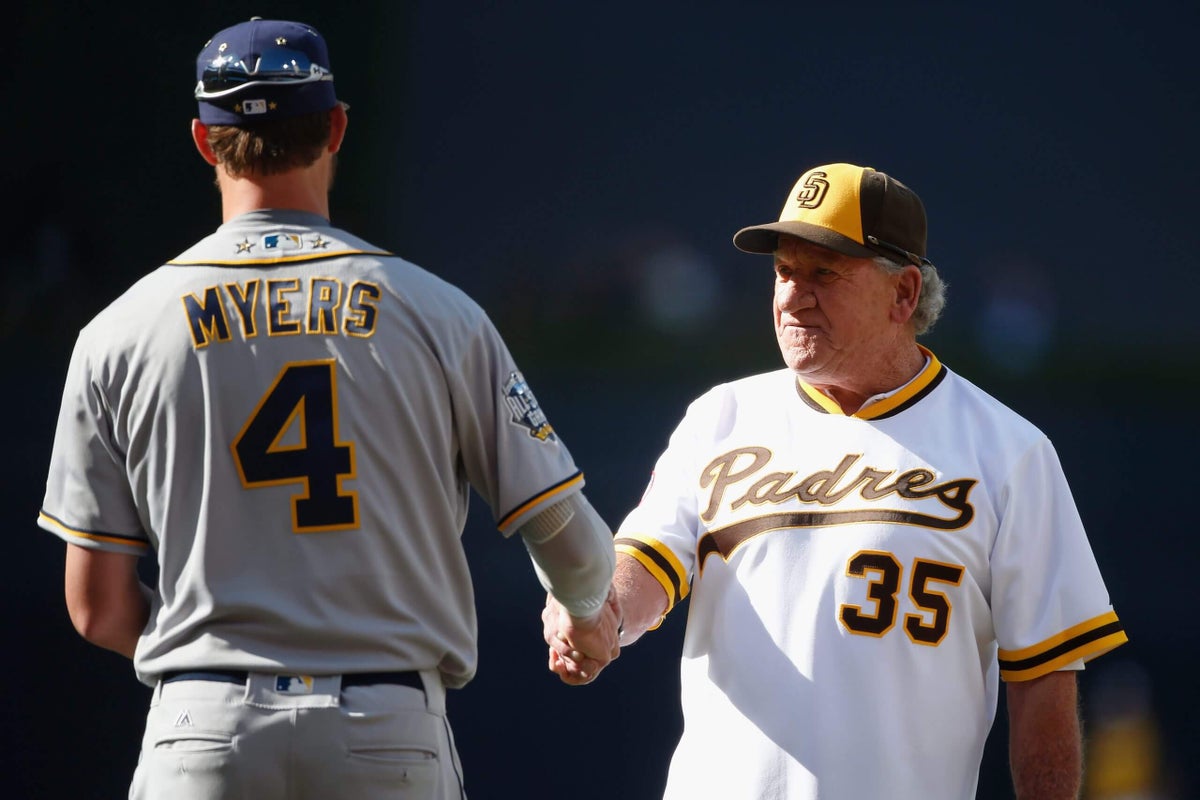
Randy Jones, the sinkerballer who won the San Diego Padres’ first Cy Young Award and remained a fan favorite well after his final pitch, died Tuesday, the Padres confirmed. He was 75.
“With deep sorrow and heavy hearts, the Padres mourn the passing of our beloved left-hander, Randy Jones,” the team said in a statement. “Randy was a cornerstone of our franchise for over five decades, highlighted by becoming the first Padres pitcher to win the Cy Young Award. Inducted into the Padres Hall of Fame in 1999, his impact and popularity only increased in his post-playing career, and he became a tremendous ambassador for the team and a true fan favorite.
“Crossing paths with RJ and talking baseball or life was a joy for everyone fortunate enough to spend time with him. Randy was committed to San Diego, the Padres, and his family. He was a giant in our lives and our franchise history.”
Equipped with modest height and unremarkable velocity, Jones rose to national prominence as the Padres’ first homegrown star. He was the runner-up for National League Cy Young in 1975 and the winner of the award in 1976, a crafty lefty credited with swelling the attendance at what was then known as San Diego Stadium. He made All-Star teams in the two aforementioned seasons and wound up spending eight of his 10 big-league campaigns as a Padre.
With deep sorrow and heavy hearts, the Padres mourn the passing of our beloved left-hander, Randy Jones. Randy was a cornerstone of our franchise. The CY Young Award winner, Padres Hall of Famer, and tremendous community ambassador, was a giant in our lives and will be greatly… pic.twitter.com/AwXWb92aCD
— San Diego Padres (@Padres) November 19, 2025
In retirement, he served as a broadcaster, team ambassador and owner of the popular Randy Jones BBQ stands at Qualcomm Stadium and Petco Park. In 1997, the Padres recognized his achievements by retiring his No. 35. Two years later, they included him in their inaugural Hall of Fame class alongside Nate Colbert and Ray Kroc, who saved the Padres from moving to Washington, D.C., when he purchased the team in 1974. The next two years saw Jones carve an indelible place in franchise lore.
“It seemed like the community came together when I went out to pitch. Those were wonderful years,” Jones recalled to the San Diego Union-Tribune in 1999. “And the kids who were my fans back then are today the fathers of young Padres fans.”
Jones charmed multiple generations of supporters with his everyman demeanor, permed hair and unique pitching style. He was born in Fullerton, Calif., and attended Brea Olinda High School and Chapman University before the Padres drafted him in the fifth round in 1972. By then, a nagging case of tendinitis had rerouted his career, prompting Jones to subsist on a diet of high-70s heat.
He debuted the next year for a franchise still in its infancy. Like the Padres, Jones initially struggled, absorbing more losses in 1974 than anyone else in the National League. Then, in 1975, he rebounded as San Diego’s first 20-game winner. He placed second, behind Hall of Famer Tom Seaver, in NL Cy Young voting. In 1976, he went 16-3 before the All-Star break, graced the cover of Sports Illustrated, finished with 22 wins and secured the league’s top pitching award.
During that two-year peak, Jones captivated fans with his brisk tempo and a stream of slow sinkers and sliders, rarely reaching the mid-80s on radar guns. He simultaneously confounded opponents from coast to coast. Pete Rose, a switch hitter and Major League Baseball’s all-time hits leader, once resorted to batting left-handed against Jones. Another time, Rose stepped out of the batter’s box and shouted toward Jones, “Throw hard, dammit!”
The performances, despite a lack of velocity, were often as swift as they were successful. On July 20, 1976, Jones outdueled Hall of Famer Steve Carlton with a 91-minute complete game at San Diego Stadium. On May 4, 1977, he singlehandedly pitched the Padres to another victory against the Philadelphia Phillies in 89 minutes. The latter remains the shortest game in club history.
Jones’ workload — he threw 43 complete games across the 1975 and 1976 seasons — caught up to him when he tore a nerve attached to his left biceps tendon in his 40th and final start of 1976. He never sustained his previous level of excellence, although he pitched six more years, the final two for the New York Mets.
A longtime resident of Escondido, Calif., Jones remained a fixture around San Diego and the Padres for more than four decades. He tutored young pitchers, including Barry Zito, a fellow lefty who went on to win the American League Cy Young Award in 2002. Jones remains the Padres’ franchise leader in innings pitched, games started, complete games and shutouts. He finished his big-league career with 100 wins.
“My proudest thing was in the 70s, putting the franchise on the map,” Jones told the San Diego Union-Tribune in 2014.
Jones revealed in 2017 that he was undergoing treatment for throat cancer. He announced later that year that he was cancer-free.
Jones is survived by his wife, Marie, and their two daughters.