
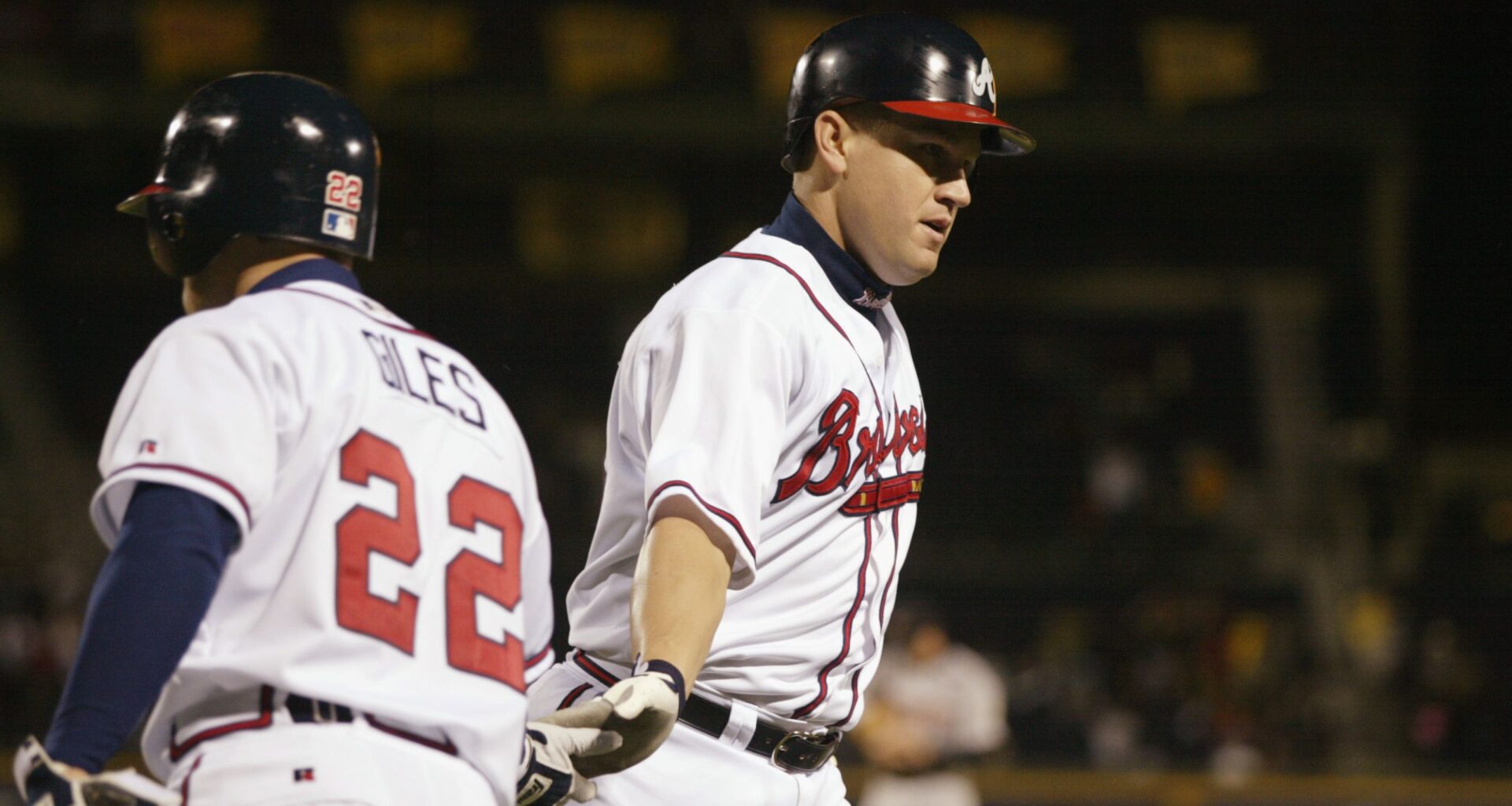
Image credit:
Wes Helms (Photo by Jamie Squire/Getty Images)
In early-90s North Carolina high school baseball, Wes Helms was the cream of the crop. The 1993 Co-State Player of the Year (along with future big league standout Trot Nixon) during his junior year at Ashbrook High School, Helms knew he had a future on the diamond after high school.
He just didn’t know if that immediate future would be honoring his commitment to the University of North Carolina or heading the pro route after being selected by the Braves in the 10th round of the 1994 MLB Draft.
“My dad said, ‘Look, you can always go to college. Your mind is always going to be there, your body isn’t always going to be there. Why don’t you give this a shot,’” Helms said.
Helms chose Atlanta, signing for $100,000 and jumping right to the Gulf Coast League after graduation. In doing so, he joined a loaded Braves farm system that included a 17-year-old Andruw Jones.
Helms’ journey through the minors was slow and steady, by design.
“Each level we made it to, we were ready,” said Helms, who rose to be a top 10 prospect in the Atlanta system in the late 1990s and early 2000s. “They had you ready or you weren’t making that jump.”
Want more podcasts like this one? Subscribe below!
Apple Podcasts | Spotify | Player FM
As loaded as the farm system was, the big league club was even more talented. The Braves were in the middle of 14 consecutive division titles and had a future Hall of Famer in Chipper Jones manning third base—Helms’ position.
As he reached the high minors, Helms began to come into his own, learning the type of player he’d be at the big league level. He wouldn’t be a Chipper Jones, so he couldn’t worry about replacing him. Instead, he kept his focus on how to best maximize his potential.
“I had a lot of power, but my swing was geared more to gap-to-gap,” Helms said. “I realized when I got to Double-A, almost to Triple-A, ‘Ok, this is the player I’m going to be. I need to focus on being the best version of me.’”
Helms debuted in Atlanta late in the 1998 season before breaking in for good as a 25-year-old in 2001. His first two seasons in the big leagues saw him as a role player. He spent the entire season in the show but didn’t clear more than 239 at-bats while seeing time in the field at four different positions.
He enjoyed the winning and learning under the tutelage of Jones and other Braves stalwarts, but a trade to Milwaukee in December 2002 let Helms swap out winning ways for regular playing time as a full-time starter.
“For me to progress in my career, I have to get those at-bats, I have to show that I can play this game,” Helms said. “It’s not selfish. It’s one of those things where yeah, 100% I’d rather be on a winning team, but there’s also times where, this is my career, I’ve gotta provide for my family. One day, this is going to be over, and I have to have the financial capabilities to have a life after baseball.”
His first year in Milwaukee led to his breakout as a big leaguer, socking 23 homers for the 2003 Brewers. But injuries limited him across his following two seasons. He rebounded to hit a career-high .329 for the 2006 Marlins, but his four-year stint in Miami (with a forgettable Phillies stint in 2007 mixed in) led to a new kind of role for Helms.
The 2006 Marlins had nine starting rookies on Opening Day. Thirty years old when he arrived, Helms had gone from young utility player in Atlanta to elder statesman and clubhouse guy, so much so that younger Marlins nicknamed him “Uncle Wes.” His main priority was still to produce on the field but nearly as much was to mentor his younger teammates.
“It was one of those roles where it’s go do your thing, be the player you are,” Helms said. “But also I want you to be the leader for these younger kids and show them the way to do things.”
Though never a star, the last four years of Helms’ 12-year career saw him become a mainstay, the veteran presence in a Marlins clubhouse that sorely needed that kind of leadership. The Marlins released him in 2011, and despite interest from the Rockies via a 2012 spring training invite, Helms decided it was time for one more role change—to full-time husband and dad.
“We sat down as a family and talked about it,” said Helms. “You played a long time, you played 12 years in the big leagues (…) we just made a family decision to say alright, this is it.”