
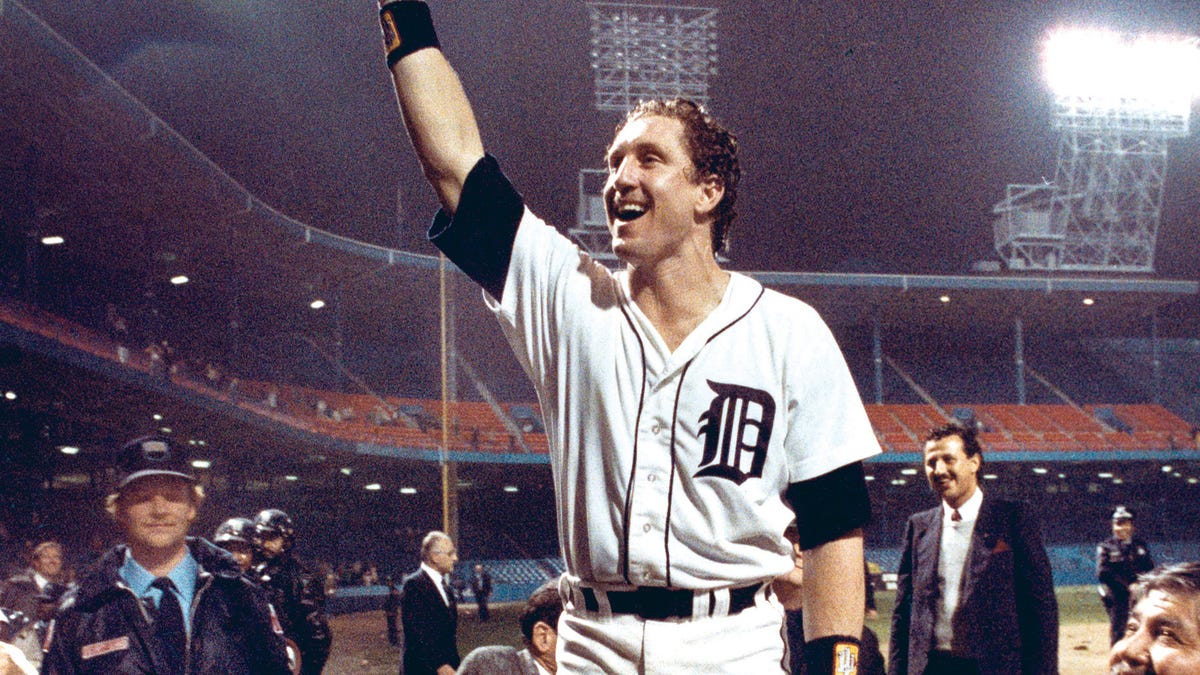


Tigers catcher Dillon Dingler credits teammate for 2025 AL Gold Glove
Detroit Tigers catcher Dillon Dingler spoke with reporters Nov. 3, 2025, about winning an American League Gold Glove Award for the 2025 season.
Detroit Tigers legend Lance Parrish – a 1984 World Series champion – knows a thing or two about winning American League Gold Glove Awards. He earned the honor three consecutive seasons during his decade in Detroit, part of a 19-year MLB career.
Parrish, now a 69-year-old legend ambassador in the Tigers’ front office, has high praise for catcher Dillon Dingler, who claimed his first AL Gold Glove in 2025 during his first full season in the big leagues.
Not only is Parrish a three-time Gold Glove winner, but he is also an eight-time All-Star and six-time Silver Slugger. He hit .252 with 324 home runs across 1,988 games for seven teams, including the Tigers from 1977-86.
Parrish spoke with the Free Press on the Nov. 5 episode of the “Days of Roar” podcast, discussing the origin of his “Big Wheel” nickname, his evaluation of Dingler, the offensive development at the catcher position and his former teammates Alan Trammell and Lou Whitaker, among other topics.
[ MUST LISTEN: Make “Days of Roar” your go-to Detroit Tigers podcast, available anywhere you listen to podcasts (Apple,Spotify) ]
Where did your “Big Wheel” nickname come from?
“So actually, there’s a story behind that. Back in the early 1980s, I think it was the year before 1984, we were playing pretty well in the middle of the season. Everybody was having a pretty good run. We had found out that we were going to be the featured team on ‘This Week in Baseball’ with Mel Allen. On Saturday, after we had taken batting practice, we ran into the clubhouse and watched our little-bitty TV up on the locker. It’s not like they have nowadays with the big-screen TVs. Everybody gathered around and wanted to watch him talk about us, so Mel Allen started the segment by saying, ‘The wheels of the Motor City are turning.’ It showed different highlights of Gibby [Kirk Gibson], Tram [Alan Trammell], Jack [Morris], Lou [Whitaker] and everybody else that was making contributions that week. I must’ve been exceptionally hot that week, but he said, ‘And now for the Big Wheel,’ and as soon as he said that, everybody in the clubhouse just went off, like, ‘Ah, the Big Wheel.’ From then on, that’s all anybody called me: ‘Big Wheel.’ I’ve always said they could have called me a lot worse things, so the ‘Big Wheel’ is not too bad, but I got it from Mel Allen.”
What stands out to you about Hall of Fame shortstop Alan Trammell in his special assistant role with the Tigers?
“I know Tram loves doing that, and he wants to be as involved as much as possible. He pretty much takes it upon himself to make his own schedule and visit all of the different minor league facilities. When he’s there, he wants to be a hands-on guy. He loves to be out on the field working with the infielders. He even does the same thing with the big-league club when he comes through Detroit. He is always available to help out and do whatever he can – advice or instruction. He is our Hall of Fame representative. He was a very good player. He is a very good instructor, very intelligent guy. The Tigers are lucky that he has lent himself to them in such a big capacity. I appreciate that. [Former manager Jim] Leyland is the same way. Jim goes around and pretty much acts as an advance scout, watching to see what goes on and sharing his opinions with the front office guys. These guys are baseball lifers. Leyland has been in the game forever. Tram has been in the game forever. They love being connected, and they love being a part of what’s going on. They’re a big factor in the Tigers’ rise as a ballclub.”
Celebrate 125 seasons of the Tigers with our new book!
What did you see from Tigers catcher Dillon Dingler in the 2025 season that led to him winning the Gold Glove Award?
“He’s very deserving. I watched him all year long. He has definitely developed into one of the premier defensive players. I had the good fortune of being down in Lakeland right after they had signed him. I had the chance to watch him perform down there. I thought back then he stood out defensively. It seemed like he just knew what he was doing. He got some great instruction at Ohio State, but he looked like he had it all going on. I advocated and threw my two cents in when we had the meetings at the end of spring training about where everybody should go. I said, ‘There’s really nothing this has shown me that he can’t do. Let’s push him.’ We were in need of some catching in the big leagues. I thought we could put him on the fast track by starting him off in Double-A. I must have been the only one who thought that because he started in A-ball. Obviously, it took a little bit longer for his bat to come around, and that’s OK. Whatever they did, it worked out because he’s there, and he’s done a great job. I thought he hit very well this year, along with his catching, and I think more power will come. He is a big, strong guy. I know he’s going to hit some home runs. Defensively, I thoroughly enjoyed watching him and Jake [Rogers] both when they were behind the plate because I thought they were both great defensive guys, very fundamentally sound. They both threw very, very well. I was always a skeptic of the whole one-knee thing, and I didn’t know how that was going to parlay into throwing and blocking, but they’ve both made a believer out of me. I didn’t think that anybody would be able to, but they’ve done a great job, especially Dillon. I’ve watched him over and over and over blocking balls and jumping to his feet when he was on one knee to have to throw somebody out at second base. He throws lasers down to second right on the money. He’s got everything going for him. I’m very, very happy that the rest of the league recognized what a great asset he is to the Tigers behind the plate.”
What does the way Jake Rogers handled the change in his role – from starter to backup – tell you about him as a teammate?
“It sheds a big light on Jake Rogers as what type of an individual he is. He is a team guy. I watched him when he was in the dugout pulling for guys when he wasn’t getting the opportunity to play every day. The unfortunate thing, when you go down with an injury, you’re opening the door for the other guy to get a foothold on that job – and that’s exactly what happened. When you open the door for somebody, à la the old Lou Gehrig/Wally Pipp story, Dillon came in, and he proved to everybody that he was ready. He was more than capable, and he did a great job. As far as Jake, when Jake gets behind the plate, he still does an amazing job calling a game, working with his pitches. He’s one of the great throwers in baseball. He can throw anybody out. I think Dillon and Jake are probably the best one-two combination, throwing-wise, in baseball right now. I think Jake is a very classy guy. He probably has helped Dillon quite a bit off to the side. When Dillon might’ve had a question about this or that, I’m sure Jake is more than willing to help him out in any area that he needs help in because Jake is that kind of guy. To Dillon’s good fortune and Jake’s good fortune, they’e got a great catching coach in Ryan Sienko, and [manager] A.J. Hinch himself was a catcher in the major leagues. There’s a lot of instruction and advice that flows around in that little area when all of those guys are together. I think it’s really benefitted Jake and Dillon both.”
Why does it often take catchers longer to develop, especially on offense?
“It’s very difficult when you’re not swinging the bat well to push that out of your mind and concentrate on what you’re doing behind the plate. I had the good fortune of playing with guys like Tram and Gibby. They would always remind me, if I came back to the clubhouse pissed because I took an 0-for, it’s like, ‘We won the game, you did a great job behind the plate. That’s really all that matters.’ If you don’t contribute offensively in any game, as long as you do the job behind the plate, that’s really what matters. You need to guide the pitching staff, and you need to do a good job throwing to the bases. When I heard that a couple of times, that’s the mindset I took into each and every game, and it’s a difficult thing to do. Everybody wants to contribute at both ends of the spectrum. I took a lot of pride in my offense. I always wished I was a better hitter than I was – fortunately, I hit some home runs – but at the end of the day, my biggest contribute to the success of our ball club was always what I was able to do behind the plate and working with pitchers and being able to control the running game. The offensive part is always fun. Everybody likes to hit all day long every day. If you’re a catcher, nobody really likes working on blocking balls and all that other stuff. Maybe that’s one of the things that makes it difficult for guys to be successful on both ends. You take a beating back there. There’s just no doubt about it. It’s hard on your knees. It’s hard on your back. You take a few foul balls here and there. You wear that for a week or two, especially if you’re hitting your hands or your elbows or whatever else you’re using to try to swing a bat with. That’s why I tip my hat big time to Cal Raleigh for the year that he had. Once upon a time, I hit 32 home runs in 1982, and I set an American League home run record for catchers – and he doubled it in one season. It’s not that easy, but he made it look easy. At the end of the day, if you were to put a bunch of baseball players in a room and ask how many of them wanted to catch, there wouldn’t be too many guys raising their hand. It takes a special individual – somebody that can endure pain, somebody that doesn’t mind sweating their butt off every day and every night. I wouldn’t trade it for anything. I wouldn’t mind getting on the mound one time. I see a lot of guys getting the opportunity to pitch. I would’ve loved to sneak in there for one inning to see what I could do.”
Do you believe former Tigers second baseman Lou Whitaker should be in the Hall of Fame, and what’s your case for him?
“It would have been really, really nice if when Tram was put into the Hall of Fame that Lou would have been right there beside him. I thought that would have been the perfect ending to a great story on both of their careers. Do I think Lou deserves to be in the Hall of Fame? I absolutely do. It’s funny it seems like these usable metrics that everybody refers to and uses to evaluating players, when it works to their benefit when they’re trying to make an argument, it’s all good, but in Lou’s case, the big metric that everybody uses now is WAR – Wins Above Replacement – and Lou’s WAR number was better than a heck of a lot of guys, second basemen included, that are already in the Hall of Fame. If that’s the big criteria that everybody looks at, why did Lou get bumped off the ballot after his first year, and why doesn’t anybody give him a second look. I saw Alan’s statistics and Lou’s statistics side by side. They’re almost identical. Literally, almost identical. If Tram’s numbers are good enough to get him in the Hall of Fame, why are Lou’s numbers not good enough to get him in the Hall of Fame? I don’t understand that. I watched a lot of second basemen. I can honestly tell you that there weren’t too many guys that I would put above Lou Whitaker at second base. He could do everything. Maybe the only thing he didn’t do is steal more bases than other guys, but he was capable of it. He hit home runs. He hit for average. He was a great fielder. He had a great arm with great range. I don’t understand it. Somewhere along the way, if everybody keeps barking loud enough, maybe they’ll give him the honor that he deserves and put him in there. But yes, I do believe that Lou Whitaker should be in the Hall of Fame.”
Contact Evan Petzold at epetzold@freepress.com or follow him @EvanPetzold.
Listen to our weekly Tigers show “Days of Roar” every Monday afternoon during the season and Tuesday afternoon during the offseason on demand at freep.com, Apple, Spotify or wherever you listen to podcasts.