
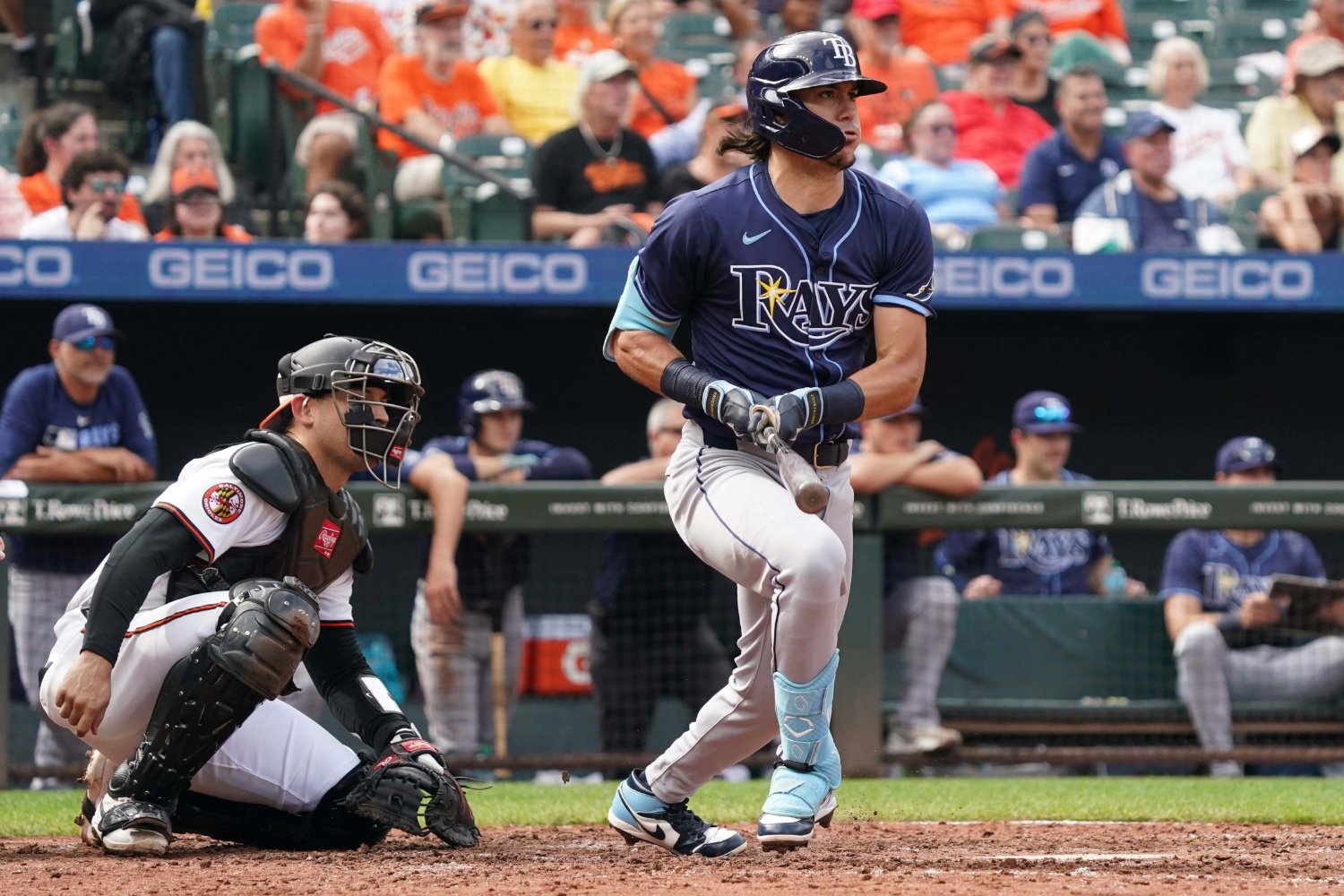
The Boston Red Sox made an intra-division trade Tuesday afternoon, shipping previously-designated-for-assignment Luis Guerrero to Tampa Bay. In return, the Red Sox received 29-year-old utility player Tristan Gray. Gray appeared in 30 games last season after the Tampa Bay Rays acquired him in a trade with the Chicago White Sox. He would go on to hit .231/.282/.410 with five doubles, three home runs, and nine RBIs.
Gray profiles as a depth option with the Red Sox, the utility player having spent time at all infield positions in 2025 with most of his games played in the majors being at first base. Should Gray make it through the offseason and enter spring training with the Red Sox, he would be competing against the likes of Nick Sogard, Nate Eaton and David Hamilton for an end-of-bench role. Though, in all likelihood, should Gray still be with the team by the end of spring training, he would open the season with Triple-A Worcester, providing a veteran depth option for the organization on a cheap contract.
Gray as a hitter is a rather interesting figure. Offensively, he may not make contact often (based on a 28.6% strikeout rate in his short career) and will chase pitches as shown by a 27.6% chase rate last season (not to mention a whiff rate of 31.9%), but when he does make contact, he doesn’t miss out. Gray hits the ball hard, as evidenced by his average exit velocity for 2025 being 91.4 mph along with his max velocity being 110.6 mph. Of the balls he did hit this past season, nearly half of them were considered hard-hit as well, his rate being 44.3% in the 30 games he played. One other interesting trait of his offense is his bat speed. In 2025, it averaged 74.4 mph. As written by our very own @Jack Lindsay earlier this offseason, the Blue Jays focused on improving their bat speed so that when they fell into disadvantageous counts, they could still put together a powerful, controlled swing on the baseball. Of the Red Sox players in 2025, only Triston Casas, Jarren Duran and Roman Anthony had bat speeds higher than Gray’s.
The Red Sox are clearly interested in pumping up their lineup’s bat speed, and Gray follows that trend, especially for someone on the bench. Unfortunately, it doesn’t matter what your bat speed is if you fail to make contact. His zone-contact rate last season was only 75.4%, an increase from his 2024 numbers but still below what many consider to be average (roughly 85-87%). Also of note, while he showed he could handle fastballs, Gray struggled against off-speed pitches and whiffed more against breaking pitches, especially at Triple-A. And while he has struck out at a 28.7% rate for his career, his walk rate of 7.4% isn’t high enough to make up for the lack of contact.
Defensively, Gray’s versatility is of interest. The fact he can play not just one or two infield positions but all four makes him extremely valuable for depth purposes. Last year, Nick Sogard was in a similar role, where he could be called up from Worcester to cover the loss of a player for a week or two and be plugged into the lineup in a wide variety of positions. Gray fills a similar need as thanks to his one remaining option year; he could be shuttled back and forth from Worcester to Boston as the team needs a body, giving Alex Cora someone who can be inserted into the lineup anywhere on the infield dirt. He doesn’t stand out with the glove at any one position, though he’s competent at each, making one error at each of first base, second base and third base while accruing an Outs Above Average of one at shortstop last season.
He very much fits the mold of end-of-the-roster players that the Red Sox have brought in over the past few seasons and have managed to turn into contributors at the major-league level. Guys like Rob Refsnyder, Romy González, and Nate Eaton were all castoffs from their previous teams who are now core depth pieces on the roster. While that’s no guarantee Gray will continue that trend, the Red Sox’s track record with similar players suggests a brighter future than most may expect from the now-former Ray.