
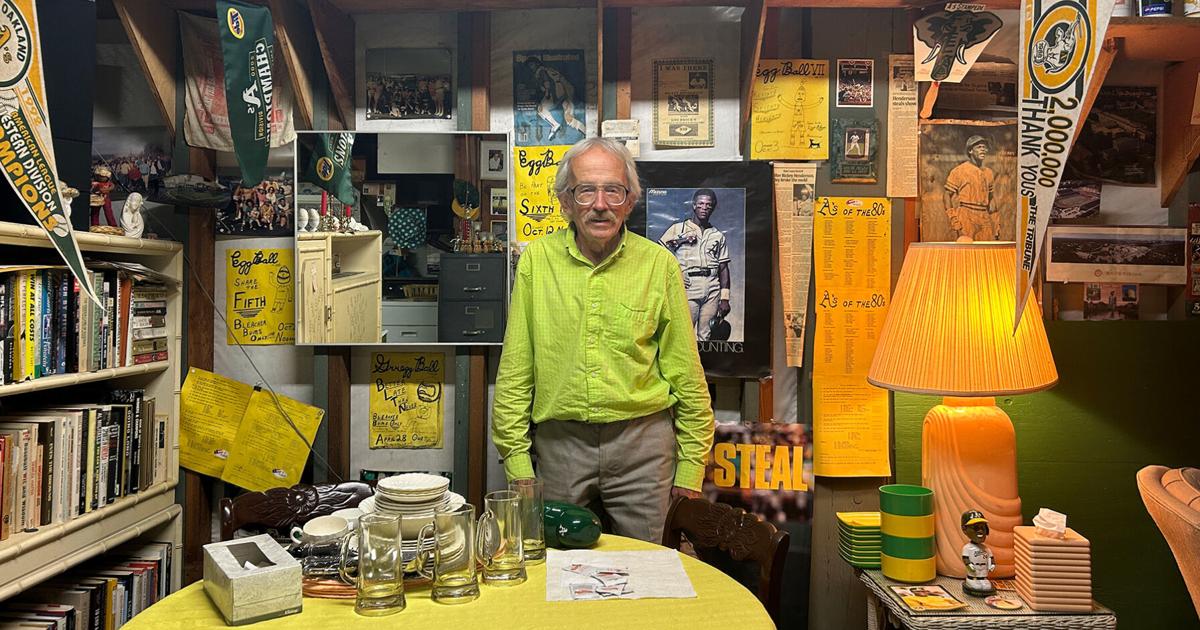
My mom always told me that if I didn’t have anything nice to say, I shouldn’t say anything at all. But for many baseball fans, a total opposite philosophy grounds how they heckle and who gets to be the unlucky target of their verbal antics. In an interview with David White — a 79-year-old Berkeley resident, baseball fanatic and former academic activist — I learned of the hilariously cruel tactics of White and his motley crew of Oakland A’s fans in the 1980s.
Seated in his garage-turned-casita called “Baseball Heaven” on Airbnb and Vrbo, I sat on his sofa, which was clad in a green and yellow crocheted quilt to complement the bright green floors and walls adorned with more yellow posters — all to visually declare White’s allegiance to the Athletics. Behind the couch where I was sitting, partially covered by beds and bookshelves, was a miniature-scale painting of a baseball diamond, down to the bases, mound and foul lines.

Jojo Pak | Staff
As someone who grew up around more BBC documentaries than broadcast sporting events, the world of baseball was somewhat of a mystery to me. In fact, I had little awareness of the profundity of the mental warfare between the players and the spectators. But for White, the most fun part of the game was just that. White recalled the names and active years of countless baseball legends, games, iconic plays and striking crowd moments that he was part of.
At 79 years old, White ended up in “Baseball Heaven,” but he didn’t always reside in his tabernacle for the A’s. Hailing from Massachusetts, White recalls always loving baseball as an integral part of his family and community:
“(In the) little leagues, my dad pitched, my grandfather was a pitcher, so … we played all games … It was $2 for the bleachers — it was just a really easy thing to do. And then I went for almost every game for several years.”
Arriving in the East Bay during the “glory years” of a legendary team on a winning streak, White found a new home after placing a bet on the A’s participation in the 1974 World Series:
“I was in my cousin’s house in Flint, Michigan … and the A’s were in the World Series in 1973. And the game wasn’t sold out. And I said, ‘If they’re in the World Series the next year, I’ll be there.’ And they were, and I was. So we came out in the glory years of Oakland. Reggie Jackson was on the team, Catfish Hunter and all these Hall of Fame players that eventually won the Yankees. But they were the stars that had three consecutive World Series championships. And it was ’72, ’73, ’74 …”
From there, White described his friend group of A’s fans that would gather at every game to creatively heckle the A’s enemy teams, reaching their peak in the mid-’80s. The heckles would range from playful chants to puns with players’ names, such as calling Giants catcher Bob Boone “Butterfingers Boone” or shouting to the former Dodgers player Dusty Baker as if his name was actually “Dirty.” They had become a “coterie of comedians” with an electrifying energy for the crowds. White said that this was a place where their “original great lines” at someone else’s expense were not only accepted, but celebrated.
Although White often thrived off of spur-of-the-moment brilliance, he was one to spend his time off the field, such as studying players’ television appearances, to deepen the impact of his taunts:
“So Reggie Jackson goes on ‘The Jeffersons.’ And the premise of it was that George Jefferson had gone to the game and the ball had come to center field and had landed in his blow and he dropped it. So Reggie says, ‘Yeah, well, everybody in the dugout, we were calling you “toaster glove.”’ So sure enough, the next time that the Angels come to Oakland, (in the) right field, Reggie Jackson’s there, stands under the ball, drops his ball. So I yelled out, ‘Hey, Reggie! Hey, toaster glove! George Jefferson would have had it!’ … You keep track of all this stuff.”
What I found to be the most creative was White’s anecdote of a woman, Bianca, who brought her two kids and piles of newspapers to every Angels game:
“So she was there all the time and she would just tear up newspapers. The whole game. And when we had a home run, we always had to put our hands over our beer because she would be throwing all the newspapers … and then she passed them out and then left the bleachers so that when Reggie Jackson came up to plate, there’d be nothing but newspapers in the bleachers … to the point that the announcer got to say, ‘Up comes Reggie, and up comes the newspapers.’”
Jojo Pak | Staff
What struck me was White’s analysis of the impact of his heckling antics. White recalled drinking beers with umpires at a bar accompanied by his group of fans. In fact, White and his heckling crew considered themselves friends with the umpires, routinely greeting each other at games from California to Philadelphia. Meanwhile, among broadcast radio features and local newspaper mentions, White and his clique had just as much clout in the dugouts and locker rooms as the players themselves.
But the entire cultural ecosystem of baseball seems to have evolved. White reminisced upon his heydays of free heckling, remembering the fan coalitions in the stands that mirrored his own group’s sense of territorial belonging:
“There were other subcultures. There was one … they would be in the left field bleachers right in the corner, right under the shade … and it was their little area. And the last game, this guy said, ‘We were the first ones that had a group. We were Reggie’s Regiment. We passed out tickets and everything’ … So little things like that have popped up over time. But I think it’s because of the bleachers that you have the free flowing thing that you can create an environment. And the closest thing you get to that now is the real rich seats, that if you watch the Dodgers games, Larry King used to have a seat right behind home plate. You could watch Larry King watch the game … that’s a subculture because they’re there all the time. But they’re paying an arm and a leg, literally to sit in those seats. But that becomes a culture in itself.”
According to data from the MLB during the 2021 season at the height of COVID-19, the absence of fans in the stands dramatically improved the performance of players across the board. Today, attempting to heckle in an overtly degrading manner can serve as grounds for removal from the game, or, at the very least, some mean stares from your peers in the stands. The game of baseball seems to have been one molded by the spirit of the onlookers — active participants in the experience. However, the fans have been demoted from exerting their potentially ruthless force onto their team of disfavor. While the game may now be kinder, sharing spite toward players often gave people a reason to come together. In the lulls of baseball, these moments shared between fans were what made experiencing the major leagues so special. And for White, the vibrance of those years were worth dedicating half of his home to:
“There’s only like eight minutes of action in a baseball game. But you sit and talk to each other, and you’d never do that in a basketball game because you’d miss half the game. People will shut you up at a football game, you cheer, you cheer, it’s a totally different dynamic. With baseball, it’s interactive, and you make friends … What I think is nice about sports in general is it creates culture … People say, ‘(The Airbnb is) a man cave.’ I suppose it is. But in general, I think males and females can relate to baseball pretty well in terms of talking about this, that and the other. And it’s engaging and creates a little bind in the culture that you can talk about things without talking about things.”