
Uncertainty abounds in the New York Yankees rotation, and as a result, Brian Cashman will be on the prowl for yet another top arm to insulate the club against the question marks present among the current group. He’ll have plenty of options, too. The free-agent market is well-stocked with aces, but that doesn’t mean all are great fits.
We’ve seen the Yankees choose wrong before, whether it be via trade or in free agency. Those scars should hold weight. As Cashman surveys the field, there are three highly-regarded names he’d be wise to cross off his list immediately.
These three all will command massive contracts and may go on to have success in other places, but for the Yankees, signing one of them could spell disaster.
The Yankees shouldn’t touch these three free-agent aces with a 10-foot poleFramber Valdez
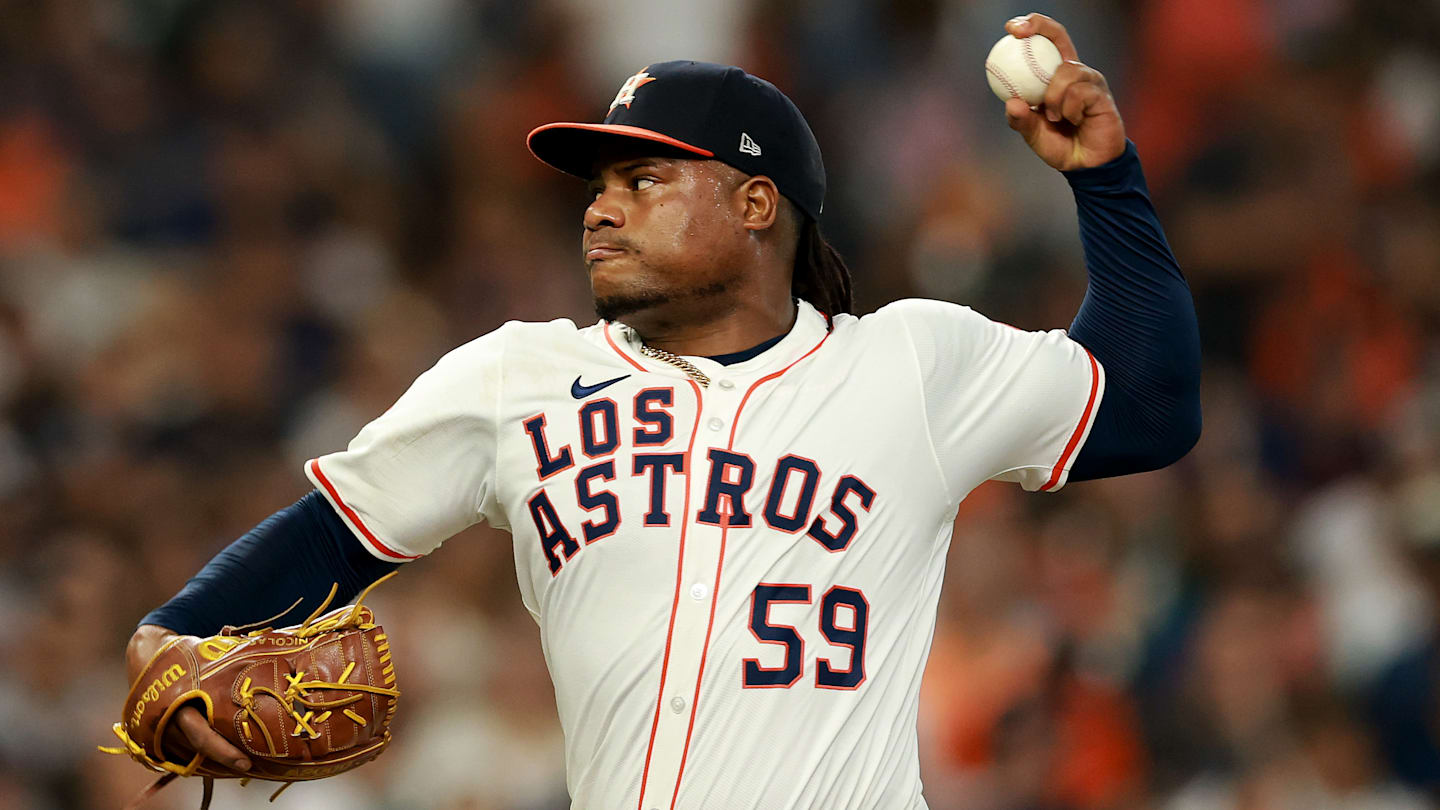
It’s long been assumed that Framber Valdez would price himself out of the Houston Astros’ budget, and the soon-to-be 32-year-old southpaw has been one of the most durable and productive starting pitchers over the last half-decade. He might be, objectively, the best free-agent starter on the market.
And on paper, the numbers would make him seem like a perfect fit for the Yankees. A career 3.36 ERA and 3.51 FIP are certainly ace-like. He’s topped 190 innings pitched in three of the last four seasons, showing impressive durability. His whopping 61.8% career ground ball rate would play wonderfully in Yankee Stadium.
So what’s the holdup? Well, Yankees fans got a front row seat to his meltdown when he “unintentionally” crossed up catcher César Salazar, drilling his catcher in the chest with a fastball following a Trent Grisham grand slam. That incident was bad, but it was hardly the only time Valdez could be accused of being a bad teammate. In July, he threw the Astros’ coaching staff under the bus for the defensive alignment after taking the loss against the Washington Nationals. In this instance, Valdez probably wasn’t wrong, but he didn’t need to publicly air his grievances.
The New York media would have had a field day with him had these incidents occurred with him in pinstripes … but there’s more. The Astros collapsed hard in the second half, missing the playoffs for the first time in a decade. And while he wasn’t the only culprit, Valdez was a big reason why. After posting a 2.75 ERA in the first half, he saw that number balloon to 5.20 after the All-Star break. He was part of the problem, not the solution, and that alone would’ve put him under the microscope. When you add in his antics, he’d become major tabloid fodder and a distraction that simply isn’t worth the cost.
Shota Imanaga
At a point in time, Shota Imanaga was viewed as a nice Yoshinobu Yamamoto consolation prize. The Japanese southpaw had shown out in international play and raised his profile to the point that he could be considered a front-of-the-rotation option, even if he wasn’t quite as dominant as his younger countryman.
Despite some rumblings, the Yankees didn’t seriously pursue Imanaga, and he landed in Chicago with the intention of heading up the Cubs’ rotation. His rookie season went as well as one could’ve hoped, with him throwing 173 2/3 innings of 2.91 ERA ball in 2024.
With an average fastball velocity of just 91.9 miles per hour, Imanaga wasn’t overpowering, but he was a strike-throwing machine who recorded a minuscule 1.45 BB/9, while racking up a healthy 9.03 K/9.
His 2025 follow-up saw him miss time with a hamstring injury, but Imanaga still tossed 144 2/3 frames and posted a respectable 3.73 ERA. The injury may have affected him for most of the year; however, as his fastball velocity dipped over a mile per hour, coming in at 90.8, and his K/9 fell to just 7.28.
That’s a bit of a concern. While velocity isn’t the end-all be-all, such a severe dip is notable when you’re already not throwing gas, but more curious was the dramatic dip in strikeouts.
While that might be the first red flag, it isn’t the biggest. Imanaga’s been entirely too homer-prone during his time stateside. In 2024, he gave up 1.40 HR/9 and last season it rose to a ghastly 1.93 mark.
Imanaga is one of the worst performers in baseball when it comes to pulled fly balls, so if his baseline is a career HR/9 mark of 1.64, you could expect it to be even worse playing half of his home games in the Bronx. That’s simply too much risk to take on, even if there are a lot of other things to like about his game.
Tatsuya Imai
As the offseason gets underway, a name that keeps getting more and more buzz is that of Tatsuya Imai, the 27-year-old hurler who will be the latest ace to jump across the Pacific and try his hand in the bigs.
The Yankees have started being connected to him, and it’s easy to see why. Like most Japanese imports, he comes with an array of pitches, but his bread and butter is a mid-90s fastball that can hit 99, alongside a wipeout slider. At his age, whichever team lands him is getting an arm who is entering his prime years.
His 1.92 ERA this season in the NPB is drawing attention, but it’s important to take the numbers players put up in these foreign leagues with a grain of salt. For example, Hideki Matsui was a perennial 35+ homer bat in the NPB, and while he had a great career in the MLB, he wasn’t that type of hitter here.
One thing to take note of is the velocity. Imai has it in spades, which isn’t as common in Japan as it is in MLB. Many Japanese hitters struggle against elite velocity, with one of the most exciting bats coming over this winter, Munetaka Murakami, famously struggling to make contact against heaters thrown in the mid-90s and above. Meanwhile, the majors are littered with guys who can run up the radar gun but regularly get clobbered.
That isn’t to say that Imai’s stuff can’t translate; it’s just that it’s not a guarantee. On top of that, his slight frame should be some cause for concern. Listed at 5-11, 154 pounds, Imai has a slim build that isn’t ideal for a starting pitcher. A common issue for Japanese pitchers is adapting to the five-man rotation, and without the workhorse-like heft to him, there’s a chance that could cause issues with durability and stamina.
Lastly, there’s the question of what Imai’s ceiling truly is. The consensus seems to be that his best outcome is as a mid-rotation innings eater, which certainly has value. However, he’s projected to get a deal upwards of $150 million, which is an overpay for that type of pitcher in most cases.
The bottom line here is that the Yankees are seeking another starter — not because they lack top-end talent, but rather because they lack certainty. Spending that kind of cash on a player who is more of a dice roll than most in that context doesn’t make a whole lot of sense. There’s a strong chance Imai works out, but there’s an equally strong chance that he doesn’t live up to his deal, and a myriad of things that could go wrong. For that reason, the Yankees should take him off their board.