
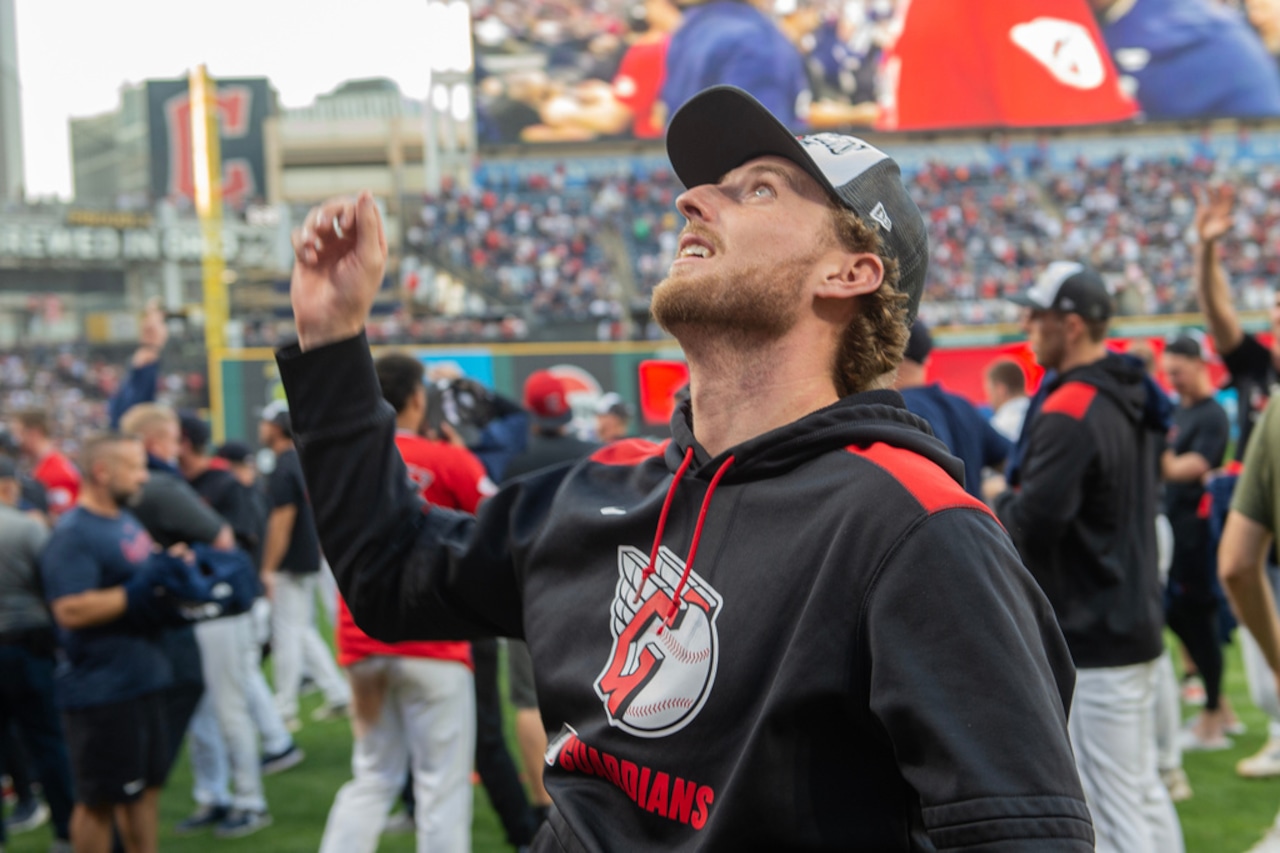
CLEVELAND, Ohio — The Guardians’ reputation as baseball’s premier pitching development factory has paid off handsomely — not just for the team, but now for the young arms themselves, thanks to MLB’s pre-arbitration bonus pool.
Three of Cleveland’s emerging pitchers scored significant financial rewards for their 2025 performances, with Gavin Williams leading the way at a whopping $347,000 in bonus money. Cade Smith ($295,000) and Tanner Bibee ($217,000) also cashed in, as revealed on the latest Cleveland Baseball Talk Podcast.
“When young players perform at a high level in terms of award voting or reach certain benchmarks with WAR and their statistics, they get a cut of this bonus pool,” explained Joe Noga, cleveland.com Guardians beat reporter. This system, negotiated in the latest collective bargaining agreement, ensures young stars get compensated before reaching arbitration eligibility.
The payouts reflect Cleveland’s continued excellence in developing pitching talent. As Paul Hoynes noted: “It says a lot about Cleveland’s pitchers, the pitching development and the depth of the pitching… that’s what Cleveland does. They draft these guys, they develop them and they get these guys to the big leagues.”
Williams’ team-leading payout among Guardians pitchers reignites the debate about who truly serves as Cleveland’s ace. The right-hander went 12-5 in his breakout campaign, matching Bibee with 31 starts but posting superior overall numbers. Bibee, who signed a $50 million contract extension before the season, went 12-11 with a 4.24 ERA.
Despite Williams earning the larger bonus, Hoynes still gives the ace label to the more established Bibee: “Williams had the breakout year, but let’s see what he does in 2026, 2027. Bibee has been consistent for the last three years. He’s led the team in innings, pitched and starts.”
The bonus pool system, which distributes $50 million annually among pre-arbitration players, has been particularly beneficial to Bibee. He’s collected payouts in all three years of the program’s existence, including over $1 million following his rookie season when he finished second in AL Rookie of the Year voting.
Smith’s substantial bonus represents one of the system’s greatest success stories. The undrafted free agent signing stepped into the closer role following Clase’s absence and delivered a dominant season with 76 appearances.
“This is a good program,” Hoynes said. “The players association wanted to get more money to their younger players, but since you need three years to be eligible for arbitration, a lot of that money wasn’t getting to them, and more and more teams were playing younger players, turning those guys into everyday players.”
For Cleveland, the bonuses validate their player development approach while creating an interesting dynamic where their young pitchers are being financially rewarded for outperforming their modest salaries — a win for both players and the team’s sustainable model.
Want more insights on how the Guardians continue to develop elite pitching talent while managing their payroll? Tune in to the Cleveland Baseball Talk podcast for in-depth analysis of the organization’s pitching philosophy and how it’s positioned them for sustained success.
Podcast transcript
Joe Noga: Welcome back to the Cleveland Baseball Talk Podcast. I’m Joe Noga, joined by Paul Hoynes, Hoynsie, we’re back from a long week off with Thanksgiving. You get a chance to work off the turkey?
Paul Hoynes: Oh, you’re not kidding, Joe. All I’ve been doing is eating. I’m, I’m rolling around the house. I’m not walking.
Joe Noga: I mean, that’s better than the not eating, I guess. So, yeah, it was a, it was a long week. Went down to South Carolina and visited some family down there and had a great meal and some, some great times. So now we get, now we get to dive, you know, roll up our sleeves and dive into season and all sorts of things that are going on. But right off the top, news on the Emmanuel Classe Luis Ortiz trial and the case against them in federal court. The latest coming up on Tuesday. Both are expected to be in court for a conference. A status conference. Correct.
Paul Hoynes: Right. So, you know, in the Eastern District in New York, it’s, it’s called a status conference and I guess, you know, class A and Ortiz will be there with their, with their lawyers. From what I gather, and I’m certainly no legal expert, you know, these meetings are used to perhaps set a trial date, exchange evidence, perhaps talk about a plea bargain or if there’s motions to be made. It’s just kind of something to move the trial along.
Joe Noga: Yeah, the, the, the whole process is going to start to play out. We’re going to see it more like, you know, what we see on trials on TV and that, that sort of thing. Any sense or any, you know, feeling whether or not this might come to a conc. Conclusion quickly, maybe with some sort of plea, maybe some sort of agreement based on the, the amount of evidence that the government has shown that they already have against the two.
Paul Hoynes: Yeah, you know, I do not know, Joe. I, I just know from talking to people, you know, that are close to the, to the case and, and that they would like to have this thing wrapped up by spring training. Baseball would like to have. The MLB would like to have this wrapped up by spring training. So, you know, the guardians could kind of move forward here and, and find you to figure out, you know, with, with Class A is still owed some guaranteed money for 2026. Cheese, of course, is not eligible for arbitration. But I would think, you know, that’s, that’s the big issue right now when they come to spring training. You know, penalties are imposed by, by mlb. Then from everything I’ve heard that they will. Cleveland will not be responsible for any financial, whatever financial terms are Left on, on Class A’s deal.
Joe Noga: Yeah. And you know, there’s all sorts of precedent that, that could be set with this case and the way, you know, sports gambling and offenses and all those sort of things are handled moving forward and really how this, you know, signals to the rest of the league, to the rest of the players out there, the severity and the penalties that they face if, if they get caught doing what Class A and Ortiz were accused of. So yeah, I, I think it’s going to continue to move slowly, but like you said, the, the government’s case is going to have to wrap up before Major League Baseball gets involved in imposing its own penalties on the players themselves, depending on I guess what their level of freedom is at the time. They both face up to 65 years in prison just based on the charges that are on the table right now. So we will continue to keep an eye on and keep our ears open for what happens in the courtrooms coming out of the, the Eastern District of New York for the remainder of this week, a week that will end or lead us right into baseball’s winter meetings. Generally a time when a lot of activity goes on in terms of player movement, signings, free agents, big trades get discussed. Maybe the, the, the, the groundwork for some of those trades gets laid or, or maybe they come out. You know, we, we’ve seen that in the past. Prior to that, some big signings have already happened. One that relates to the Guardians, Sam Hentious, who pitched out of the bullpen for several years. He signs with the Giants at $1.4 million after he was non tendered by Cleveland. Just, you know, the, the, the Giants sort of betting on Hench’s ability to, to recover from multiple surgeries in the off season and, and, and get back on the mound.
Paul Hoynes: Yeah, Joe, you know, I think it was kind of a surprise because obviously Sam hasn’t pitched, you know, for two in 2025. He had the missed summit. 2024, had the shoulder capsule surgery along with the surgery on his labrum. And then in this September he also underwent arthroscopic surgery on his right knee. So hopefully he’s healthy, Joe, he’s, he’s back can help the Giants. So this, you know, hopefully this a solid bounce back contract for him and he, you know, can stay on the field and his shoulder holds together.
Joe Noga: The big news I guess this week, the signing of Dylan Cease, what, seven years, $210 million with the Toronto Blue Jays. So the World Series runners up, not sitting back and resting on their laurels, they’ve they’ve gone after some, some big names to, to bolster their pitching. Cease joining a rotation that will now feature Kevin Gosman, Shane Bieber, Trey Savage, Jose Barrios is in there as well. Just what do you think of Dylan Cease, one of the big name pitchers on the market now signing with Toronto?
Paul Hoynes: Yeah, Joe, I mean interesting signing by the Blue Jays, really an aggressive move by them. You know, Cease has. Did not have the greatest season come, you know, with San Diego last season. You know, it’s kind of era was a bit inflated, but still, you know, we’ve seen him at his, his best against when he spaced the Guardians and, and he’s a solid guy, consistent guy, so. Yeah, but that’s, I mean that contract, seven years for 210 millions I think that, that sets, that sets the market for starting pitching in this free agent period.
Joe Noga: Yeah. And if, if Dylan cease is worth 210 million and Tarek Scubal is out there as a trade candidate, you know what he could potentially sign an extension for if he’s traded to the Mets or anywhere else based off of what, what Cease is now worth. Yeah, that the numbers could become staggering in terms of what that, that starting pitching is valued at. Another pitcher that signed over the weekend, Ryan Helsley, a top bullpen arm, a guy who was traded from St. Louis to, to the Mets during the season last year. He signs for two years, $28 million with the Baltimore or friend Craig Alberna is down in Baltimore now as the manager. He, he gets some, some help in his bullpen. Gets a solid, reliable closer. A guy who’s been at the top of the National League for the last several years. Always mentioned sort of in tandem with Emmanuel Class A over the last few years as the best relievers in baseball. Housley signs for, for big money there. Just, you know, what do you think of Alby getting some, some help in the bullpen?
Paul Hoynes: Yeah, they, they needed a guy to, to close the game, Joe. A couple of their closers have been, you know, nursing injuries. So Helsley, Helsley should come in there and I think he should help that ball club. After getting traded from St. Louis to the Mets last last season, he struggled with the Mets, but I think if everything goes right with the Orioles, you know, that’s, that’s a good piece for them and Alby I think won’t hesitate to use him if he’s, if the house.
Joe Noga: Yeah. The last two years on the bench. Besides Stephen Vogt in Cleveland, Craig Albarnas definitely knew and learned and developed the value of a solid bullpen and particularly the back end of a solid bullpen. And so he knows just how much Helsley means to a club like Baltimore. It should be fun to watch how Alby deploys his bullpen this upcoming season. Some more player movement, but with guardians ties. Matt Crooks, who was released from the roster earlier this offseason. He signed with the the formerly the Oakland. He signed with the A’s. Tyler Zuber, who was in camp last year with Cleveland. He goes back to the Marlins on a minor league deal. So just some. Some housekeeping news and moves and those sorts of things. You know, in terms of not the real big fish that we’re anticipating by about this time next week when the. The win full swing and you know, guys are coming off the board left and right.
Paul Hoynes: No. Yeah, yeah, Joe, just it really has. There’s been a couple big moves so far. You know, one of them the Tyler Ward deal to the Orioles for. With Tyler Ward going to the Orioles from the Angels for Grayson Rodriguez. You know, that was kind of a big deal right there. You know, of course Josh Naylor signing with Seattle kicked off the free agent period. But. Right. Yeah, I think it’s building like you said before towards the, the winter meetings and after the winter meetings and I think this could be a busy week leading up to the meetings and then during the meetings, you know, a lot of stuff, you know, if it doesn’t happen at the meetings, the groundwork is laid for that to happen as you go into spring training.
Joe Noga: Yeah, you know we, we’ve heard Stephen Vogt so many times talk about the cadence to a season and you know, the rhythms and those sorts of things. There’s a cadence to the off season as well. And you know, this is sort of that building up period as we, we head into the winter meetings in that that period. So we’ll, we’ll look forward to those moves. There a couple of guardians players that really benefited from their performances on the mound this past season. Guys who are pre arbitration. So these are still under team control, not eligible for arbitration. But MLB and the players union got together and created this bonus pool idea a few years back and one guy who’s really benefited from that has been Tanner. When young players perform at a high level, finish highly in terms of award voting or reach certain benchmarks with WAR and their statistics and things like that, they get a cut of this bonus pool which is what, $50 million something like that that all the teams pay into and then the money is dispersed and it was learned that Gavin Williams this year was the, the Guardians top guy in terms of dispersals. Williams making more than $347,000 based on his performance this past season. Kate Smith, $295,000. Bybe checks in just over $217,000 in bonus pool allotments. Boise what’s that say about these guys and, and their positions and their, their status among, you know, not just the Guardians, but American League pitchers in general?
Paul Hoynes: Joe I think it’s, you know, this is a good, I think this is a good program. I think this, you know, it was part of the basic agreement. The, the players association wanted to get more money to their younger players, but since, you know, you have to have three years to be eligible for arbitration, a lot of that money was going to, wasn’t getting to the, to the younger players, and more and more teams were playing younger players, turning those guys into everyday players. So this, you know, just kind of rewards performance and it’s, I think it says a lot, you know, obviously out Cleveland’s, you know, pitchers, the pitching development and the depth of the pitching. With Cade Smith, you know, he took over for class a bit, you know, big, big year, 76 appearances. Williams has a breakout year, goes 12 and five. And Bybe, you know, kind of just that hammer, you know, that consistent hammer that you have to have in the rotation. 12 and 11, 4.24 ERA, 31 starts, matching William Williams with 31 starts. You know, those are the, those are the kind of guys, the arms that, you know, that’s, that’s what Cleveland does. You know, they, they, they, they draft these guys, they, they develop them and, you know, they get these guys to the big leagues. And I think all three, all three of these guys are draft picks, right? I’m, I’m pretty sure developed by, by Cleveland.
Joe Noga: Yeah. Drafted and developed all by Cleveland, actually. Was, was Smith.
Paul Hoynes: Smith was a free agent.
Joe Noga: I think he was a free agent signing, but again, developed by Clevel. You look at BYBE statistics from the season, 4/era, 12 and 11, the record, you know, it doesn’t really jump off the page at you, but if you understand the innings that he pitched and the, you know, the, not just the surface level numbers there, he really did have a much better season than those, those two statistics reflect. And his war, his value to the team, his value in relation to other pitchers in the American League, I’ll, I’ll make him very worthy of being a guy who gets, gets another payout here. I think he’s, he’s the only one who’s been, you know, part of that bonus pool for all three years that they’ve, they’ve had it.
Paul Hoynes: Definitely. He made what, just over a million as a rookie when he finished second in a rookie of the year voting. Bobby’s done all right. And then last spring he signed a multi year deal. What if I think it was a $48 million deal? You know, Tanner’s doing okay.
Joe Noga: Yeah, well, it’s an example of maybe not how you play but when, when you play what era you played in. Because you know, he, he came on, he came on and has performed well at the right time to be a right handed starter in the American League. He’s, he’s benefited from everything he’s been able to do and he’s certainly deserving of, he puts in the work and, and you know that a guy like that really, he bleeds for it. He, he signed the big contract. You know, the, the pressure is there every day. He wants to be the best version of himself he can be and he works at it constantly. You know, we’ve seen that out of Tanner Bybey. You know, you had a headline over the weekend, who’s the, the Guardians? Ace Bybee or Gavin Williams this past year. The, the numbers show that it was Williams who was the sort of in the driver’s seat. But what do you think of Bybe versus Williams in that debate?
Paul Hoynes: We got to go with Bybey still. Williams, you know, had the breakout year, but let’s see what he does, you know, in 2026, 2027. Bobby has, you know, been consistent for the last three years. He’s led the team in innings, pitch and starts. He, he posts, you know, and so does, and, and Gavin posted this past season as well, both with 31 starts. But you know, I think Bobby has a little longer track record.
Joe Noga: You know, I, I sort of hang my star on Gavin Williams just based on what he was able to do this season. Just to be able to add pitches mid season and to be as effective with three different kinds of fastballs and that kind of thing. It was a really impressive season but like you said, needs to repeat it. I will say this time last year I was the one calling for everybody to pay attention that Gavin Williams was going to have a breakout year. It was pretty much the only prediction I made last year that actually came true. So, you know, thank you Gavin Williams for you know, at least making me not look completely wrong. But yeah, just all three of those guys certainly deserving of being paid out from the bonus pool. And we’ll see how that works. Hey, Hoinsey, there’s. If you’re not busy tonight on MLB Network, they’re going to be airing a special that was, it was filmed in back in July at the hall of Fame. Tom Hamilton, our friend and the legend in the broadcast booth for the Guardians, now a Ford C. Frick winner and hall of Famer inducted into the broadcasters wing of the Baseball hall of Fame in Cooperstown. He sat down with Bob Costas, another legend. They talked for an hour. I’m sure they probably talked for several hours, but 45 minutes of it made it to an MLB Network special that’s going to air tonight and certainly in heavy rotation for the next several weeks. It’s got a lot of Guardians highlights. I’ve seen the first 10 minutes of it. There’s a lot of. Every one of Hammy’s, you know, signature calls that you can think of is, is featured in this broadcast. There’s some great quotes from Hammy. The two of them sit down and, and trade stories about his childhood, his upbringing, and then, you know, just what it means for him to be basically the voice of, of Cleveland in the summer. And, and the, the sound that makes us all feel. It’s like a hearing Hammy in the summer is like a big warm hug. It’s just it, it’s reassuring. It’s what we. You sort of live for. What do you think about tuning in to watch one of our friends on TV tonight when, when Hammy and Bob Costa sit down for a talk?
Paul Hoynes: I can’t wait, Joe. I can’t wait to hear the. Down goes Anderson. Down goes Anderson call. My favorite call, probably the next one after that was the Giambi home run, I think in 2013 against the White Sox. Just great calls. When you need to get a pick me up, all you gotta do is go to YouTube and, and get, and punch in Tom Hamilton’s calls and that’ll get you going for the day.
Joe Noga: And it’s nice as you’re going through that whole list. And don’t forget the Raja Davis home run in 2016 and game seven. All of those calls are part of this special. I’ve seen, you know, the majority of it and they’ve played some clips and I’m just like, you know, yeah, you’re right. It’s a pick me up. Especially in the winter when there’s snow on the ground. Here you hear, you hear a Hammy call and it’s like, like it’s back in the middle of July. Definitely want to Tune in for that. And if you don’t catch it tonight, you’ll catch it at some point on Major League baseball network on kleeguardians.com. you’ll be able to see it there for sure. Oh, and Z, one more thing before we get going here. I want to relay a story that I thought it was kind of fun. I was watching, you know, I, I doom scroll. I sit here on my phone and I flip through highlights on TikTok and on Reels on Instagram and happened across a video of Dustin Pedroia. He was on a podcast. Pedroia, of course, on the ballot right now, being considered by BBWA writers for the Class of 26 hall of Fame. He’s in his second year. I think last year he only got like 11% of the vote, but he stayed on the ballots. You know, maybe they give him a little bit of a longer look. This is a guy who’s got a couple of rings with Boston. He won an mvp. I just a real gamer, but a guy who’s maybe short of stature, not necessarily the prototypical big league hall of Famer. You know, you stand him next to a guy like, you know, Aaron Judge or anybody like that, Diminutive, I guess, is the way to describe him. You know, makes me think about Jose Ramirez and how the measure of a man, the measure of a player isn’t necessarily by his size, but by what he’s accomplished. And Pedroia was on this podcast he was talking about when he was playing. He was playing against David Wright and the New York Mets. And of course, David Wright, also on the, the hall of Fame ballot in, in what his, like, fourth or fifth year, I think on the ballot, has even fewer, you know, votes over the last several years. I think he’s like 8% of the vote last year to stay on the ballot. But the podcast was talking about this incident where, not an incident, but a funny moment where Pedroia was on second base. Guy hits a foul ball. But Pedroia was running hard and had rounded third base. And David Wright had given him a hard time talking trash to him as he rounded the base and, you know, called him a name associated with people of shorter stature that might not be politically correct, so I won’t repeat it, called him a little person and was giving him a hard time about it right there in front of the Mets bench. And Pedroia said he fired back with, with, yeah, but when I stand on my rings, how tall am I then? And, you know, I guess it, it shut David right up. You know, he’s like Yeah, I, I can’t, I can’t argue with that. He said he just destroyed the entire Mets bench with one phrase. It’s like when I’m standing on my rings, how tall am I now? And that made me think of Jose Ramirez. That made me think of. These are these two guys when they’re standing next to each other. Pedro and Ramirez are looking eye to eye. They’re, they’re five, eight if they’re lucky. You look at what they’ve accomplished and Dustin Pedro is being considered for the hall of Fame. Jose Ramirez one day will be on that ballot. Pedroia’s got a case because he’s got two rings and an mvp. Jose Ramirez has numbers that are stacking up to be some of the best all time. For, for a guy who plays his position and is a switch hitter and all that. I just, you know, what do you think of that? That I, you don’t have to be 6, 7 and, you know, 250 pounds and hit, hit 500 foot home runs to be a guy to make it to the hall of Fame.
Paul Hoynes: Yeah. Joe the Great. That’s the best thing about baseball. It doesn’t matter how big you are, how big, how small, how much you weigh. If you can play, you’re going to get a chance to play. It doesn’t matter if you’re left handed or right handed, if you come from the Dominican Republic or if you come from Alaska. I mean, if you can play, you’re going to, you’re going to get a chance. And you know, that’s, that’s the best thing about it. And Pedroia and Ramirez are two great examples of that. Just, you know, fiery players that get the most out of their body, that play hard every day and just, and they have to be noticed to have that talent come alive. That, that’s what drives them and that’s the only way that those guys know how to play.
Joe Noga: Yeah. And I just look at Jose’s impact, not just on the team that he plays on. You know, he’s a leader in that clubhouse. The young players look up to him and follow his lead, but his impact on the game of baseball and just what he’s done. Even a guy like Shohei Ohtani, who is the face of the game in a lot of ways, Shohei Ohtani will tell you, Jose Ramirez is one of his favorite players. Those two have absolutely nothing in common, and yet they have everything in common. It’s just kind of amazing. And you look at the impact that he has on Cleveland and the community that he plays in. And I just think, you know, it’s funny how I’m listening to a podcast talking about Dustin Pedroia, and it still sets off an alert in my brain about, yeah, this is how we’re going to see Jose Ramirez in a few years.
Paul Hoynes: Yeah, that’s a great point. And I love the pictures of Jose, you know, when he’s talking to Ohtani at the All Star Games. At different All Star Games, you know, Ramirez doesn’t come up to his shoulder. You know, Ohtani just kind of lumen over them. But you’re right, you know, they couldn’t be two more different people. But the game makes them almost inseparable. Yeah.
Joe Noga: And it game makes them. The game makes them equals. I, I mean, they’re, they’re, they’re both as dangerous, you know, once they step into that box. All right, Hoyns, that’s going to wrap up today’s edition of the Cleveland Baseball Talk podcast. We will check back with you tomorrow and we’ll talk to you then.
Paul Hoynes: Good deal.