
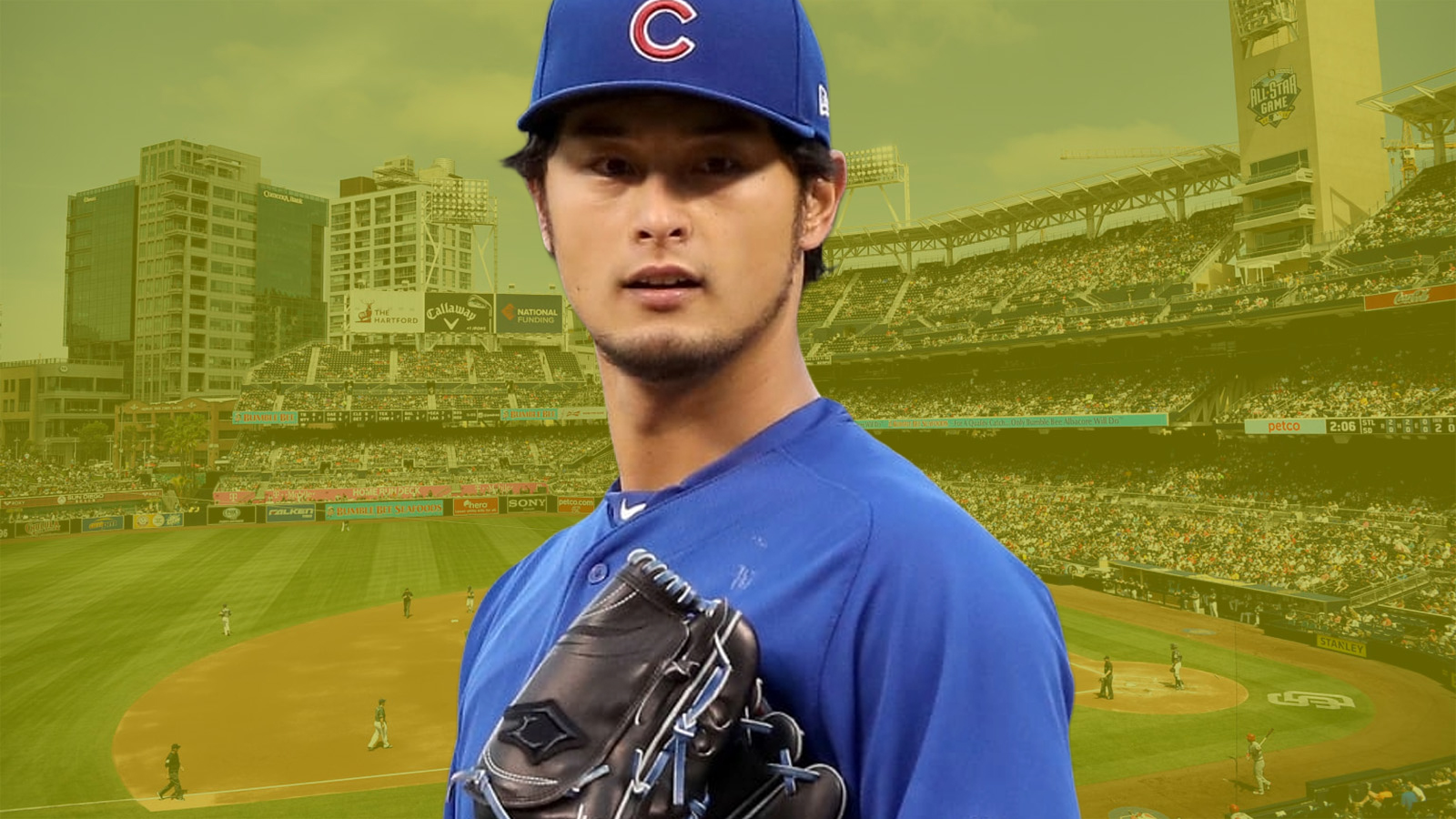
With the 2025-26 MLB offseason in full swing, now is a good time to revisit trades that occurred half a decade ago. This is a series we’ve done in past years. This feature will focus on the Padres’ acquisition of Yu Darvish from the Chicago Cubs.
Five years ago, the Cubs came off a disappointing end to their 2020 season. Chicago won the NL Central that season by three games, besting the Cardinals and Reds in the shortened year. However, the Cubs — on the verge of a significant teardown — began moving out pieces that winter, as Yu Darvish was the first piece to go. Darvish was shipped out five years ago on December 29, as part of a seven-player deal.
Darvish with the Cubs
Darvish’s tenure with the Cubs lasted three seasons. The right-hander signed with the Cubs in February 2018 on a six-year deal, at the time the largest contract handed out that winter. The veteran pitcher had a strong overall track record, as he struck out 200+ batters in three of his first five campaigns.
And, he filled a hole in the rotation. Former Cy Young Award winner Jake Arrieta went to free agency that winter and would eventually sign with the Phillies a month later. With Darvish, the Cubs were able to roll out a strong top-four on paper, as he joined a rotation that also included Jon Lester, Kyle Hendricks, and Jose Quintana.
However, Darvish came into the winter on a sour note. The ex-Dodger, who came over from Texas earlier in 2017, gave up nine hits and eight earned runs against the Astros over 3.1 IP during the World Series.
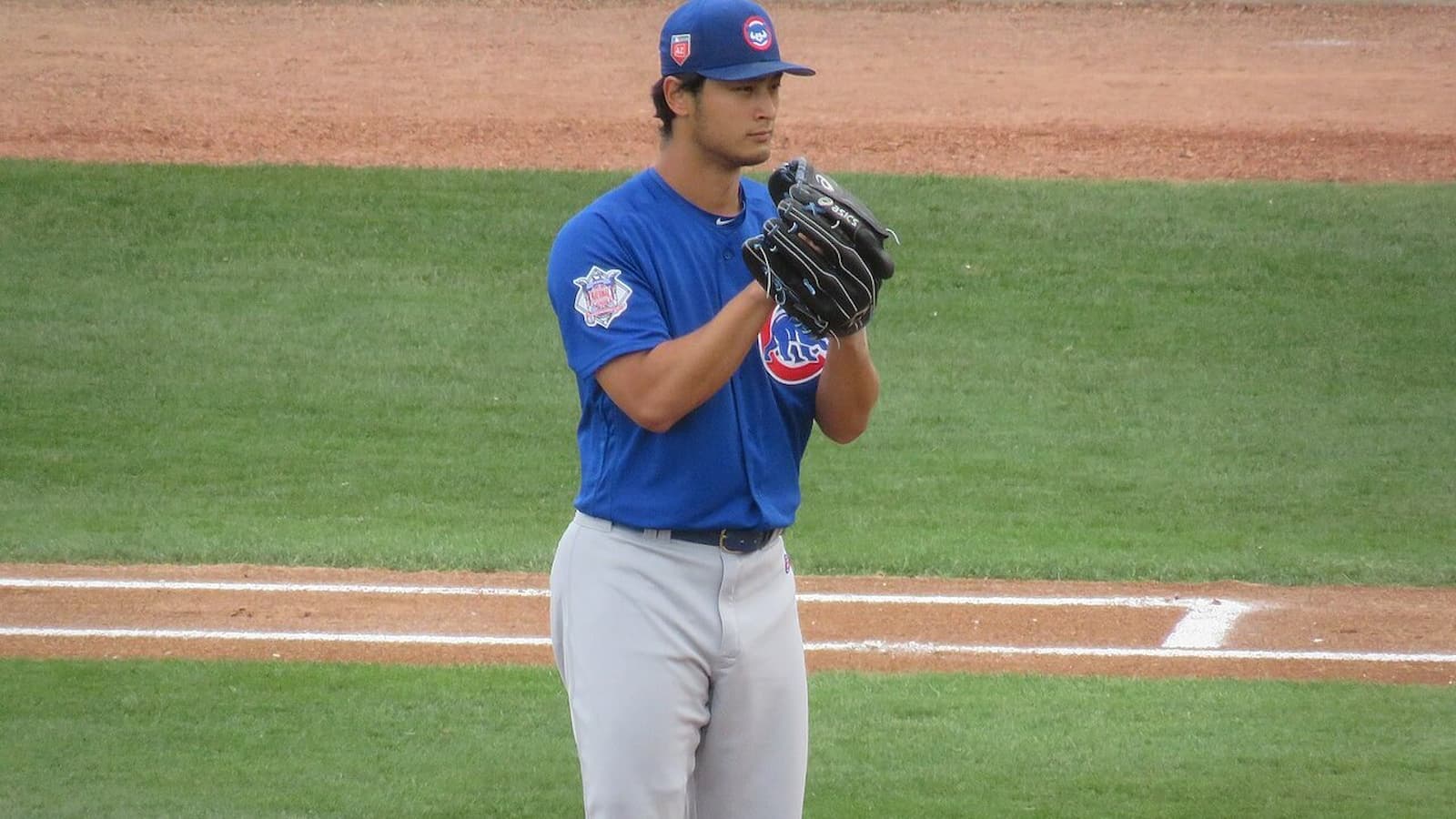 Darvish from 2018 Spring Training. Image via Wikimedia Commons (Bryan Green)
Darvish only made eight starts in 2018, as an illness and triceps trouble kept him off the mound for much of the year. He returned to form in 2019, as he struck out 229 — good for a top-10 finish in the NL — in 2019. Then, in the 2020 season, Darvish had a fantastic run in the shortened campaign. Darvish struck out 93 over 76 innings, posted a stellar 2.01 ERA, and pitched well in the postseason that October against the Marlins.
The shortened season did wonders for Darvish. His velocity ticked up, as he averaged close to 96 MPH off his four-seam and limited walks. Walks weren’t as much of a problem for Darvish in 2019 but they were in 2018, as he conceded 21 over 40 innings.
Darvish entered the 2020-21 offseason with significant term left on his deal. However, the Cubs were in a tight spot. Heading into 2021, most of the Cubs’ core were going to be free agents after that season. Javier Baez, Anthony Rizzo, and Kris Bryant were among those on expiring deals. But in December 2020, Darvish was the first to go.
The Padres on the upswing
San Diego made the expanded playoffs in 2020, marking the first time in over a decade that the Padres became postseason-bound. It marked the first real success under AJ Preller, who was very aggressive when it came to adding pieces to his roster.
Things began to come together in 2019. The Padres signed Manny Machado to a 10-year deal worth $300MM in February 2019, a move that gave a young team a franchise pillar to work with.
Machado wasn’t the first marquee signing, though, for this specific iteration of the Padres. The year before, San Diego signed former World Series champion Eric Hosmer in free agency. And in 2019, the team’s foundation further fell in place when Fernando Tatis Jr. came up to San Diego. Tatis Jr. hit .317/.379/.590 with 22 home runs as a rookie.
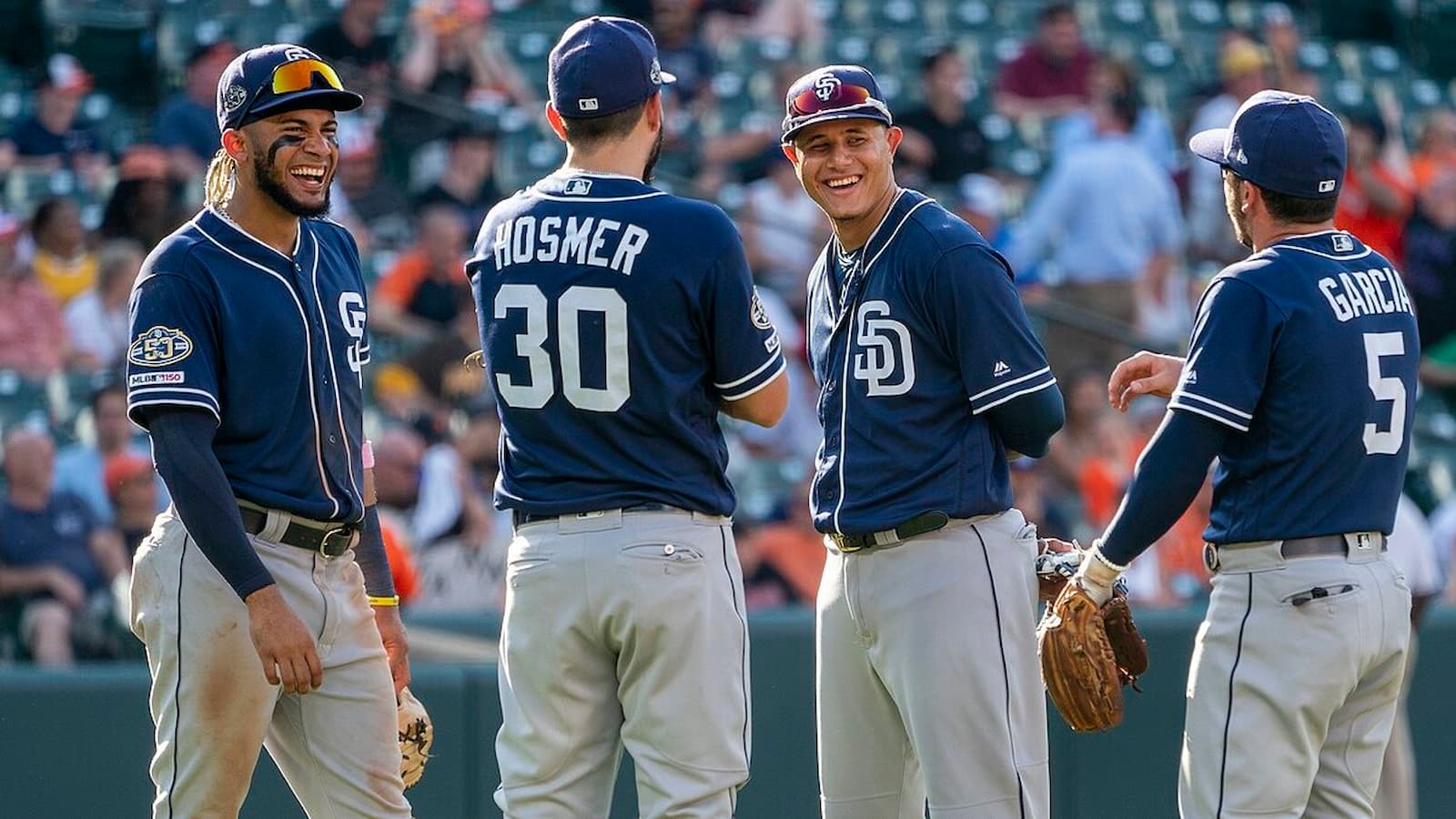 Image via Wikimedia Commons (Keith Allison)
With Tatis Jr. and Machado entrenched, the Padres went big-game hunting in 2020. San Diego acquired Trent Grisham, a standout rookie the year before with Milwaukee, and picked up Tommy Pham and a versatile infield prospect, Jake Cronenworth, for Hunter Renfroe and then-prospect Xavier Edwards.
Pham didn’t hit well in 2020 — but Cronenworth did. Cronenworth had 22 extra-base hits and a .831 OPS over 54 games, which earned him a second-place finish in the 2020 NL Rookie of the Year race.
The Padres’ lineup was highly productive that year. Tatis Jr. and Machado combined for 33 regular-season home runs. Wil Myers hit 15 home runs, Hosmer (.851 OPS) produced, and San Diego also received good returns from Jurickson Profar. The rotation, though, was an area of concern.
It wasn’t as much of a problem in the 60-game season. Zach Davies and Dinelson Lamet were both standouts. Lamet, in particular, had a breakthrough year, as he struck out 93 over 69 innings and finished fourth in the NL Cy Young vote. Mike Clevinger, acquired in the summer of 2020 in a massive deal that sent Josh Naylor, Cal Quantrill, Gabriel Arias, and Joey Cantillo to Cleveland, helped deepen the rotation.
But for an upcoming 162-game season in 2021, the Padres wanted more reliable starting pitching. San Diego went out and added several high-end arms that offseason, starting with Darvish.
How it worked out for the Padres
It’s been an interesting tenure for Darvish as a Padre.
Darvish was an NL All-Star in his first season with San Diego. He pitched exceptionally well in the first half, as he struck out 125 over 105 innings before the break. Things were good for the most part at that point. San Diego got reliable starting pitching from the righty, and the Padres were in a playoff spot as of mid-July. At the break, San Diego was 53-40 and in a Wild Card spot.
However, things began to spiral downward for Darvish. He got caught with the long ball, as Darvish conceded 15 home runs over 61.1 IP in the second half. It was an injury-riddled second half, as Darvish was dealing with back tightness and a hip impingement, the latter of which ended his year.
The 2022 season was a complete season for Darvish and arguably his best as a Padre. Darvish won 16 games and struck out 197 over 194.2 IP, along with a clean 4.8% BB% that ranked as one of the best of his career. Darvish pitched well in October that year, as he struck oit 23 and threw a career-high 25 playoff innings.
San Diego rewarded Darvish handsomely a few months later. The Padres gave him an extension in 2023 that signed him through the 2028 campaign, what will be his age-41 season. At the time, Darvish was still pitching at a healthy clip. His fastball had life, and not to mention, he remained a heavy slider/splitter pitcher, keeping hitters away from his velocity.
Injuries, though, have been a major problem for Darvish over the past few seasons.
Darvish remained healthy in 2023. But in 2024, neck tightness and a groin strain, the latter of which kept him out for three months, limited him to 81.2 IP. The following year, Darvish posted a 5.38 ERA and had multiple bouts with elbow problems.
He required UCL brace surgery in November 2025 and will miss all of 2026.
What the Cubs got
The Cubs received five players for Darvish and Victor Caratini, the former Chicago catcher, packaged in the deal. Those players were outfield prospect Ismael Mena, infield prospects Reginald Preciado and Yeison Santana, 2020 draft pick Owen Caissie, and pitcher Zach Davies.
We’ll start with the prospects. Santana was released by the Cubs in 2023 after low offensive output in A-ball. Mena met the same fate in 2025.
Preciado hit very well in the ACL during his first season with the organization, as he slashed .333/.383/.511 with 16 extra-base hits as an 18-year-old. However, he stalled in A-ball and posted a .594 OPS in High-A this past year.
As for Caissie, he was arguably the best prospect involved in this trade at the time. A second-round pick out of Ontario, Caissie never played a game in the Padres’ system. However, he was the lone prospect to make it to the Majors.
Caissie made his MLB debut in 2025 after developing into a good power hitter in the Cubs’ system. Granted, Caissie had his flaws; namely, he’s a big swing-and-miss hitter. Nonetheless, that comes with the territory, in some cases, for power hitters.
The lone Major Leaguer who went to Chicago was Zach Davies. Davies, acquired with Grisham from Milwaukee in 2019, made a living off being a heavy sinker/changeup pitcher. While he never threw hard, capping out at the low-90s, his ability to change speeds and induce ground balls was valuable.
Unfortunately for the Cubs, Davies wasn’t a success in Chicago. He wasn’t able to get hitters to chase at the levels he could with Milwaukee and San Diego. He posted a 5.78 ERA in his lone season with the Cubs.
He spent 2022 and 2023 with the Diamondbacks after leaving the Cubs as a free agent. Davies last pitched in affiliated baseball in 2024.
Conclusion
Was this trade a success for the Padres? It depends on what your definition of success.
From a pure asset management standpoint, it was a major success. San Diego traded in Davies and four prospects — none of whom have broken through as regulars yet — to upgrade their rotation. While Darvish dealt with numerous injuries, he did give the Padres the chance to compete in playoff baseball. A key reason why he was acquired in the first place.
No, Darvish hasn’t won a championship with San Diego. That doesn’t mean it was a bad trade.
As for the Cubs, Caisse is still very much an unknown at the MLB level. He’s only had 12 games to this point in the Majors. Still, the potential is there for him to be an everyday player.
Check out more of our MLB coverage.
Like this:
Like Loading…