
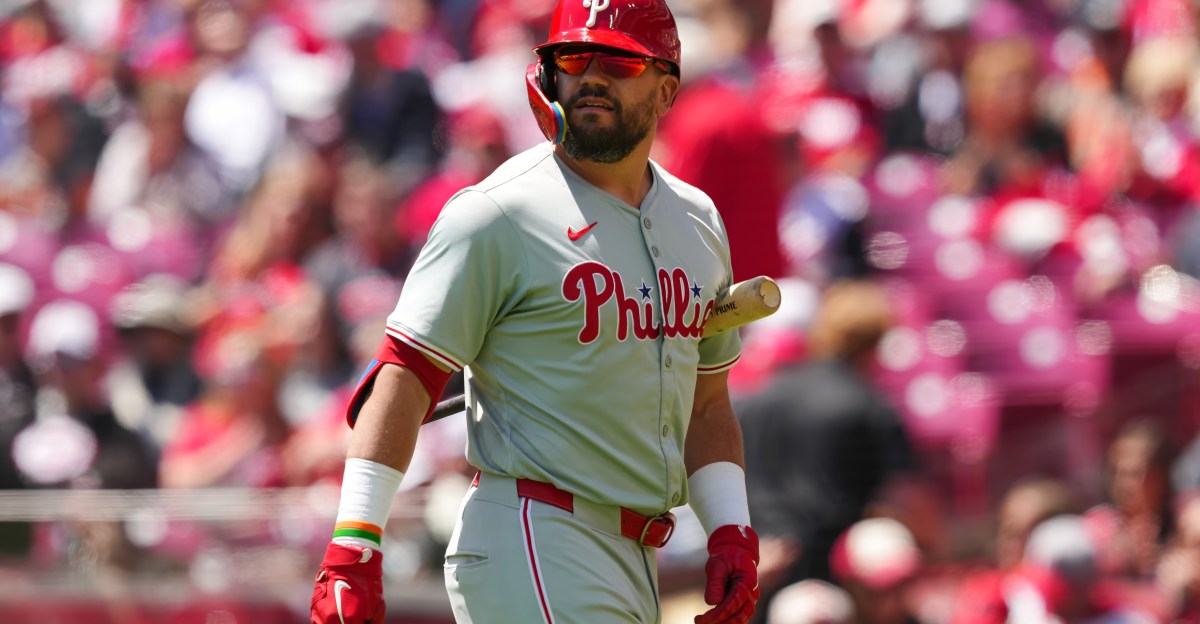
On the back of a 2025 season that saw him hit 56 homers, lead all Major League Baseball with 132 RBI, post a career-best 4.7 bWAR, and walk over 100 times, Kyle Schwarber entered free agency this winter as one of the prizes of the class. By all accounts, his patience at the plate and irreplicable power will make him one of the most sought after pieces all winter, with pretty much every single team out there capable of looking at their roster and saying yeah, we can find a place for him somewhere.
He’s probably just a DH at this point. He’s potentially a 1B here and there, and a left fielder if you have nobody else in the dugout to play left field. He’ll also be 33 years old in March. Still, his exploits have him poised to potentially land a nine-figure contract, something akin to a ~$30 million AAV, or even both.
None of that second paragraph puts him in any ballpark for an offer by the Cincinnati Reds, at least not the Cincinnati Reds we’ve come to know as frugal over the last two decades. They’ve extended some of their own stars (reluctantly), but never once gone over $64 million for a player in free agency – and the scars of that free agent class still ripple through their decision making process today. Still, Schwaber’s a Middletown, Ohio native, and that’s got more draw than zero for him, and with the Reds a clear fit on-paper (budget issues aside), the two continue to get mentioned as potential partners despite the Philadelphia Phillies – Kyle’s home since 2022 – the likely favorites to retain his services.
Spotrac suggests Kyle has almost exactly a $25 million per-year market value over a future 4-year deal, while MLB Trade Rumors suggested a 5-year, $135 million deal ($27 million AAV) in their offseason free agent predictions. If we split the difference and go with a 4-year deal at $27 million per ($108 million overall), here’s what the Reds would have to do to a) fit him in and b) still find enough room elsewhere to rebuild an entire bullpen after the winter departures of almost all of it to free agency.
Current Payroll Obligations
With the departures of Santiago Espinal and Ian Gibaut before the non-tender deadline, the Reds saved an estimated $4.5 million from their large arbitration-eligible pool of payroll for 2026. That dips down to roughly $47 million per the tallying I did back in early October based on the MLBTR arbitration estimates.
Pair that with existing contractual obligations paying Jeimer Candelario’s dead money, Ke’Bryan Hayes’ salary, Hunter Greene’s salary, and Jose Trevino’s – the three current Reds under multi-year deals – and that’s another $36.78 million.
That’s some 15 players of the would-be 26-man active roster constituting some $84 million. Adding 11 players to that mix at the league minimum of $780,000 would tack on an additional $8.58 million, putting Cincinnati’s in-house options for a roster next year at something a bit over $92.5 million.
Per Cot’s Contracts, the Reds had an Opening Day payroll just shy of $112 million last year, and their year-end payroll (after their trade deadline additions) came in a bit over $118 million. With comments from Nick Krall suggesting payroll will be just about the same in 2026 as in 2025, it’s clear that an addition of Kyle Schwarber at $27 million would eat up the entirety of that wiggle room – and more.
The Reds need a Schwarber, or something as close to him as possible. Despite playing their home games in the cozy confines of GABP, they ranked just 24th overall in ISO (and that was with Austin Hays and Miguel Andujar, who are both now free agents), and their 80 homers hit in away games was the 5th lowest of any team in the game.
The Reds also need an entire bullpen overhaul, too. Emilio Pagan, their closer, is a free agent, as is free agent Nick Martinez (whose 165.1 IP ranked third on the team). Scott Barlow and his 75 appearances are gone, too, as is fireman lefty Brent Suter. Zack Littell, who helped them to the finish line after his acquisition at the trade deadline, is also out as he, too, reached free agency. Wade Miley? Gone. Ian Gibaut? Gone, too.
So, the Reds either need to commit to an entire youth movement (read: cheap) while replacing over 460 IP off last year’s roster, or they’re going to have to find some innings-eaters out there on the market to backfill that void. Those, you’ll recall, cost money.
Finding Space in the Payroll
Brady Singer currently projects to be the team’s highest-paid player in 2026, with MLBTR suggesting he’ll command a final arbitration salary of some $11.9 million before reaching free agency at season’s end. Considering the Reds haven’t yet extended him and that he’s unlikely to be a guy they’d be willing to roll the dice of a Qualifying Offer on at season’s end, he seems a guy who, in theory, they’d try to cash-in on this winter for a more controllable piece. That said, he led the team in IP last year (169.2) and I’m all of one paragraph removed from emphasizing just how much the Reds need to find innings-eaters with such a young, unproven pitching staff around him.
Elsewhere on the roster, it’s worth looking at exactly who Kyle would ultimately render redundant if signed. That’s firmly Gavin Lux and, to an extent, Spencer Steer. Lux is a mostly positionless DH-only at this point (unless worst-case scenario), and he hits left-handed. Steer, meanwhile, was primarily a 1B last year but has Sal Stewart over his shoulder as a younger, cheaper option, and now faces either time in LF (where he’s subpar defensively) or at DH. Finding a taker for Lux ($5 million estimate) or Steer ($4.5 million) would free up redundancy on the roster while also freeing up substantial payroll, though moving Lux would be more salary dump while moving Steer may be a way to bring back some much needed young, cheap pitching depth.
If – and it’s a big if – the Reds could find a way to move Singer and Lux and bring in a young, MLB ready arm for either starting or bullpen innings, that’s a way to shave of nearly $16 million of salary obligations. In theory, that would be enough room for a Schwarber salary, though they’d have to get creative on the cheap with other bullpen arms much in the same way they did when they signed Barlow, Suter, Buck Farmer a few years ago, etc. Still, that wouldn’t leave an obvious amount for a ‘qualified’ closing option, something that seems a bit vital given this team’s intentions on contending in 2026.
There is nothing in Big Business that cannot be redefined by creative accounting. Buyouts, deferrals, etc. have dominated the sports landscape since contracts began getting exponentially bigger, and you’ll recall that Ken Griffey, Jr. just finally came off the Reds payroll last year. Last year!
The Reds have been forced to eat contracts of decent size over the last handful of seasons. Their co-record free agent signee, Mike Moustakas, is one obvious one, while the disastrous Shogo Akiyama experiment is another. The abject failure of Jeimer Candelario’s deal with the Reds came to a swift end early in the 2025 season, you’ll fondly recall, and the Reds are still on the hook for the $13 million owed him for 2026 and the $3 million buyout of his 2027 team option.
I’ve included that into the above calculations for their ‘actual’ payroll. What I don’t know, though, is exactly what Krall meant when he told MLB.com’s Mark Sheldon in early November that ‘our 2026 payroll will be around the same as our payroll from 2025.’
If they’ve got a sunk cost line on their ledger, the Candelario deal isn’t part of that. If they have written that off into the realm of some established rainy day fund, well, there’s suddenly a lot more available coin that we’ve otherwise been moved to consider. Is what were the money owed to Moustakas and Akiyama went when they were cut? What ‘pool’ are those funds dedicated to relative to actual, active roster payroll? This is a team that doesn’t even flirt with luxury tax levels of payroll – so it’s not something we’ve ever microanalyzed – but it’s hard to ignore that the Reds may categorize certain obligations for 2026 in ways more defined than I’ve given them credit for here.
And in the best case scenario, having moved Jeimer into sunk cost territory won’t penalize them on the same bottom line as the actual 40-man and active roster payroll amounts Krall has been given to work with.