
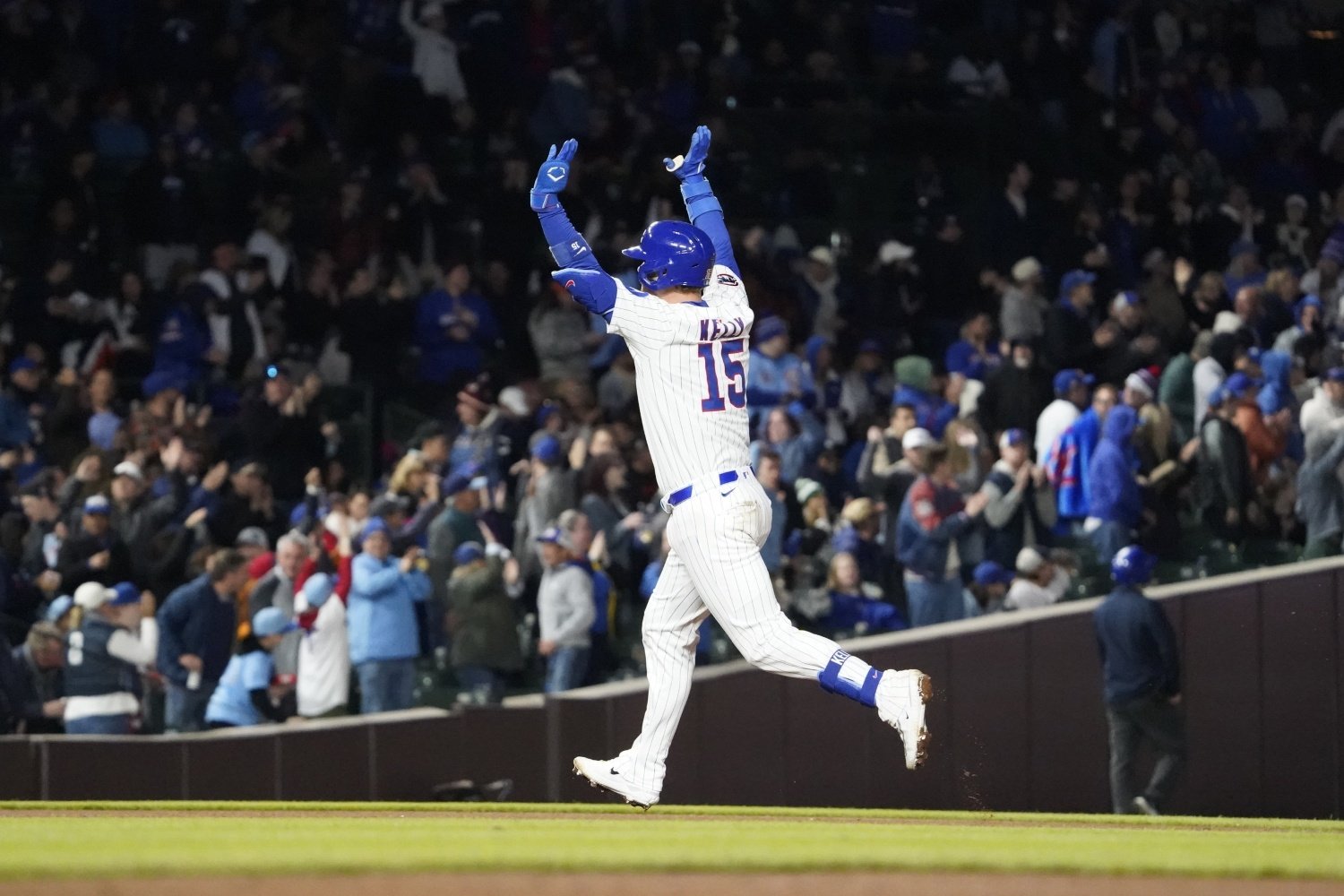
Carguel Kellaya.
Apologies for the Harry Caray-esque name combination, but it seemed the most efficient way to capture the shared brilliance of Miguel Amaya and Carson Kelly. Those two have been, while not as significant as the Pete Crow-Armstrong breakout, one of the most significant carrying factors in the early season for Chicago.
To grasp their impact, rewind to 2024. Cubs primary catchers last year (Amaya, Christian Bethancourt, Yan Gomes, Tomás Nido) totaled only 1.5 WAR, and Gomes and Nido were so bad they combined for -1.3. They had a .214 batting average, with 57 runs scored, 34 RBIs, and 14 home runs.
That group’s wRC+ (a holistic measure of offense in wbich 100 is average and higher is better) paints an even bleaker picture. The four backstops averaged approximately 53. This means they were 47% worse than average. Gomes was particularly damaging; he had an untenable 16 wRC+ in what looks likely to be his last gasp of big-league oxygen. The catching position in 2024 was an absolute black hole, a dead spot that was more damaging than any position group the Cubs fielded in 2024.
Nowm let’s fast forward to 2025, where the Cubs have essentially reincarnated Gabby Hartnett.
Of course, they are splitting the playing time, and the counting stats won’t look as impressive as one might think. Combine their production, though, and here are the full-season paces when you combine Amaya and Kelly. These are incredible numbers for the catching position.
Runs: 116
Home Runs: 40
RBIs: 159 (put them together, and they’re leading the league in ribbies, despite Amaya having a possible addition to the ledger thwarted Wednesday afternoon)
.288 batting average
8.9 WAR
157 wRC+
This displays the discrepancy these numbers have, compared to their production at the position in 2024:
Stat
2025 Cubs
2024 Cubs
Runs
116
57
Home Runs
40
14
RBI
159
34
Batting Average
.288
.214
WAR
8.9
1.5
wRC+
157
53
This inspired a deep rabbit-hole dive of historical seasons from catchers who matched this level of offense. There have been some outstanding seasons, of course. If Kelly and Amaya can continue this, the Cubs’ aggregate production would be at the level of these two:
1970 Johnny Bench: 97 R, 45 HR, 148 RBI, .293 AVG
1953 Roy Campanella: 125 RBIs, 41 HR, .312 AVG, 103 R
Both of these Hall of Fame catchers won MVP awards in these seasons. The comparison isn’t quite fair, since we’re putting a composite of two players totaling 100% of the playing time up against two guys who had backup backstops and took some days off throughout the season, but it makes a fair point, right? This is elite catcher offense.
Of course, it’s not likely that they continue doing this. According to the fantasy baseball website Razzball, Kelly has already slowed down (.227/.320/.348 in the past 30 days), which was to be expected. Amaya is picking up the slack (.997 OPS in past 30 days), though, and his swing change success has carried over from August of 2024.
But none of that matters, big picture. The Cubs have already received more production in late May than they received all last season at the position. Even with the expected regression to the mean, the catchers for 2025 are offensive assets, not holes in the lineup to patch over. This position has been instrumental to the current first-place iteration of the Cubs.
Once a major weakness, the position has become one of the most significant reasons the Cubs sit atop the NL Central.