

Aided by LTN, the migration lowered costs, increased control and flexibility
Mid-Atlantic Sports Network (MASN) broadcasts Baltimore Orioles and Washington Nationals games to fans across a seven-state region. Alongside its core baseball coverage spanning every ballpark in the U.S., MASN produces a 24/7 lineup of sports content, including pre/postgame shows, documentaries, college sports, and live events year-round.
As satellite delivery costs and limitations grew, MASN explored full migration to IP delivery — following the likes of TelevisaUnivision, MSG Networks, and Tennis Channel, all of which announced IP transitions supported by media-tech company LTN Global in the past two years. The network successfully transitioned all its channels from satellite to IP ahead of the 2025 MLB season, lowering distribution costs by nearly 60% while giving MASN greater control, flexibility, and visibility over its transmission feeds.
Finding the Right Moment for Satellite–IP Transition
For many regional sports networks, satellite has long been the default method for distributing live content. It offers wide coverage and reliability but comes with challenges around operational costs, visibility into signal quality, and growing uncertainty around long-term C-band–spectrum availability, with further auctions mandated by the FCC within two years.

“Switching to IP is a big change but one that has made day-to-day operations much simpler and more effective.”
MASN faced the same pressures. The broadcaster needed to modernize its distribution while keeping its existing partners and viewers connected. Key requirements included reducing delivery and maintenance costs, preserving satellite-grade reliability, and gaining deeper insight into network performance — all while serving traditional MVPDs and streaming platforms while maintaining uninterrupted coverage throughout the transition.
“Satellite has always been dependable, but it’s expensive, and we needed a more affordable way to serve audiences across cable, digital, and direct-to-consumer,” says Ken Stiver, SVP, engineering, operations, and production, MASN. “We wanted a future-proof approach that matched the reliability of satellite and gave us more control, without the extra costs or complexity. But we couldn’t afford a minute of downtime.”
Migration Matters
Building on an existing relationship and experience, MASN teamed up with LTN to manage its transition from satellite to IP. The migration process took just 60 days, including a dual-illumination phase when satellite and IP ran in parallel to guarantee zero disruption.
LTN worked closely with MASN’s engineering teams and affiliates to plan, test, and implement the new delivery workflow. This included hands-on project management, onsite configuration, and direct coordination with MVPD headends to ensure that all endpoints were ready to receive IP feeds before the switch.

LTN’s Bryan McGuirk: “Our goal was to give them a model with predictable costs, greater operational control, and complete confidence in their video performance.”
“We wanted the transition to be as smooth, straightforward, and uneventful as possible,” adds Stiver. “They managed the logistics with our affiliates, handled testing, and ensured everything worked before the cutover. We now have full visibility into all our feeds: if someone calls me with an issue, I know exactly where to look and who to call if it needs fixing. We never had this with satellite.”
MASN now distributes four variants of its two full-time channels, MASN 1 and MASN 2, via LTN’s purpose-built IP video network. The setup enables MASN to insert localized advertising and tailor content for its two core markets: Baltimore and Washington, DC.
“MASN wanted to move quickly but carefully,” says Bryan McGuirk, chief revenue officer, LTN. “Our goal was to give them a model with predictable costs, greater operational control, and complete confidence in their video performance while maintaining the exceptional quality fans expect.”
Purpose-Built Foundations for Growth
With many broadcasters still weighing their options amid uncertainty over spectrum repackaging, MASN is comfortable with a proven, future-ready model in place.
“Switching to IP has given us more control and peace of mind,” says Stiver. “We can track signal health in real time and work much more efficiently with our partners. It’s a big change but one that has made day-to-day operations much simpler and more effective.”
McGuirk adds, “MASN’s migration shows how quickly sports networks can move to IP once they take the leap. Fully managed, SLA-backed IP distribution is now the most cost-efficient, reliable way to distribute multiple channels to diverse platforms with maximum advertising revenue.”
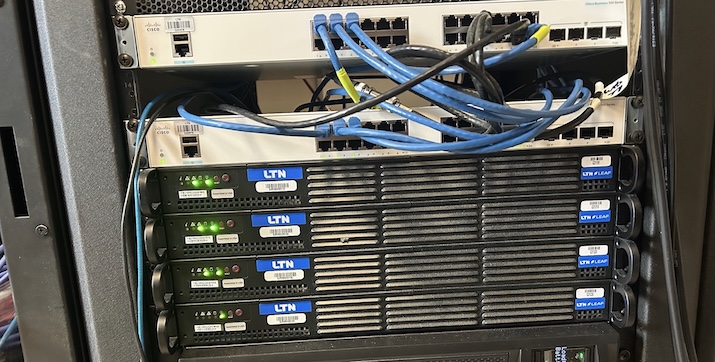
LTN equipment installed at the MASN facility
Beyond distributing its main channels, MASN also works with LTN for event–based IP transport, including the MLB Spring Training series and other live productions. LTN’s low-latency IP transmission allows MASN to centralize production at its control facility while pulling live camera feeds from venues across the country.
For Stiver, it’s now all eyes on 2026. “It has been a solid first year with LTN, and making the switch before our regular season was a no-brainer. We’re looking forward to starting the 2026 calendar and bringing all the action to our fans with a better distribution foundation in place. Game on.”