
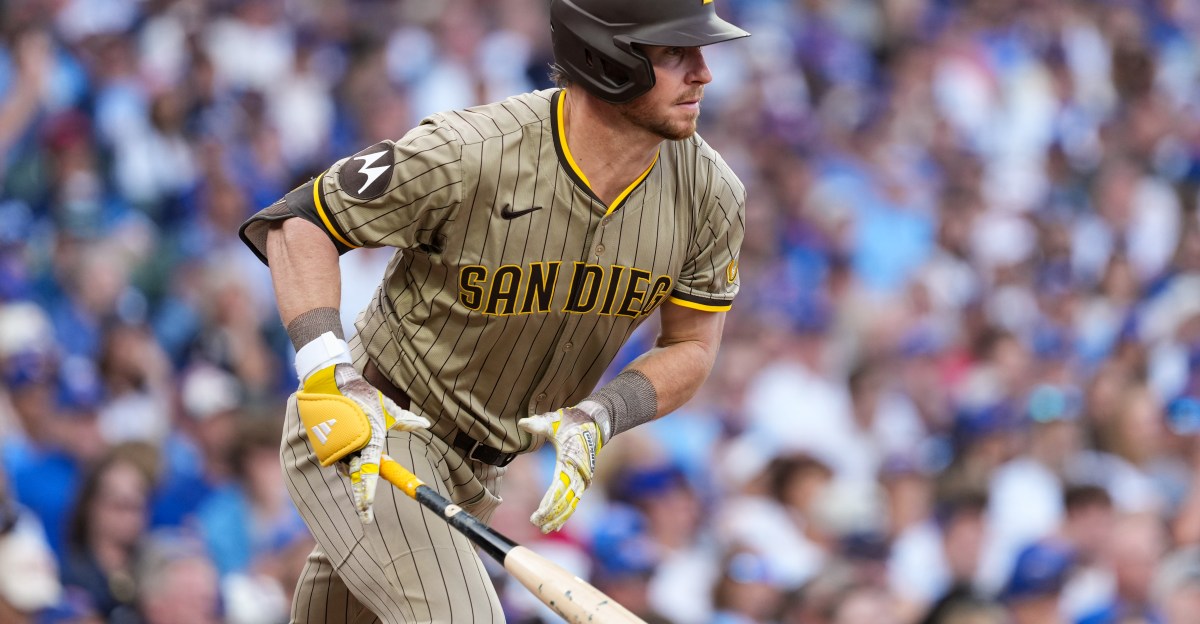
On his last night as an Oriole, about ten players pulled up chairs around Ryan O’Hearn’s locker at Camden Yards. They all knew what was coming: the trade deadline was hours away, and their teammate was about to be dealt. So they sat, talked shop, and said their goodbyes to a player who’d become a leader in the clubhouse. It was a fitting sendoff for the onetime Kansas City castoff who’d resurrected his career in Baltimore, becoming not just an All-Star but a clubhouse pillar.
Now, as the Orioles head into the winter with two right-handed hitters penciled in at first base/DH in Ryan Mountcastle and Coby Mayo, neither of too-reliable output, a proven left-hitting first baseman who can consistently hit right-handed pitching wouldn’t be such a bad thing.
And with Ryan O’Hearn hitting free agency this winter after his best offensive season yet—a .281/.366/.437 slash line with 17 home runs and 63 RBIs between Baltimore and San Diego—the Orioles should strongly consider bringing “Brohearn” back home.
The Orioles’ first base/DH situation heading into 2026 is complicated. The front office, somewhat surprisingly, tendered a contract to Mountcastle despite his injury-plagued 2025 season (a .250 BA/.653 OPS in just 89 games). Mayo showed improvement in the second half after O’Hearn’s trade, but he’s still striking out at gaudy rates and hit just .199 against right-handed pitching. Also in the mix is Samuel Basallo, the 20-year-old lefty slugger who is taking turns at catcher, first base, and DH after signing a shocking (well, for this team, which doesn’t often do long-term extensions) eight-year, $67 million deal in August.
O’Hearn has several positives to his name here. He hits righties well—to the tune of .294/.384/.490 this season, production that ranked among the best in baseball—which would make him a good complement to Mountcastle or Mayo.
His peripheral data is good (and has been ever since he signed with Baltimore, which famously revamped his offensive approach). Last season, O’Hearn put the ball in play with authority, ranking in the top 15% of all hitters in sweet-spot contact off the bat. Compared to his swing-happy days in Kansas City, his approach at the plate is much better, too. As an Oriole, O’Hearn cut his strikeout rates in half (from 28% in 2021 with KC to 14% in 2024), and doubled his walk rate (from 5.1% in 2021 to 10.7% in 2025).
O’Hearn would also bring consistency and experience to a position where the O’s are somewhat lacking in it. That’s something the 20-year-old Basallo, however promising, can’t guarantee. In fact, the Orioles roster as a whole is looking pretty short on veteran presence ever since Cedric Mullins, Anthony Santander, and O’Hearn himself were shipped off and pitchers like Kyle Gibson and Charlie Morton hung up their cleats.
And signing O’Hearn doesn’t block anyone’s development. Mayo can continue getting at-bats against left-handed pitching while learning from a veteran who’s been through the grind. If the Orioles decide to trade Mountcastle (as many expect), O’Hearn provides the immediate stability the roster needs. And if Basallo’s bat forces him into more playing time, having O’Hearn’s flexible defensive profile (he’s not a great outfielder, but he can play the corners) helps maximize lineup options.
Finally, there’s something to be said for organizational familiarity. O’Hearn has spoken openly about how the Orioles believed in him when no one else did, how getting everyday at-bats for the first time in his career allowed him to refine his approach, and how comfortable he became in the organization. That goes beyond his on-field performance. When he was traded, interim manager Tony Mansolino didn’t mince words about what the team was losing. “[W]e loved the man. He helped this team get into the playoffs and was a leader in the clubhouse, a guy so loved and well-liked among the Americans, the Latins, the old guys, the young guys.” Cedric Mullins called O’Hearn “a big voice in the clubhouse” and added, “Yeah, he’s going to be missed, 100 percent.”
OK, that’s the statistical and sentimental case for O’Hearn. But we know that this front office isn’t particularly sentimental. The financial case for O’Hearn is that, despite his All-Star performance in 2025, it looks like the 32-year-old slugger isn’t likely to command a massive contract, with projections suggesting he’ll land somewhere in the two-to-three-year range at around $12 million annually.
That’s a reasonable sum for a player who provides quality at-bats, plus-plus discipline, and the versatility to play first base, DH, and corner outfield positions. And compared to Ryan Mountcastle, who’s projected to earn $7.8 million in arbitration but missed significant time with injuries, the difference isn’t that great—and O’Hearn has actually proven he can produce at an elite level in this exact role.
Ryan O’Hearn’s story is one of baseball’s most satisfying redemption arcs. After years of struggling to stick with Kansas City, he was traded to Baltimore for cash considerations, designated for assignment within days, and had to work his way back through Triple-A Norfolk. Instead of fading away, he became one of the American League’s toughest outs. That story deserves to continue in Baltimore. The fit is obvious, the price is reasonable, and the track record speaks for itself. Bring back Brohearn!