
The Arizona Fall League wrapped up play recently, with Royals prospects helping to power the Surprise Saguaros to another AFL Championship. This was the third title in the past four years for the Saguaros, as well as their sixth consecutive championship appearance. Though success has waxed and waned in that span for the Kansas City Royals, some of their prospects have had the chance to experience winning in the desert. In the process, they got additional reps against high-caliber minor leaguers — generally 21–25-year-olds on the cusp of the 40-man roster.
This year, Statcast technology was present at all six AFL stadiums for the first time. This means that player performance data is more complete than ever. While it remains a small sample, it is a meaningfully more robust sample thanks to this implementation. That said, this data is oddly difficult to locate. If you can find it on Baseball Savant, the home of everything else Statcast, then you are better at navigating the site than I. The Jim Callis article linked above does not provide a link to the data that it continually references. Last year, this meant I had to trawl through MLB’s Gamefeed and tabulate everything manually. I thankfully need not repeat this task as the good folks over at Prospect Savant have already done it. We’ll stick with hitters today as I think I will still need to do some legwork to get pitch-level data for the hurlers.
A few resources for reference: this link provides context for Statcast metrics (ie. what is league average?), while this link explains sample sizes and how many plate appearances are needed for metrics to “stabilize.”

GLENDALE, AZ – NOVEMBER 02: Blake Mitchell #8 of the Surprise Saguaros runs to third base during the game between the Surprise Saguaros and the Glendale Desert Dogs at Camelback Ranch – Glendale on Sunday, November 2, 2025 in Glendale, Arizona. (Photo by Norm Hall/MLB Photos via Getty Images) Photo by Norm Hall/MLB Photos via Getty Images
The 2025 campaign was a frustrating one for Mitchell. He suffered a broken hamate during Spring Training, returned for four games in early May, then went back on the shelf with lingering soreness. He returned on June 23 and played in 56 games the rest of the way. Hitters often struggle upon returning from hamate injuries and that seemed to be the case for Mitchell. Drawing walks was just about all he did effectively at the plate as he whiffed a ton and didn’t hit for power. He slashed .218/.390/.320, which is remarkably similar to his 2024 minor league performance, minus about 100 points of SLG. Having taken just 255 plate appearances in 2025, it made perfect sense for the Royals to send him down to Arizona for some reps. His production improved somewhat, though still took the shape of his regular season — lots of walks, lots of strikeouts, and a frustrating lack of game power — as he slashed .230/.434/.311 in 83 plate appearances.
Mitchell clearly has plus raw power; he hit a ball over the fence at 116.5 mph, a max exit velo that would have been tied for 17th-highest in MLB this year. So why hasn’t this power been actualized in games? “He must be striking out too much,” you say. You are partially correct. After punching out 31.8% of the time over the minor league season, he struck out in 26.2% of his 83 AFL plate appearances. That’s high, but not necessarily alarming — Cal Raleigh, Kyle Schwarber, and Byron Buxton all struck out at a higher rate in the majors this year. His 17.4% chase rate is in Juan Soto territory of patience, and his 79.6% contact rate on pitches in the zone is the same mark posted by Aaron Judge this season.
The biggest problem was not poor swing decisions or a lack of contact. It was Mitchell simply not making quality contact on a consistent basis. His 39.5% hard-hit rate is below the big league average. The guys with swing-and-miss that I linked above are posting hard-hit rates north of 50%. Take Soto’s plate discipline and Judge’s contact skills, combine them with Alek Thomas’s batted ball quality, and you get Mitchell’s AFL batting line. Don’t get me wrong, his contact rates are still a problem. After all, he’s posting these numbers against minor leaguers. A 30%+ K-rate before reaching Double-A is reason for concern, but the poor batted ball quality is perhaps more alarming.
I am willing to chalk up the power outage to Mitchell’s continued recovery from his early-season hamate injury. This had better be the case, as his offensive profile is not viable with the lack of power he showed in 2025. His patience allows him to keep his head above water in the lower minors, but that won’t work as he moves up the system. Although his contact rates were better in Arizona, they were still below average and remain an area of concern moving forward.
Fortunately for the Royals and Mitchell, they can afford to be patient with him. He just turned 21 in August, and prep catchers tend to be developmental slow-burners, especially when they have Mitchell’s offensive profile. The Royals have a very similar player already on their big league roster that plays a similar game and will still have rookie status in 2026. There is no reason whatsoever for the team to rush him through the minors. Considering he hasn’t played above High-A, it’s a bit of a wonder that Michell was sent to Arizona in the first place. He almost certainly would not have if he had played 105 minor league games this year.

GLENDALE, AZ – NOVEMBER 02: Carson Roccaforte #1 of the Glendale Desert Dogs bats during the game between the Surprise Saguaros and the Glendale Desert Dogs at Camelback Ranch – Glendale on Sunday, November 2, 2025 in Glendale, Arizona. (Photo by Norm Hall/MLB Photos via Getty Images) Photo by Norm Hall/MLB Photos via Getty Images
After an underwhelming first full pro season in 2024, Roccaforte improved tremendously this season in his second look at High-A, hitting .237/.364/.466. He was promoted to Double-A in late July and batted .290/.387/.475 the rest of the way. He also showed off his speed on the bases, swiping 43 bags across both levels. This continued into the fall, where Roccaforte got action at all three outfield spots for the Saguaros. In 84 plate appearances, he batted .279/.393/.485 while also stealing seven bases in nine attempts.
How did Roccaforte produce so well in the fall? His .425 BABIP would explain much of it as his metrics are nothing special. His hard-hit rate was just 41.5%, which was below the big league average in 2025. He paired that with a 20-degree average launch angle, which would have been one of the higher rates in the majors. Just on those two metrics, he’s a dead ringer for Pete Crow-Armstrong. Of course, Crow-Armstrong barreled the ball almost twice as often as Roccaforte did, and is a significantly better defender to boot.
You don’t have to look too deep to find a flaw in Roccaforte’s AFL performance: he struck out in a third of his plate appearances. His 41.7% whiff rate would have been the highest in MLB this season. What’s even more remarkable about this is that his contact rate on pitches in the zone was 85.0%. That’s a bit under the big league average, but not bad! This means that when Roccaforte chased, which he didn’t do often, he basically never made contact. Of course, his scarcely chasing appears less the result of plus plate discipline and more a product of extreme passivity. He swung at only 33.0% of pitches and 51.7% of pitches in the strike zone. Both marks would have been the lowest in the majors this season. “I bet you can’t throw me three strikes before you throw me four balls” is a valid approach in the lower minors, but that won’t play at higher levels. This was borne out in the minors this season as well, where he struck out 29.4% of the time while walking at a 14.9% clip.
Roccaforte looks like a tweener outfielder — not enough glove to play center and not enough bat to man a corner spot. 2026 will be a pivotal year for him. A year from now, he will be Rule 5 eligible, and the Royals will need to make an important decision on his future in the organization. His defense improving enough to play a credible center field seems unlikely, so offensive improvement will be necessary to demonstrate that he should be included in the team’s future plans.

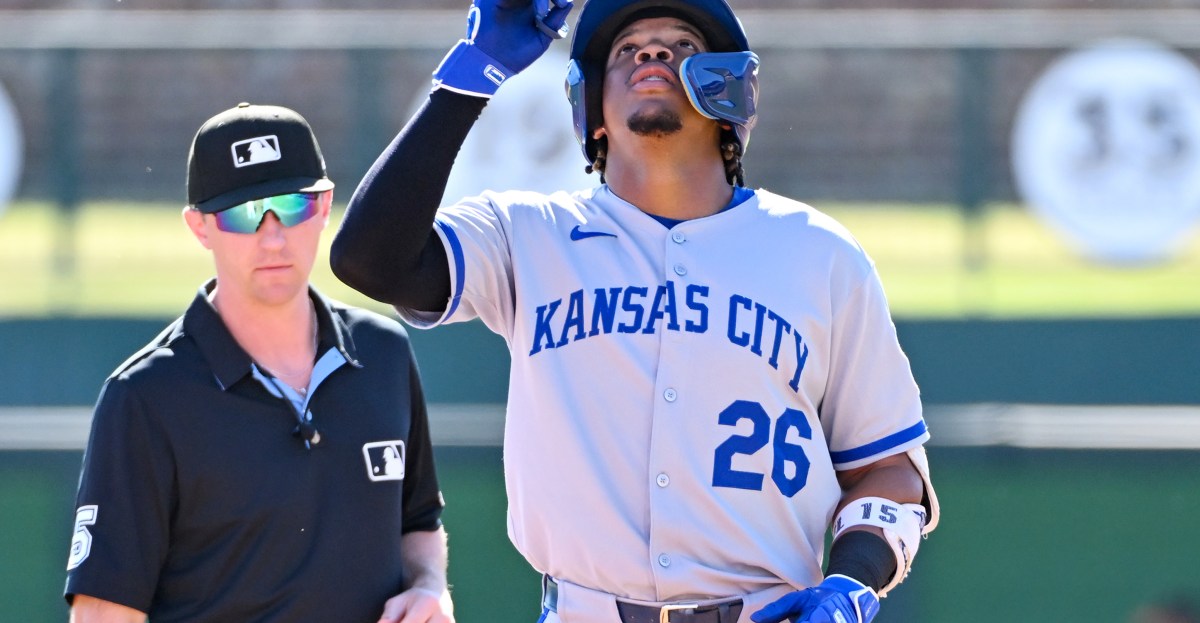
SURPRISE, AZ – NOVEMBER 05: Daniel Vazquez #26 of the Surprise Saguaros looks on during the game between the Scottsdale Scorpions and the Surprise Saguaros at Surprise Stadium on Wednesday, November 5, 2025 in Surprise, Arizona. (Photo by Norm Hall/MLB Photos via Getty Images) Photo by Norm Hall/MLB Photos via Getty Images
Vazquez spent his fifth pro season almost entirely in High-A, hitting around league average with a .260/.333/.351 batting line before a brief stint in Double-A to end the season. For a second straight year, he headed to Arizona after the conclusion of the minor league season. In his second crack at the AFL, Vazquez put together the best extended offensive stretch of his pro career as he hit .329/.459/.468 in 98 plate appearances. He clearly earned the trust of Saguaros manager Jesus Azuaje as he led the team in plate appearances while playing a ton of shortstop, with a bit of third base thrown in for good measure.
Like Roccaforte, Vazquez benefited from an inflated BABIP, clocking in at .421. Vazquez’s is more believable however, as he absolutely torched the ball, hitting it hard 57.9% of the time. Too much of that contact was into the ground, with his average launch angle below zero degrees, but clearly enough of those hard groundballs found holes. He maxed out at 109.7 mph, which isn’t elite by any means but is mighty impressive for a smaller guy with six career minor league homers. None of Mookie Betts, Kyle Tucker, or Kerry Carpenter managed an exit velo that high this season.
In addition to crushing the baseball, Vazquez walked in 19.2% of his plate appearances. How exactly he managed this is unclear. His 44.0% swing rate was low, though not abnormally so. His 29.8% chase rate was better than average, but hardly elite. He’s consistently posted double-digit walk rates in the minors, so clearly he has a decent idea of the strike zone, but his near-20% clip from the fall is likely a small-sample aberration. Vazquez also whiffed on 29.0% of his swings. While not as disastrous as the previous two players, that’s still a concerningly high rate, especially for a guy who produces as little in-game power as Vazquez.
So far, Vazquez’s minor league career has tracked similarly to Maikel Garcia’s, with both infielders moving up to High-A at age 21 and Double-A shortly thereafter. The comparisons end there, though, as Garcia was considerably better on both sides of the ball. Vazquez hasn’t consistently hit for average or power in his minor league career and is closer to average than plus as a shortstop defender. He was Rule 5 eligible this offseason and, unsurprisingly, went unselected. Vazquez will likely start next season at Double-A, looking to prove that he can hack it in the upper levels.