
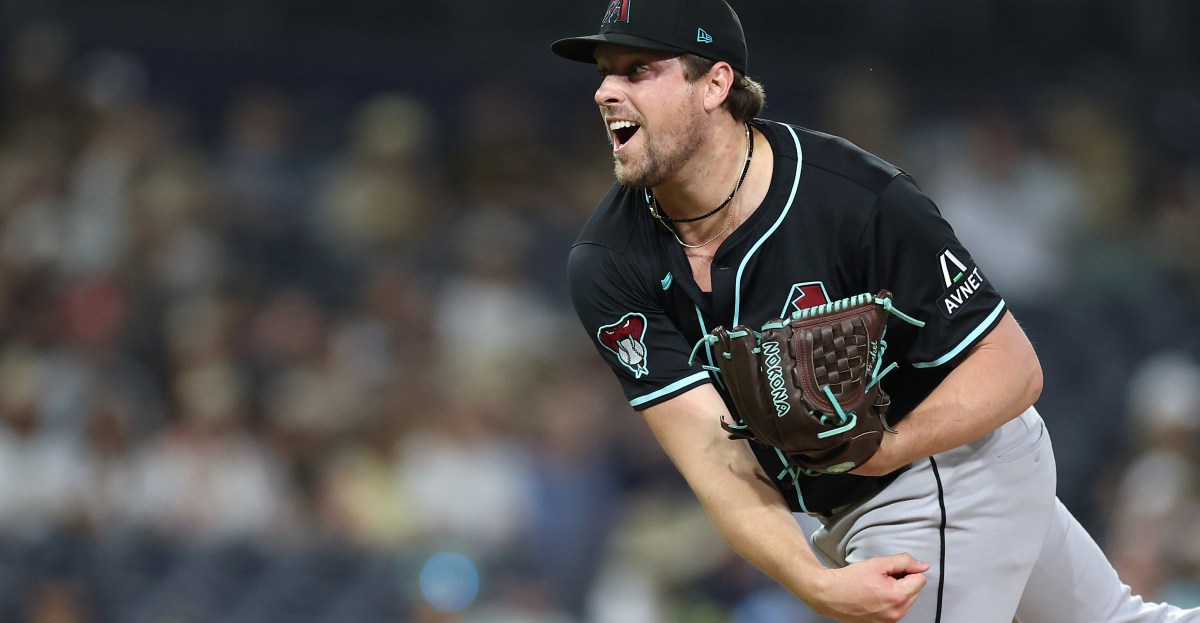
Rating: 4.482025 stats: 29 G, 25.2 IP, 7.36 ERA, 3.64 FIP, -0.8 bWARDate of birth: March 24, 1994 (age 31 season)2025 earnings: $2,425,0002026 status: Final year of arbitration
It’s surprising to realize how long Kevin Ginkel has been with Arizona. This was his seventh season as a Diamondback: he’ll tie the franchise record as a pitcher next year, joining Randy Johnson and Andrew Chafin on eight. Ginkel took a few years to establish himself: his ERA across his first three seasons was only 94+. But over the past couple of years, he was one of the league’s most reliable relief arms, both in terms of performance and availability. Among those with 125+ innings in 2023-24 – itself a testament to his stamina – his 2.86 ERA put Ginkel in the top fifteen MLB relievers. At age 31, there was no real reason to expect anything less from him in 2025.
So, what the heck happened? That -0.8 bWAR put him in the top fifteen worst relievers in the National League this year, as he struggled both with health and effectiveness. There had perhaps been indications at the tail end of 2024, as he struggled down the stretch: he had an 8.00 ERA in September. But he still came into spring training as one of the candidates to close for Arizona, manager Torey Lovullo naming him alongside Justin Martinez and A.J. Puk. Kevin performed in line with that, allowing one run over six Cactus League innings, and an impressive K:BB ratio of 8:1.
But on the same day the team announced Jordan Montgomery’s Tommy John, Lovullo revealed Ginkel would need to start the season on the Injured List due to right shoulder inflammation. The hope at the time was that he’d only need to miss the minimum 15 days, but Kevin ended up missing more than a month. He came back for the final game of April, but allowed an earned run in three of his first five appearances. That was just an appetizer for one of the all-time dismal performances by a D-backs reliever, on May 9th. He came in to protect a three-run lead in the ninth at Chase against the Dodgers, and…
After Ginkel was lifted, Ryan Thompson allowed a three-run homer to Shohei Ohtani. That left Kevin taking the loss while allowing five earned runs and recording one out. That was something which had been achieved only once before by an Arizona reliever (David Hernandez on June 7, 2011). Worse was to follow: because Ginkel did exactly the same thing, just eighteen days later. This time there was even less excuse, because it was against the woeful Pirates. Through his first thirteen appearances, he had amassed a 12.60 ERA, which resulted in a swift bus ticket to Reno for Kevin, with some very specific notes.
Lovullo said. “I just felt like from my seat and the things I saw that he lacked the finish and the consistency of his pitches. He’s got a great two-seam fastball, great four-seam fastball, yet he was turning away from that and going to the secondary stuff.” GM Mike Hazen concurred: “Some of the stuff we talked about was really around fastball command with the two-seamer and the four-seamer. He is throwing a lot of sliders, and his slider’s a weapon, but setting that up probably a little bit better mostly with the fastball plays very well, I think that’s probably the biggest thing.”
The stay wasn’t long, and though the results weren’t great (five walks in 2.2 innings), Ginkel was called up when Martinez suffered his season-ending injury. It looked like more of the same, as Kevin allowed multiple runs in each of his first two appearances, somehow increasing his ERA to an even uglier figure of 13.50. However, it then appeared as if something clicked. He made fourteen appearances the rest of the way, with a 1.98 ERA, and a FIP which was actually a little better (1.89). Ginkel even picked up a couple of saves, including closing out the epic 1-0 win in eleven innings over Pittsburgh on July 25 (albeit with a huge assist from Lourdes Gurriel).
But that pesky shoulder reared its ugly… um, arm again in early August. A sprain returned Kevin to the 15-day IL on August 4, and just two days later, his season was officially done, when the team moved him to the 60-day IL. I do wonder whether his shoulder was an issue throughout the season, particularly in the early going. If you look at his fastball velocity this year, it was clearly down compared to previous seasons, as shown below. Last year, his fastball averaged 96.0 mph, while this year it was only 94.9 mph. There were some indications it improved a little later on, though still did not have the same zip.

There is also evidence Ginkel was unlucky. His BABIP was a monstrous .360, despite a line-drive rate well below MLB average this season (18% vs 24%). As a result his fielding independent ERA (FIP) for the year was less than half his actual ERA (3.64 vs. 7.36). Over five hundred pitchers threw 25+ innings in the majors during 2025. Not one man had a bigger gap between the two metrics than Ginkel’s 3.72 runs. Though his FIP was close to a run higher than the figures from 2023 and 2024, mostly due to a sharp uptick in his walks. In 2024, Kevin allowed fifteen bases on balls in 70 IP; this year, he walked almost as many (13), while throwing only 25.2 innings.
It’s the peripherals which I think led the team to tender Ginkel a contract for 2026. If he had “genuinely” been a 7+ ERA pitcher, I think they’d have let him walk. But Kevin would seem to be a good bounce-back candidate, especially if he shows up to spring training with a fully-healed shoulder, and his velocity back to what he showed in 2023-24. I’d also like him to throw more strikes, and get the walks down to previous levels. Steamer currently has him projected for a 3.81 ERA, and with an arbitration estimate for Ginkel of $3 million, you would likely have to pay more on the open market for a pitcher of that caliber.
However, there are causes for concern. Despite the high ERA, Ginkel was actually good at keeping the ball in the park, with only two home-runs allowed in those 25.2 innings. The resulting HR/FB rate of 6.5% was barely half the MLB average of 11.9%, and may well regress. xFIP is a variety of FIP which presumes a league average HR/FB rate, and is a better predictor of future numbers than FIP. xFIP was 4.49 for Ginkel in 2025. Although still significantly better than his actual ERA, it’s getting into more marginal territory for a reliever, which is reason for optimism to be somewhat guarded.
All told, I think Kevin will be better than this year, but I’m not sure he should be considered as a potential solution for high-leverage situations. It’s going to be a process, starting in spring with him proving his health, velocity and control are no longer concerns. I suspect he’ll be working around the seventh inning initially, and his performances there will determine whether he moves up or down the bullpen ladder.