
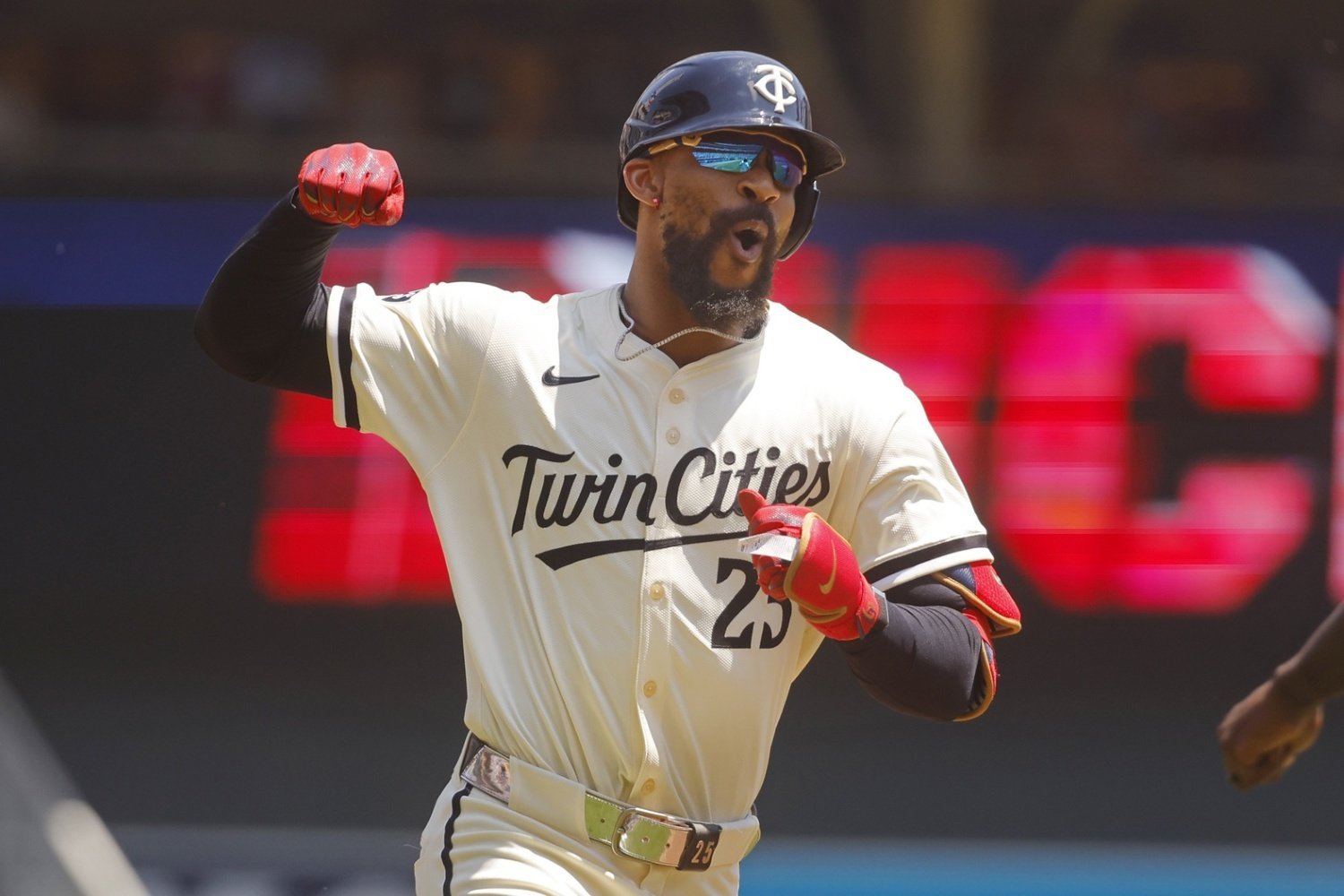
Byron Buxton has repeatedly stated that he would stay in the Twin Cities for the rest of his career. Now, the veteran star appears increasingly open to the idea of waiving his no-trade clause. That shift has quietly pushed the door open for teams like the New York Mets, who have been circling for months and believe they are one impact defender away from transforming their offseason.
Let’s take a deeper look into why the Buxton trade conversation has resurfaced, why the Mets remain heavy suitors, and which young players could catch the Twins’ interest if talks gain traction.
Why a Buxton Trade Is Back on the Table
If the Twins had kept their veteran core intact at last summer’s trade deadline, this conversation might feel far-fetched. Instead, the front office pivoted toward selling, after injuries and inconsistency dragged Minnesota out of the AL Central race. Buxton stayed put then, but the logic behind that decision appears to be changing.
Buxton has three years and just $45 million remaining on his extension, making him one of the league’s best dollar-for-dollar values following a 2025 season in which he launched 35 home runs; posted an .878 OPS; and delivered nearly five wins above replacement. That production, combined with a playable center field glove, is precisely the kind of asset that rebuilding teams often cash in while they still can.
Reports from ESPN and The Athletic indicate Buxton is willing to approve a move under the right circumstances. The Braves and Mets reached out about Buxton at the deadline, but he held firm to his desire to stay in Minnesota. If the Twins want to maximize value before age and injury concerns resurface, a winter move might be the moment.
Why the Mets Are Locked In on a Center Field Upgrade
David Stearns, the Mets’ president of baseball operations, has made it clear that New York intends to improve its run prevention and athleticism. To be fair, the Twins’ front office has said similar things about Minnesota’s roster over the last year. Earlier this winter, New York traded Brandon Nimmo to Texas for Marcus Semien, signaling a shift toward better infield defense and more stability up the middle. That maneuver, though, created a glaring opening in the outfield.
Juan Soto is penciled into right field, but center field remains unsettled. The Mets retained Tyrone Taylor as a depth option and are giving top prospect Carson Benge the chance to compete for a roster spot in spring training. They are also hovering around the high end of the free-agent market, where names like Kyle Tucker and Cody Bellinger linger. Neither of those players are center field options, though.
Buxton is a different category of target. He is significantly cheaper than the star free agents and offers a reliable defensive fit, even if his power output fluctuates. If Benge proves ready sooner than expected, Buxton could shift to left field and immediately improve the outfield defense. If Benge needs more seasoning, Buxton becomes the everyday anchor in center. For a team aiming to contend with the Braves and Phillies, this flexibility matters.
The Mets’ window is open. Stearns has the prospect capital. The logic lines up.
Mets Top Prospects Who Could Interest the Twins
For a player of Buxton’s caliber, the Twins should expect multiple premium talents in return. The Mets have precisely the type of system that can support such a deal.
Nolan McLean, RHP (No. 1 in the system, No. 11 in MLB)
McLean is still prospect-eligible, but he’s a big-leaguer and could step into the Twins’ rotation if they trade from their veteran starting pitcher depth. Last season, he posted a 2.45 ERA with a 1.13 WHIP and 27.2 K% at Double A and Triple A. He was even better during his big-league debut, with a 2.06 ERA and 30.3 K% in eight starts. McLean would be tough to wrestle away, even for Buxton.
Carson Benge, OF (No. 2 in the system, No. 21 in MLB)
This is another tough piece to pry loose. Benge is likely to debut in 2026 and could slot into New York’s outfield for years. Last season, as a 22-year-old, he moved through the three highest levels in the Mets’ farm system. In 116 games, he hit .281/.385/.472, with a 150 wRC+. If Minnesota insists on a potential Buxton replacement, they will start the conversation here.
Jett Williams, IF (No. 3 in the system, No. 30 in MLB)
Williams has on-base skills and defensive versatility that fit Minnesota’s development patterns perfectly. He might be the most realistic centerpiece, if New York wants to keep Benge and McLean. Last season, he hit .261/.363/.465, with a 136 wRC+ in 130 games, although that included some struggles upon a promotion to Triple-A Syracuse. He was drafted as a middle infielder but has also played some center. Like Benge, he would be a plausible Buxton replacement.
Jonah Tong, RHP (No. 4 in the system, No. 46 in MLB)
Tong won MiLB’s Pitching Prospect of the Year Award in 2025 and profiles as a rotation stabilizer with upside. At the two highest levels of the minors, he posted a 1.43 ERA (best among full-season qualifiers) and led the minors with 179 strikeouts in 113 2/3 innings. His 40.5% strikeout rate, 29.9 K-BB%, .148 opponents’ batting average, 1.68 FIP, and 2.16 xFIP were all tops among minor leaguers with at least 100 innings pitched. His brief struggles in the big leagues at age 22 might make the front office hesitate, but this is precisely the type of right arm the Twins covet.
Brandon Sproat, RHP (No. 5 in the system)
Sproat is a power righty who could help the Twins as soon as 2026. He pitched the bulk of his innings at Triple A last season and compiled a 4.24 ERA, with a 1.24 WHIP and a 22.1% strikeout rate. Adding him as part of a larger package would firm up Minnesota’s pitching depth.
Jacob Reimer, 3B/1B (No. 6 in the system)
One of the best third base prospects in baseball, Reimer would give Minnesota a long-term solution behind Royce Lewis or a high-ceiling bat if injuries or roster decisions shift the infield picture. He split time between High A and Double A last season, with a 157 wRC+, 21.5% strikeout rate, and 11.1% walk rate. Reimer is a right-handed power bat, something the Twins have lacked in recent seasons.
A realistic Twins ask could be a package built around Williams or Reimer, paired with a pitching prospect like Tong or Sproat. If the Mets are determined to push past other NL East competitors, this is the price they will finally agree to pay.
A Buxton trade is not imminent, but the conditions feel more aligned than ever. The Twins need young, controllable talent with a chance to make a big difference. The Mets need a steadying force in center field. Buxton is increasingly open to a new chapter. The two clubs have danced around this possibility for months. This winter might be the time they finally finish the song.
Which prospects would make an ideal Buxton package? Would the Mets overpay for Buxton? Leave a comment and start the discussion.