
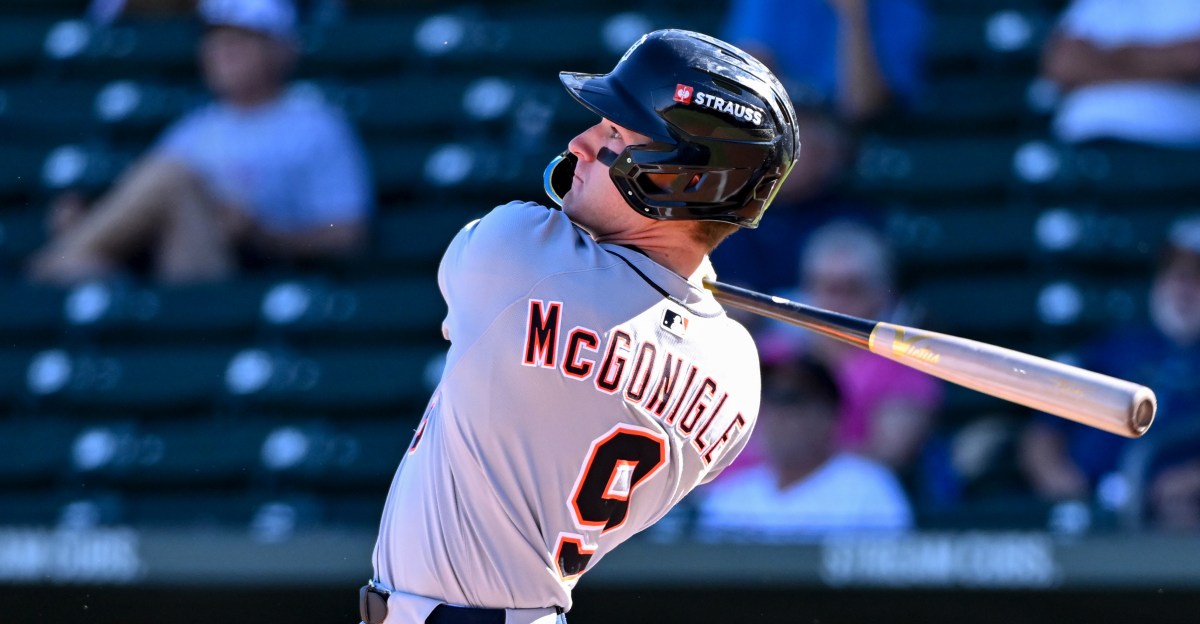
Baseball America updated its list of the Top 10 prospects in the Detroit Tigers farm system, and it’s the usual candidates at the top. The Double-A trio of Max Clark, Kevin McGonigle and Josue Briceño have been the talk of minor league baseball, and they all have a future in the bigs.
Detroit’s other first-rounders over the past few years — shortstops Bryce Rainer and Jordan Yost — are also in the top 5. Second basemen Max Anderson and Hao-Yu Lee are just behind them. Baseball America values a few high-risk prospects more than others, making the bottom of this list interesting. Leaving out guys like Jaden Hamm and particularly catcher Thayron Liranzo is a bit head-scratching.
Still, one thing is apparent: Detroit has plenty of offense in its farm after years of being pitcher-heavy. Here’s my take on the top 10, along with Baseball America’s future value grades and risk-adjusted grades. Find their complete coverage here with a subscription that is well worth the money year in and year out.
If you don’t know Kevin McGonigle by now, you probably aren’t too into the whole prospect scene. One of the best pure hitters in the 2023 draft fell to the Tigers in the supplemental first round, and he’s swiftly moved to the No. 1 or 2 spots in every prospect ranking in the country.
When he was drafted, I checked in with the family of someone who played with him on Team USA, and they told me that they’d never seen a contact tool like that. This person also played with Roman Anthony, and it sounded like overhyping a friend. It wasn’t.
He’s hit over .300 in each of his three seasons in the minors and won the Arizona Fall League MVP this year. Over 183 games, he’s slashing .308/.410/.512 (.922 OPS) with 25 home runs and 130 runs batted in. He’s also walked 123 times to 84 strikeouts. This is a real 70-grade hit tool, and he should find his way to Detroit at some point next year. He may not hold at shortstop, although he’s been better than any expected when drafted. He played some third base in the fall, but is most likely to land at second base in the big leagues.
What BA said: “McGonigle is already a savvier hitter than many big leaguers. Velocity? He doesn’t blink at seeing top-tier fastballs, as he demonstrated with a monstrous home run on a 100 mph Jarlin Susana heater. Spin? He handled breaking balls with aplomb. Plate coverage? He has no clear holes with his swing. Expand the zone? He has the rare ability to be aggressive on pitches in the strike zone while rarely swinging at bad pitches. Platoon issues? He had a higher OPS against lefties. McGonigle could sometimes be fooled by changeups, but even that is a blemish more than a glaring flaw. He is a perfect example of how having a short but powerful frame can be an advantage for a hitter.”
“He should be the best homegrown Tigers hitter in decades.”
Scouting Grades: Hit: 70 | Power: 55 | Run: 55 | Field: 55 | Arm: 45
Max Clark was one of the most-hyped high school prospects in recent memory coming into the 2023 draft, and fans were still upset the Tigers drafted him third overall instead of Wyatt Langford out of the University of Florida. Contact, power against righties and speed are his best tools, but it’s his drive to be great that will make him special.
Clark is what 2020s baseball is all about. He embraces analytics, he already established a connection with fans on social media and still shows up to work at the ballpark day-in and day-out the way your grandpappy likes — well, not Frye Daddy…
I have a soft spot for Clark. I got to record his first Single-A homer and saw him stay mentally grounded during a rough patch — he crashed into the wall making a play and struggled at the plate for most of the week I was in town.
The big chains around his neck, long blonde hair and infectious personality are always going to draw some weird detractors, and yet he’s still a consensus top-10 prospect in the game. McGonigle might be the more polished hitter right now, but Clark’s ceiling feels higher. Position-wise, he’s more valuable. A true centerfielder with speed to make up for any bad reads, Clark plays defense aggressively and sometimes with reckless abandon.
Detroit would like him and McGonigle to be linked forever. They might spend some time apart if Clark needs a few extra months against Triple-A pitching, but they should both be staples of the Tigers offense for the better part of the next decade.
What BA said: “Clark’s skill set at the plate shares a lot of similarities with McGonigle, but with some rougher edges. He’s a wonderfully pesky hitter who uses the whole field with a slashing swing that leads to plenty of hard line drives to left and center field. He rarely swings and misses, and he seldom chases pitches. Clark doesn’t handle velocity as well as McGonigle, and while he battles lefties, his power largely disappears against them. His exit velocities are among the best in the Tigers’ system, but they often are scorched grounders.”
“He has to be dragged out of the batting cage and he has worked to pack as much muscle as his frame can hold. Clark’s plate discipline, swing decisions and well-rounded game should fit in Detroit at some point in 2026—and for many years to come”
Scouting Grades: Hit: 60 | Power: 50 | Run: 65 | Field: 60 | Arm: 60.
Considered the best high school shortstop in the 2024 draft not named Konnor Griffin, Bryce Rainer has the potential to be Detroit’s starting shortstop for years to come. He’s got the size and arm McGonigle doesn’t, and it feels like every ball he hits comes off the bat over 100 mph.
The problem is that Rainer missed most of his first full season in the minors. He got hit in the head early in the year, keeping him out for a bit, and then he dislocated his shoulder sliding back into first base a few weeks later. Rainer was a pitching prospect, too, but the bat plays too well to keep him on the mound.
In 35 games last season, Rainer had an .831 OPS and 134 wRC+. He’ll need to keep it up over a full season, but there’s no reason to doubt that he’ll be one of the better prospects in the game over the next few years. The fact that he’s only No. 3 on this list says more about the Tigers bright future than it does about him as a player. For most of his time in Lakeland before the shoulder injury, Rainer was just hammering fastballs at pretty eye-popping exit velocities for a teenage shortstop prospect. Developing against secondary stuff will be the task over the next few years but he could move very quickly.
What BA said: “His 90th percentile exit velocity of 108 mph was best among Tigers minor leaguers and ranked among the best for a teenager in pro ball. Rainer’s swing is best when he’s driving the ball to the opposite field or center, and he’ll need to develop his pull power … He showed solid plate awareness. As a shortstop, Rainer wasn’t as rangy … but his arm stands out. …He can sling the ball from multiple arm angles, but he is more comfortable throwing on the run than when he sets his feet.”
Scouting Grades: Hit: 55 | Power: 55 | Run: 55 | Field: 55 | Arm: 70.
Josue Briceño joined the Tigers as part of the 2022 international class. It took him a while to put it all together, but he was the breakout player of last year’s Arizona Fall League. Briceño not only won MVP of the AFL, he delivered the first Triple Crown in the league’s history. He’s been mashing ever since.
Looking at his career stats does a disservice to his ability. He spent most of the 2021 season as a 17-year-old in the Dominican Republic, and still had a .670 OPS over 44 games. That number jumped to .931 over 55 games in the Complex League in 2022, but a knee injury slowed him down in 2024 (.758 OPS, 40 games).
After the breakout fall, Briceño demolished High-A pitching, posting a 1.024 OPS and 15 HR in 55 games. His OPS dropped below .720 in Double-A, but that level takes some adjustment.
While he’s probably destined to be a designated hitter, the Erie SeaWolves played him at catcher over Thayron Liranzo — who dropped out of the BA Top 10 after a down year — for every game of the playoffs. Speeding up the bat will help him handle plus heaters better, and he could be a 30-plus homer a year guy once that happens.
What BA said: “Briceño is a smart and savvy slugger with big power, but he’s also a hitter with several limitations. He has a lengthy swing and average bat speed, and generates his power through leverage, strength and excellent trunk rotation. He can be beaten by quality velocity, but he also punishes breaking and offspeed pitches. He has excellent pitch recognition and strike-zone awareness. …If Briceño’s bat is as good as expected, he can be a middle-of-the-lineup force, but if his bat is just a grade less than expected, he could end up being an up-and-down Triple-A slugger.”
Scouting Grades: Hit: 45 | Power: 65 | Run: 30 | Field: 50 | Arm: 55.
Jordan Yost was somewhat of a surprise pick in the most recent draft cycle. Already on campus with his brother at the University of Florida, Yost shot up draft boards, and Detroit spent a first-round pick on him.
Having seen both play in high school and covering Jordan’s brother, Hayden, with the Gators, I never considered him a first-rounder. But it makes more and more sense the more I stew on it. Hayden picked up the power at the end of his freshman year of college, and the two have similar long, lanky frames. If Jordan bulks up the same way over the next few years, his arm will be fine at shortstop, and he could move Rainer over to third.
The contact tool is there, and with some growth, he can become a base-hit machine. His speed will help turn grounders into singles, and hopefully, there are more line drives in his future. On defense, he’s twitchy in a good way and has a strong baseball IQ.
With no pro-ball data, it’s hard to project his future right now. We’ll have a close eye on him in Single-A next year.
What BA said: “Yost is an athletic shortstop with a clean swing that generates plenty of contact. That’s a great starting point for a potential future regular, but for Yost will have to keep getting stronger to reach that ceiling. He’s always been slight. …He’s still skinny, but at 175 pounds, he’s adding enough muscle to provide hope that he can go from being someone with bottom-of-the-scale power to being a line-drive hitter who hits plenty of doubles. …He has an above-average arm with a quick first step and the “baseball rat” makeup that teams love to see at shortstop.”
Scouting Grades: Hit: 55 | Power: 30 | Run: 65 | Field: 55 | Arm: 55
Hao-Yu Lee came to Detroit in 2023 in exchange for Michael Lorenzen and looked like a potential quick riser. Injuries have slowed him down — calf in 2023, back in 2024 — but he’s still on track to make an MLB debut in the next year. He spent 2025 in Triple-A, and Detroit added him to the 40-man roster in November to avoid losing him in the Rule 5 Draft.
The Tigers have been looking for a third baseman for a while, which led to Lee splitting time at second and the hot corner, but he profiles better as a middle infielder, as a former shortstop. There’s nothing that stands out in Lee’s game at this point, but he’s a well-rounded player. He’ll steal around 20 bags in the minors if he’s healthy and has shown a disciplined approach at the plate, even if the walk rate dipped and strikeout rate rose this year.
The problem is that he’s not standing among similar players in the organization. Jace Jung and Max Anderson are more or less the same player with worse defense. Having some versatility and a right-handed bat could make him the next platoon split guy off the bench, but it’s hard to see him as an everyday starter.
What BA said: “Lee has developed into a well-rounded, if utterly unflashy, infielder. He offers no clearly plus tool on his scouting report, but he strings together professional at-bats with a solid awareness of how pitchers try to attack him. Lee’s best attributes as a hitter are his timing and bat-to-ball skills. He can be induced to chase pitches above the zone, but when he makes hard contact on pitches over the plate. He hits the ball quite hard, though his struggles to pull the ball in the air limit his home run potential.”
Scouting Grades: Hit: 50 | Power: 50 | Run: 50 | Field: 45 | Arm: 45
It’s appropriate that Max Anderson lands one spot below Lee on this list, offering worse defense with more pop at the plate. Anderson spent the Fall in Scottsdale with Kevin McGonigle, and it was fun to see them both crush the ball. He was hitting so many extra-base hits at one point that pitchers just stopped giving him stuff to hit. In an everyday lineup with McGonigle and the rest of Detroit’s bats, that won’t happen.
Anderson came to Detroit in the same draft as Clark and McGonigle, but he moved up fast as a college guy. At Nebraska, he was one of the Big Ten’s best hitters, hitting 21 home runs as a junior. The running joke is that he only goes opposite field, but his spray chart was a lot more balanced this year while improving his power stroke.
He’s now considered serviceable at second base, which is an improvement as a previous defensive liability. Detroit is trying to get him to move to third base, which was the main reason he played in the AFL this year. For my money, that’s a lost cause, and he’s better off working solely at second base. He makes good decisions at the plate and the power tool makes him a better prospect than Lee in my eyes. Some up and down next year makes sense, but he’d get the call a lot quicker if he figured things out at third.
What BA said: “Anderson worked on improving his agility over the offseason, largely to help his defense, but it also paid off at the plate. …Anderson’s work to improve his range and agility helped significantly. He’s still a below-average defender at second base, but that’s an improvement from the previous year … Offensively, Anderson’s approach is unique. He’s a front-foot hitter who relies on his excellent hands to stay back and flick balls when he’s caught out front. It means he’s virtually incapable of pulling quality fastballs in the air, but he has enough bat speed and strength to drive balls out to right and center field.”
Scouting Grades: Hit: 50 | Power: 45 | Run: 30 | Field: 40 | Arm: 40
Here’s where the variability starts to play a role. If you’re in tune with the prospect world, Detroit signing outfielder Cris Rodriguez, a top-5 international prospect, likely came across your radar. He’s still 17 years old, but the power is already apparent.
Rodriguez hit 10 homers in the Dominican Summer League and regularly sends the ball off his bat over 100 mph. Power is his best tool, but he can hold it down in the outfield, too. For now, he’s in center field because he’s able to cover a lot of ground, but his arm strength profiles in right long-term.
Swing-and-miss is the only minor concern with his bat. Higher-level pitchers are going to avoid giving him fastballs at all costs, and he’s liable to chase some stuff out of the zone. But that’s what 17-year-0lds are supposed to do. With a diligent approach — and most reports suggest he his a hard worker — Rodriguez can become one of the most exciting international prospects in the game. Honestly, he already is, but let’s wait for him to get stateside before crowning him.
Of anyone on this list, Rodriguez has the longest timeline to get to Detroit. Part of that is youth, and the rest is Detroit not wanting to rush things. He doesn’t need to be babied up the ranks, but he certainly doesn’t need to get rushed either.
What BA said: “Dominican Summer League stats often don’t tell the entire story, because pitching and hitting quality vary dramatically from inning to inning in the league. But in the case of Rodriguez, his 10 home runs, second best in the league, were an accurate testament to some of the best power in the DSL in recent years. Rodriguez’s analytical numbers were even more impressive than his homer totals. His 90th percentile exit velocity of 108 mph was best among all 17-year-olds in 2025, and it has been equaled only once in the past three years, by the Rays’ Brailer Guerrero in 2023.”
Scouting Grades: Hit: 40 | Power: 60 | Run: 55 | Field: 50 | Arm: 60
9. SS Franyerber Montilla
Rainer’s injury opened the door for Franyerber Montilla — a 2022 international signee who came stateside last season — to get more time at shortstop. His flashy glove and rocket arm wowed instantly. Unfortunately, Montilla joined Rainer on the injured list a few weeks later with a torn ACL.
For a rangy shortstop, that’s a rough injury. It could take up to a year for him to get back, which slows his progression down a lot. Montilla’s bat was inconsistent in 2024. He had a .857 OPS in the rookie league, but that dropped to .405 in 20 games with Lakeland. He looked a lot better this year at .763 through 67 games, but his strikeout numbers (24.7%) are concerning.
He’s going into his fifth year of pro ball and will be 21 next season. The clock is starting to tick here, but the potential makes him interesting. If he can add more consistency to his offense, his defense will carry him to a big league debut in a few years.
What BA said: “Montilla is a near plus-plus defender with a double-plus arm. Offensively, Montilla has a lot of work to do, though he has the building blocks of a solid hitter. He was overmatched in a brief stint in the Florida State League in 2024 but showed significant improvements in 2025. Still, he remains prone to chasing pitches, and he can also be beaten by quality stuff in the zone. He shows occasional home run power, but his line-drive approach is more suited to doubles than homers.”
Scouting Grades: Hit: 30 | Power: 40 | Run: 60 | Field: 65 | Arm: 70
Including Michael Oliveto on this list is a surprise, considering Liranzo and Jaden Hamm exist. You’d like to see a pitcher somewhere in the top 10, but Andrew Sears and Jake Miller aren’t quite there either.
Oliveto joined the organization in June as a supplemental round pick. Here’s what our own Jacob Markle said when he was drafted:
“Let’s address the elephant in the room right off the bat; Detroit went way off the board for this pick. After taking shortstop Jordan Yost in the first round of this draft, a player ranked substantially lower than the 24th pick, some expected the team to make an expensive, highly ranked selection with this pick to spend the leftover money.
“Instead, they made an even deeper cut. Oliveto was ranked 59th by FanGraphs, 101st overall by Perfect Game, and 219th by Pipeline. What makes Oliveto stand out, and presumably one reason the Tigers were willing to invest so heavily in him, is the monster amount of rotational acceleration he generates on his swing.”
Oliveto’s RA is about 10 G’s and 50% faster than MLB average. What does that mean? He gets the bat around quickly and can handle the heater. With that said, this is a work in progress if there ever were one. Still, the prospect (no pun intended) of a left-handed power bat that can play behind the plate is a scout’s dream. It’s high-rish, high-reward, though.
What BA said: “Oliveto has the foundational skills to be a solid hitter, thanks to a smooth lefthanded swing that sprays line drives to all fields. He has above-average power potential and more projection remaining than most high school hitters. Defensively, Oliveto is going to need a lot of work and time. The tools are there for him to be a solid defender behind the plate. He has an above-average arm, and he moves well with solid athleticism to go with present strength. But he’s far behind his contemporaries in catching experience.”
Scouting Grades: Hit: 50 | Power: 55 | Run: 40 | Field: 40 | Arm: 55
Best Hitter: Kevin McGonigle
Best Power Hitter: Josue Briceño
Best Strike-Zone Discipline: Max Clark
Fastest Baserunner: Patrick Lee
Best Athlete: Max Clark
Best Fastball: Moises Rodriguez
Best Curveball: Yosber Sanchez
Best Slider: Kelvis Salcedo
Best Changeup: Kelvis Salcedo
Best Control: Garrett Burhenn
Best Defensive Catcher: Bennett Lee
Best Defensive Infielder: Franyerber Montilla
Best Infield Arm: Franyerber Montilla
Best Defensive Outfielder: Max Clark
Best Outfield Arm: Patrick Lee