
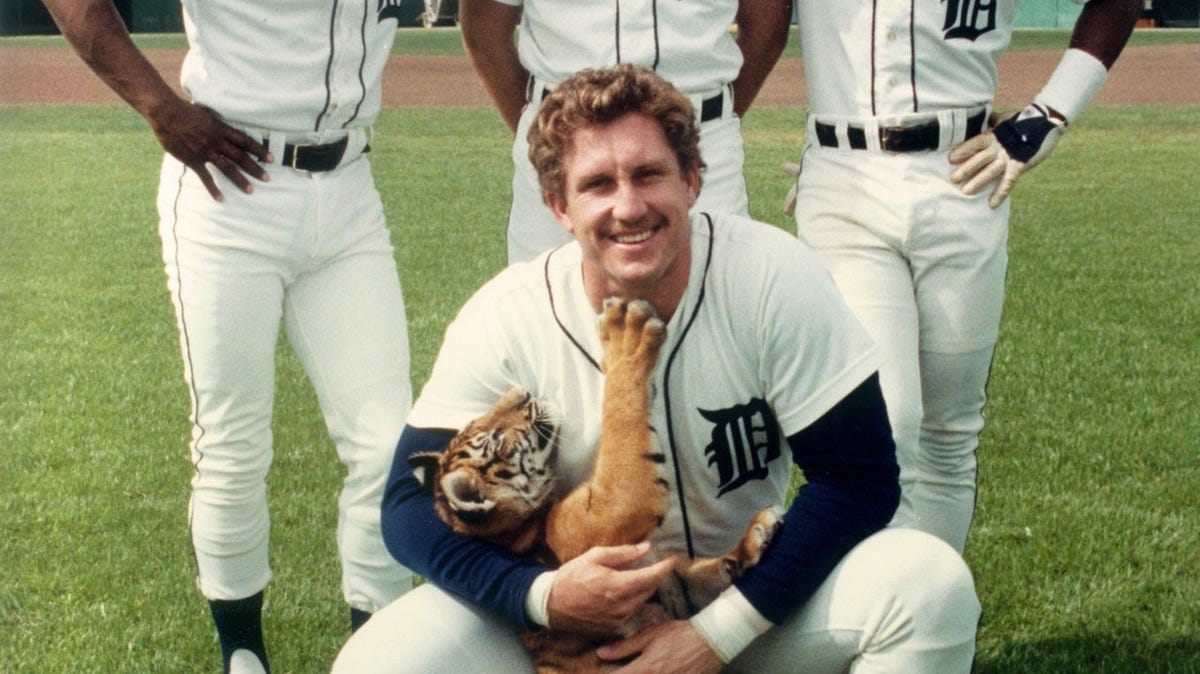


Detroit Tigers’ Lance Parrish tried to be switch-hitting third baseman
Detroit Tigers legend Lance Parrish joined the “Days of Roar” podcast, sharing the story of his brief stint as a switch-hitting third baseman.
This is an excerpt from the Free Press’ new book, “Roar of 125: The Epic History of the Detroit Tigers!” Available now through Pediment Publishing, this 208-page, full-color, hardcover book celebrates the 125 seasons of Detroit’s first big-league squad, from The Corner to The CoPa. Available now at Tigers125.PictorialBook.com, it makes a great holiday present for the special Tigers fan in your life!
The Detroit Tigers came to big-league life on April 25, 1901, as a charter member of the American League — an upstart group of minor-league squads and would-be big-league towns willing to challenge the established National League for “Major League” status.
Their first game, though entertaining, was perhaps something less than that standard — a 14-13 comeback triumph over the then-Milwaukee Brewers (we know them now as the Baltimore Orioles) at Detroit’s Bennett Park at Michigan and Trumbull (aka, “The Corner”) in which the visitors made four errors in the field and the hosts made seven before rallying in the bottom of the ninth with 10 runs.
As the Free Press put it the next day, in its writeup of the game, “Those who remained saw one of the greatest finishes ever made on any baseball diamond, and those who left early had reasons for ‘kicking themselves.’ ”
And now, 125 seasons later, the Tigers play their games at Comerica Park, about a mile northeast of “The Corner,” and have, indeed, become the model of a modern Major League franchise — 18 playoff berths, 11 pennants and four World Series titles.
Through it all, Detroit has seen nearly 2,000 players suit up in the Old English “D” (or at least some uniform representing the Tigers) — 1,833 to be exact (with 388 playing their entire careers for Detroit). The names cover the full alphabet, all the way from A (Glenn Abbott, a right-hander who threw 20 games during the 1983 and ’84 seasons) to Z (George Zuvernick, a right-hander who threw 49 games during the 1954 and ’55 seasons). Well,almost the full alphabet — there’s no “X” … though there are two Tigers by the name of Tex: Covington and Erwin.
Likewise, there are players with gloriously long careers, led by Al Kaline, aka “Mr. Tiger,” at 2,834 games — and so, so many players who got a mere cup of coffee in the majors (including 43 who lasted just one game). In all, the Tigers have sent 253 players to the All-Star Game and 22 players to the Hall of Fame. Of course, not all Tigers are equal, even among the greats. So … who’s the best?
After 125 seasons, there are bound to be some arguments over that, but we figured we’d take a stab, using the modern 26-player roster rules: 13 batters, 13 pitchers: That’s a starting nine, a rotation (though we stretched it to eight starters) and a bullpen (just five relievers, though, considering the starters, they may not get much work). And, of course, a manager, to push all the right buttons.
Without further ado, here’s the Free Press’ All-125 Tigers hitters:
Looking for the pitchers? They’re right here.
Manager: Sparky Anderson
Sparky Anderson, in his second life as a big-league manager after leading Cincinnati’s “Big Red Machine,” was many things to the Tigers.
A seer? He hinted at a World Series title within five years of his hiring and, lo, there was the parade in 1984. (He wasn’t so great at predicting individual successes; the halls of Tiger Stadium were littered with the players he proclaimed couldn’t miss … and then did.)
A spectacle? No one quite zinged the game and his players like Anderson, all while getting his meaning across, in the tradition of baseball’s most memorable managers. (Example: “Problem with (John) Wockenfuss getting on base is that it takes three doubles to score him.”) Even when his Tigers were on top, Anderson had plenty to say, including soon after the Tigers won the 1984 World Series in five games: “I hoped the Series would have gone seven games, because I had so much more to say.”
“Captain Hook,” as he was called in his Cincinnati days, didn’t always get along with his players, but he was under no illusions as to his role: “The players make the manager, it’s never the other way.”
But above all else, he was a success — his 1,331 wins were 200 more than the Tigers’ No. 2 skipper (Hughie Jennings), and he somehow maintained a winning percentage above .500 (.516 to be exact) despite nearly a decade managing a Tigers squad missing the overall talent of that 1984 team.
C: Bill Freehan
Hailed as the “thinking man’s catcher” in 1968 — one of 11 All-Star seasons, as well as the year he finished second in AL MVP voting — Bill Freehan mixed stellar defense (five Gold Gloves) and an underrated bat (including 11 seasons with at least 10 homers) over his 15 seasons with the Tigers.
Although ’68 was the Detroit native’s peak in recognition (as well as the season his Tigers won the World Series, with Freehan featured in the iconic photo celebrating with lefty Mickey Lolich), his best season may have come the year before: In 1967, Freehan hit .282 with 20 homers and 74 RBIs while walking 73 times and just 71 strikeouts en route to finishing third in the MVP vote.
He retired after the 1976 season with a .262 batting average, 200 homers and a career .993 fielding percentage that ranked No. 1 in MLB history at the time. His 44.7 Wins Above Replacement (per Baseball Reference) rank 12th in franchise history, regardless of position, and are more than a dozen WAR ahead of the Tigers’ No. 2 catcher, Lance Parrish.
1B: Hank Greenberg
Hank Greenberg’s career is almost as notable for its absences as its successes; “Hammerin’ Hank” played just eight full-length seasons with the Tigers, missing almost all of 1936 with a broken wrist and most of five additional seasons to World War II — he enlisted in the U.S. Army in May 1941, before the U.S. entered the war, and didn’t return to the Tigers until July 1945. He also made headlines in 1934, his second season, when — with the Tigers in the middle of a pennant race — he fought a growing culture of antisemitism and sat out Yom Kippur, a Jewish holiday in September.
But, oh, when he was at the plate for the Tigers … Greenberg was one of baseball’s most featured sluggers, leading the AL in home runs four times (including his 58-home campaign in 1938 that fell three short of breaking Babe Ruth’s cherished mark) and RBIs another four times. His 184 RBIs in 1937 are the most in franchise history and third-most in a season in MLB history, and his 306 homers as a Tiger are still fourth in franchise history.
Along the way, he won a pair of AL MVP awards (1935, when only his seventh-place finish in batting average denied him a Triple Crown, and 1940, after he moved to the outfield), finished in the top 10 in voting four other times and earned four All-Star nods.
Celebrate 125 seasons of the Tigers with our new book!
2B: Lou Whitaker
Though more than a few numbers might make the case for Charlie Gehringer to get the start here, it’s almost impossible to imagine a Tigers all-time team without “Sweet Lou” and “Tram” up the middle. No Tiger has logged more games at second than Lou Whitaker’s 2,310, and few did more to help the Tigers win — Whitaker combined slick fielding (three Gold Gloves) and a consistent bat (four Silver Sluggers, at least 12 homers in 13 of his final 14 seasons) to put up 75.1 bWAR, sixth-most in MLB history by a second baseman and ahead of 15 second baseman in the Baseball Hall of Fame.
After a cup of coffee in the majors in 1977, Whitaker made a quick impact with the Tigers in ’78, winning AL Rookie of the Year with a .285/.361/.357 slash line that didn’t quite hint at the power he’d develop. His best season arguably came in 1985, when he hit .279 with 21 homers while walking 80 times and striking out just 56 times. He finished with five All-Star nods (1983-87) and one top-10 MVP finish (1983, when he hit .320 with 40 doubles).
Despite his two decades of excellence as a Tiger, Whitaker hasn’t yet been recognized by the Hall of Fame; he fell off the BBWAA ballot after just one year, and missed induction from the Modern Era Committee in 2019 by six votes. But Whitaker isn’t worried: “I will wait for that day,” he said before his No. 1 was retired by the Tigers in August 2022. “I’m sure that day will come. I might be 99 and walking with a cane saying, ‘Finally, what took you so long?’ But that day will come.”
SS: Alan Trammell
No double-play combo turned two more in MLB history, as Alan Trammell and Lou Whitaker worked side-by-side for 19 seasons, than “Tram and Lou,” following their combined debut on Sept. 9, 1977. Trammell finished fourth in Rookie of the Year voting in 1978 (behind Whitaker) at age 20, then went on to make six All-Star squads behind an all-around productive bat (three Silver Sluggers) and stellar fielding (four Gold Gloves).
“Tram” was the model of consistent production for most of his 20 seasons with the Tigers. He had eight seasons with at least a dozen home runs and 12 seasons with at least 20 doubles, all while showing surprising base-running skills; he’s one of six shortstops in MLB history with 400 doubles (412), 200 steals (236) and 1,000 RBIs (1,003).
Although he was World Series MVP in 1984, Trammell’s best season came in 1987 when he hit .343 with 34 double, 28 homers, 21 seasons and 105 RBIs, only to finish second in AL MVP voting (behind Toronto’s George Bell). Trammell finished with 70.6 bWAR, fifth most in franchise history, fueled by 22.7 bWAR on defense, the most of any Tiger regardless of position.
3B: George Kell
Before George Kell was the TV voice of the Tigers for multiple generations in Detroit, he was a hit machine at the hot corner for the Tigers, joining the franchise via a trade with the Athletics in May 1946 and spending parts of seven seasons wearing the Old English “D.” That included All-Star nods in all five of his full Detroit campaigns with the Tigers, a 1947-51 span in which he hit .327 with an .835 OPS despite hitting just 20 home runs.
Kell’s batting average during that run was better than every AL hitter over that span but one: Ted Williams, who Kell famously edged for the 1949 AL batting title by .00016. That season, in which he had 38 doubles and three homers, was arguably his best, as he finished eighth in MVP voting. He also had two top-five MVP finishes, including 1950, when he finished fourth while leading the majors with 218 hits and 56 doubles — a mark no Tiger has reached since.
The Arkansas native was traded to Williams’ Red Sox in June 1952 and finished his career with stints with the White Sox and Orioles. He rejoined the Tigers organization in 1959 and spent nearly four decades as a broadcaster before his final retirement in 1996.
LF: Willie Horton
If Bill Freehan was the quiet leader of the 1968 Tigers, and Al Kaline was the veteran presence, then Willie Horton was the power and pizzazz behind the eventual world champs. The Virginia native, who grew up in Detroit and attended Detroit Northwestern High School, jacked 36 homers that season, second in the AL, while hitting .285 with 85 RBIs en route to a fourth-place finish in AL MVP voting.
But his efforts on the field were just a small part of his contributions to Detroit. In 1967, in the midst of the disorder roiling the city, Horton left Tiger Stadium, attempting to ease tensions. As he wrote in his 2004 autobiography, “The People’s Champion: Willie Horton,” “I didn’t even remove my uniform. I jumped in my car, I drove over by 12th Street near the blocks where I had delivered Michigan Chronicle newspapers as a child. … I exited my car, climbed on the roof and started shouting at people until I got their attention.”
Horton finished his career with 26 multi-homer games (including a three-homer gamer in 1970), fourth in franchise history and the most among Tigers outfielders. In all, Horton racked up 1,490 hits, 262 home runs and 886 RBIs with a .273 batting average in 1,515 games, making four AL All-Star squads.
CF: Ty Cobb
A plaque on the north side of Comerica Park, the Tigers’ home since 2000 — nearly 75 years after Ty Cobb played his last game for the franchise — identifies Ty Cobb as the “Greatest Tiger of All,” and for the first 50-some years of the Tigers, it would be tough to argue with that identifier for the fiery player known as “the Georgia Peach.”
A member of the first class of the Baseball Hall of Fame in 1936, Cobb received more votes from the panel than any other inductee (including Babe Ruth). His best season — though it’s tough to pick just one — was likely 1911, when a 24-year-old Cobb led the AL in runs (148), hits (248), doubles (47), triples (24), RBIs (127) and average (.419) while posting a 1.086 OPS and winning the inaugural AL MVP vote.
Cobb still owns the franchise marks for bWAR (by more than 50, at 145.8), batting average (.368), on-base percentage (.434), runs (2,087), hits (3,900), bases (5,466), doubles (665), triple (284), RBIs (1,811) and steals (869). Those were set during a 22-season run in which Cobb led the AL in hits eight times, batting average 12 times, steals six times and RBIs four times. He even led the AL in homers once, albeit in the days when nine was enough (topping Boston’s Tris Speaker by two).
RF: Al Kaline
If Ty Cobb was the greatest Tiger of the first half of the 20th century, the outfielder known as “Mr. Tiger” was certainly the best to close out the 1900s. Al Kaline debuted as an 18-year-old fresh out of high school in Baltimore and within two years, led the AL in batting average (.340) while finishing second in MVP voting. That season, in which he hit 27 homers, kicked off an 18-season run in which Kaline hit at least .270 with 10 or more homers every year.
It also started a run of 13 straight All-Star nods, part of 15 in his career, with 10 Gold Gloves as well. Kaline’s work in right field became so definitive that that area of Tiger Stadium — and later at Comerica Park, a stadium that opened 26 years after he retired — became knows simply as “Kaline’s Corner,” a tribute to the secion of seating removed in right field at The Corner to keep Kaline from injuring himself diving into the stands.
Kaline’s potential best season is something of a what-if: Kaline was hitting .336 with al AL-high 13 homers in just 36 games in late May 1962 before a broken collarbone — suffered making a game-ending catch against the Yankees on nationlal TV — and missed almost two months. He finished the year with 29 homers and a .286 average in just 100 games, with a sixth-place finish in MVP voting.
DH: Miguel Cabrera
It’s hard to believe that when Miguel Cabrera arrived in Detroit via trade in December 2007 — after four straight All-Star nods in Florida, and still not even 25 — there were plenty who wondered whether he’d succeed as a Tiger. After with eight more All-Star berths, five Silver Slugger awards, two AL MVP awards and the 2012 Triple Crown over 16 seasons … well, there aren’t any more questions.
To be fair, we’re cheating a bit by putting Cabrera at designated hitter; his five seasons (2019-23) as a full-time DH were the worst of his Tigers tenure, by far. He won back-to-back MVP awards (2012-13) playing third … but those were his only two seasons there as a Tiger. As a first baseman? His nearly 1,200 games there featured a .944 OPS … well behind Hank Greenberg’s 1.026.
And so we’ll “hide” Miggy — one of just seven MLB players with 3,000 hits and 500 homers, as well as the owner of 373 homers as a Tiger — at the DH spot (with apologies to Victor Martinez.) His Tigers tenure wasn’t always perfect — injuries and age came for him as they do for every hitter — but it’s almost impossible to imagine an all-time Tigers team without this generational hitter.
BenchC: Lance Parrish
Part of the young core that arrived in Detroit together toward the end of the 1977 season, Lance Parrish was indeed the “Big Wheel” that kept the Tigers offense rolling over his nine full seasons.
One quirk of Parrish’s career as a Tiger — though it didn’t keep him from drawing leaguewide recognition in Detroit — was his slow starts: The catcher posted just a .707 OPS in April, warming up to .849 in May and .832 in July before cooling off in September and October (.734). “I don’t know; maybe I’m just not a cold weather player,” Parrish told the Free Press in April 1984. “I have thin skin and hate being cold. I try everything to keep warm, I put eight layers of clothes on, but nothing seems to work. I don’t know what it is.”
And yet he made six All-Star squads in seven seasons (1980-86), while earning five Silver Slugger awards and three Gold Gloves. He gathered all three honors for the first time in 1982, when he slammed 32 home runs, becoming the first Tigers catcher with at least 30 homers since Rudy York in 1938 (though only 27 of York’s homers came as a catcher that season). He followed that with a season in which he had just 27 homers, but added 42 doubles and drove in 114 runs to finish ninth in AL MVP voting.
Parrish spent 10 seasons with the Tigers before lowball contract offers — at the height of MLB’s collusion scandal — sent him journeying across the majors. But even in that limited span, Parrish hit more homers — 212 — than any catcher in franchise history.
1B: Norm Cash
In an era when baseball veered about as far from it as possible, Norm Cash’s career was all about power. A two-sport star in college — he was drafted by the NFL’s Chicago Bears in 1955 — baseball was his game. The lefty made his name with prodigious blasts, clearing the right-field roof four times — more than any other hitter to call Tiger Stadium home. In all, he sent 373 pitches over the fences — 211 at the power-friendly Corner — to finish his career No. 2 in homers in franchise history.
Paradoxically, his greatest season as a home run hitter came in his most well-rounded campaign: 1961, when the burly Texan slammed 41 homers (finishing 20 behind MLB record-setter Roger Maris) and hit .361 to lead the majors. Cash never even topped .300 in a season again, but the homers kept coming; he was the only AL hitter with at least 20 homers in every year from 1961-69.
About the only thing as consistent as his power was his sense of humor: “When I think of Norm Cash, I smile,” Al Kaline told the Free Press in 1986. “I always did and I always will.” That sense of humor earned a spot in history, too, on July 15, 1973. As the last batter in a Nolan Ryan no-hitter in which the ace had struck out 17 — including Cash three times — he opted to try and take his final hack not with a baseball bat, but with a table leg. As the story goes, as umpire Ron Luciano sent Cash back to find a bat, he protested: “I’ve got as much chance with this as I do with a bat.”
2B: Charlie Gehringer
Even if Charlie Gehringer hadn’t been among the greatest of all time at his position, the Fowlerville native likely would have been remembered for ages, simply for his nickname: “The Mechanical Man.” As Hall of Fame left-hander Lefty Gomez reportedly put it: “You may wind Gehringer up in the spring and turn him off in the fall and in between, he hits .340.”
Though he denied the ease of it, his 19 seasons belie that; Gehringer hit better than .298 for 15 straight seasons. Beginning in 1928 — his third full season in the majors — Gehringer received MVP votes for 13 straight seasons, a run that included seven top-six finishes and the award itself, in 1937 when he led the AL with a .371 batting average and added 40 doubles and 96 RBIs. Gehringer also started for the AL in the first six All-Star games, from age 30-35, while delivering fluid, graceful work with his glove.
Many of Gehringer’s career numbers argue for him as the greatest Tigers second baseman. But he was willing to share the spotlight, telling the Free Press: “Lou Whitaker is a better fielder than I ever was. I mean it; he could make any play I ever made. But I guess I was a better hitter.”
OF: Harry Heilmann
It would be easy to overlook Harry Heilmann’s greatness at the plate for the Tigers, with his peak years overlapping with the final seasons of Ty Cobb (Heilmann’s first manager and frequent batting-race foe) and wrapping up just before the franchise won its first World Series in 1934. At Comerica Park, after all, Cobb has a statue to go with his name on the left-center field wall. Heilmann’s name is on the right-field wall — no number. (It’s even worse in the park’s lobby — a display of all the Tigers’ Hall of Famers shows Heilmann … with his name missing the second “n.”)
But for most of the 1920s — nine seasons — Heilmann was every bit Cobb’s equal. During his peak (1921-29), he hit .370 while averaging 41 doubles, 11 triples, 15 homers and 115 RBIs. That run included four batting titles (tied for second-most in franchise history, with Miguel Cabrera, and trailing only Cobb’s 12) and five straight top-10 finishes in the AL MVP vote.
Heilmann’s peak came in 1923 as he hit .403 to lead the AL by 10 points, all while smacking a league-leading 237 hits (including 43 doubles, 14 triples and 19 homers). But his most iconic moment came four years later: With the 1927 batting title virtually clinched at .392 following the first game of a season-ending doubleheader, Heilmann opted to play Game 2, telling his teammates: “I’m going to win it or lose it in this next game.” And indeed, Heilmann won it, going 3-for-4 with a double and a home run.
Who are the top pitchers? Read all about them here!