
The busiest week of MLB’s offseason calendar has arrived: The Winter Meetings are here.
New York Yankees fans have been getting antsy as they’ve watched several rival teams make major moves to improve their rosters. The club has already made a few moves by bringing back Trent Grisham, Ryan Yarbrough and Tim Hill. But more is needed to turn the Yankees into a World Series contender in 2026.
We should have a sense of which direction the Yankees will go by the time the Winter Meetings conclude on Wednesday. Here are three things we’ll be watching in Orlando this week.
Will the Yankees drop their payroll below $300 million?
Yankees play-by-play broadcaster Michael Kay made waves on his radio show last week when he discussed the club possibly operating with a hard cap on the budget this offseason.
“There’s a good chance, everybody, that the Yankees’ intent at this point on Dec. 4 is to, in fact, be under the $300 million threshold,” Kay said.
The Yankees’ current payroll is estimated at $283.6 million, according to Cot’s Contracts. That would leave them with little operating room to improve the roster before the season begins. The Yankees would be hard-pressed to have a better club in 2026 if they drop their payroll from $319 million in 2025.
The Yankees need a left fielder, unless they believe in either Jasson Domínguez or Spencer Jones to be everyday players in 2026. Both have major questions regarding their feasibility in the majors: Domínguez was one of MLB’s worst defenders last season, and Jones struck out in more than 30 percent of his at-bats across Double A and Triple A in 2025.
The club could use another starting pitcher with Gerrit Cole, Carlos Rodón and Clarke Schmidt unavailable to begin the season. Max Fried, Rodón, Cam Schlittler and Will Warren had career-high workloads last season. The bullpen also needs upgrades after losing Devin Williams to the New York Mets, while Luke Weaver remains a free agent.
Can the Yankees accomplish all of that with under $20 million to spend in 2026?
Owner Hal Steinbrenner has often said that having a payroll over $300 million is unsustainable, and he recently said dropping payroll would be “ideal,” though he didn’t guarantee that it meant he wouldn’t spend more than last year. Although he has made similar comments in the past, the Yankees have increased their payroll for five straight seasons. With the contracts they have on their books, it’s nearly impossible for the Yankees to be taken seriously as a World Series contender if they dropped their payroll below $300 million.
The window to win a title is now for the Yankees, with Aaron Judge turning 34 in April. Not maximizing this window with Judge still in his prime would be malpractice.
How hot is Cody Bellinger’s market?
More to the point, it doesn’t make any sense that the Yankees would drop their payroll under $300 million because they have been clear they would like to re-sign Bellinger to a multi-year contract. Re-signing him alone would put the payroll over $300 million, and likely over the more important fourth luxury tax threshold of $304 million.
“Certainly, we’d be better served if we could retain him,” general manager Brian Cashman said last month. “I’ve said it before, and I’ll say it again: Of course, we’d like to have him back.”
The Toronto Blue Jays, New York Mets, Philadelphia Phillies, Los Angeles Dodgers and Los Angeles Angels all could use an outfielder. It would make sense for Bellinger’s agent, Scott Boras, to wait until Kyle Tucker resolves his free agency because the clubs that miss out on him could turn their attention to the 2019 National League MVP.
Bellinger had a great season for the Yankees, finishing with a 125 wRC+ and 4.9 fWAR. He played all three outfield positions and can play first base in a pinch. But there may not be a more confounding free agent on the market than Bellinger.
Last offseason, the Chicago Cubs traded him to the Yankees in a salary-dump move so they could acquire Tucker in a trade with the Houston Astros. Three years ago, the Los Angeles Dodgers non-tendered Bellinger. His on-field value has fluctuated vastly over the past four seasons.
Bellinger does not have encouraging underlying hitting metrics, but by pulling the ball in the air, he’s excellent at maximizing his production. If he ever deviates from his approach or loses power, it’s hard to see him matching his 2025 production again.
Can the Yankees get back into the Japanese market?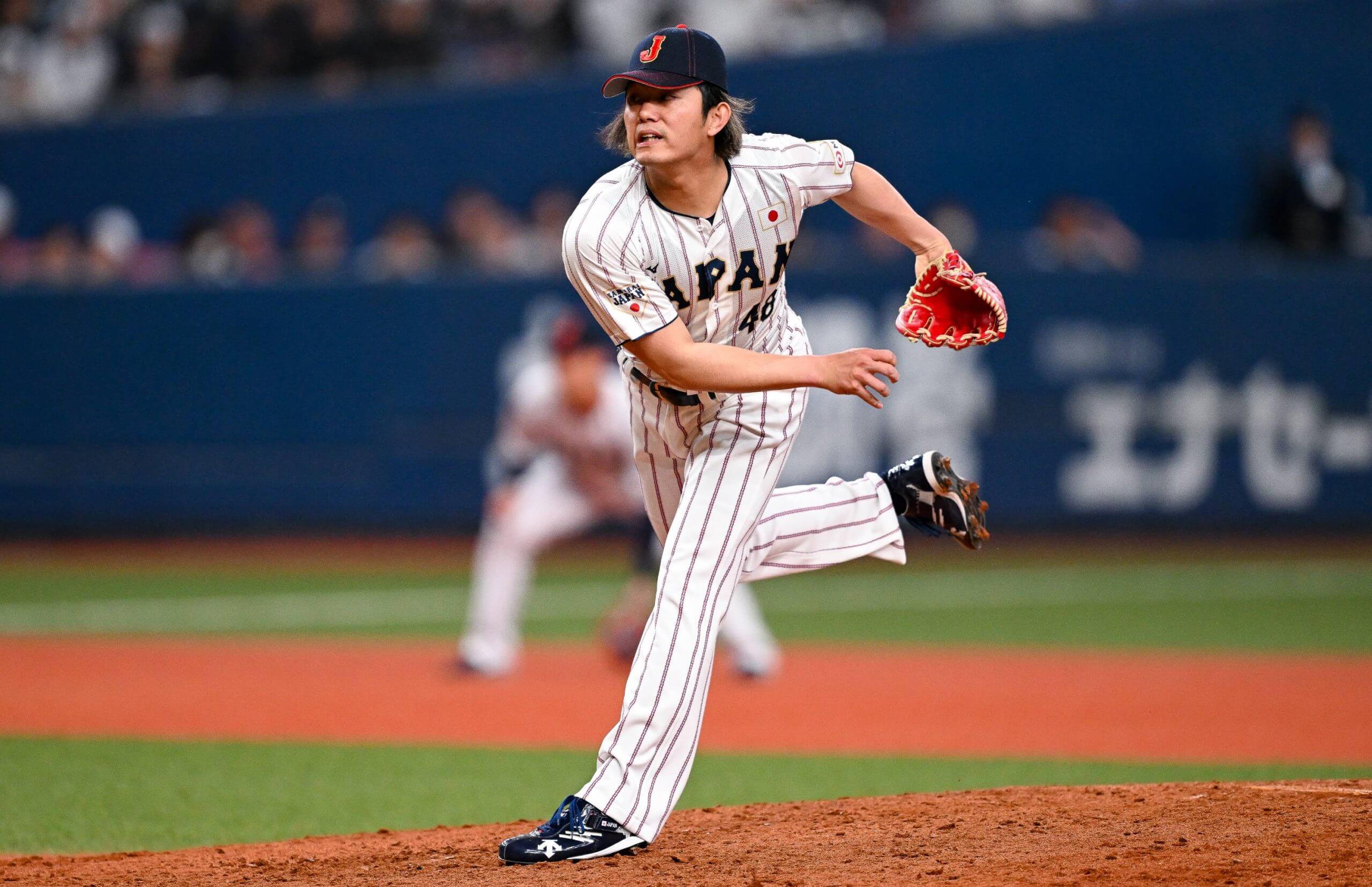
Tatsuya Imai logged a 1.92 ERA with 178 strikeouts in 163 2/3 innings in NPB in 2025. (Gene Wang / Getty Images)
The Athletic previously reported that the Yankees will pursue Japanese right-hander Tatsuya Imai in free agency. They have not signed a player from Japan since Masahiro Tanaka in 2014. They would like to change that this offseason.
“We have been very aggressive in the more recent market, but fell short,” Cashman said. “Those players made the decision to go play for the Dodgers, and clearly the success has followed them.”
Those players Cashman was referencing include Yoshinobu Yamamoto and Roki Sasaki, who have joined Shohei Ohtani in Los Angeles. Imai could be different, as he’s expressed a willingness to forge his own path rather than following his countrymen to the back-to-back champions.
“Of course, I’d enjoy playing alongside Ohtani, Yamamoto and Sasaki,” Imai told former pitcher Daisuke Matsuzaka on the Japanese show, “Hodo Station,” in November. “But winning against a team like that and becoming a world champion would be the most valuable thing in my life.
“If anything, I’d rather take them down.”
Boras, who represents Imai, said his client is “geographically open,” which means the Yankees have a relatively encouraging chance at ending their drought in the Japanese market. Imai, posted by Nippon Professional Baseball’s Saitama Seibu Lions on Nov. 18, has until 5 p.m. ET on Jan. 2 to pick a new team.
At 27 years old, Imai offers MLB teams upside with an upper-90s fastball and devastating slider. He finished the 2025 season with a 1.92 ERA and 178 strikeouts in 163 2/3 innings. He was ranked No. 10 on The Athletic’s Free Agent Big Board.
There’s less risk in signing a Japanese pitcher than there was when, say, the Yankees mistakenly signed Kei Igawa in 2006; data and video have greatly improved.
Imai doesn’t project on the same level as Yamamoto, who has developed into one of MLB’s best starters, but he should find success stateside.