
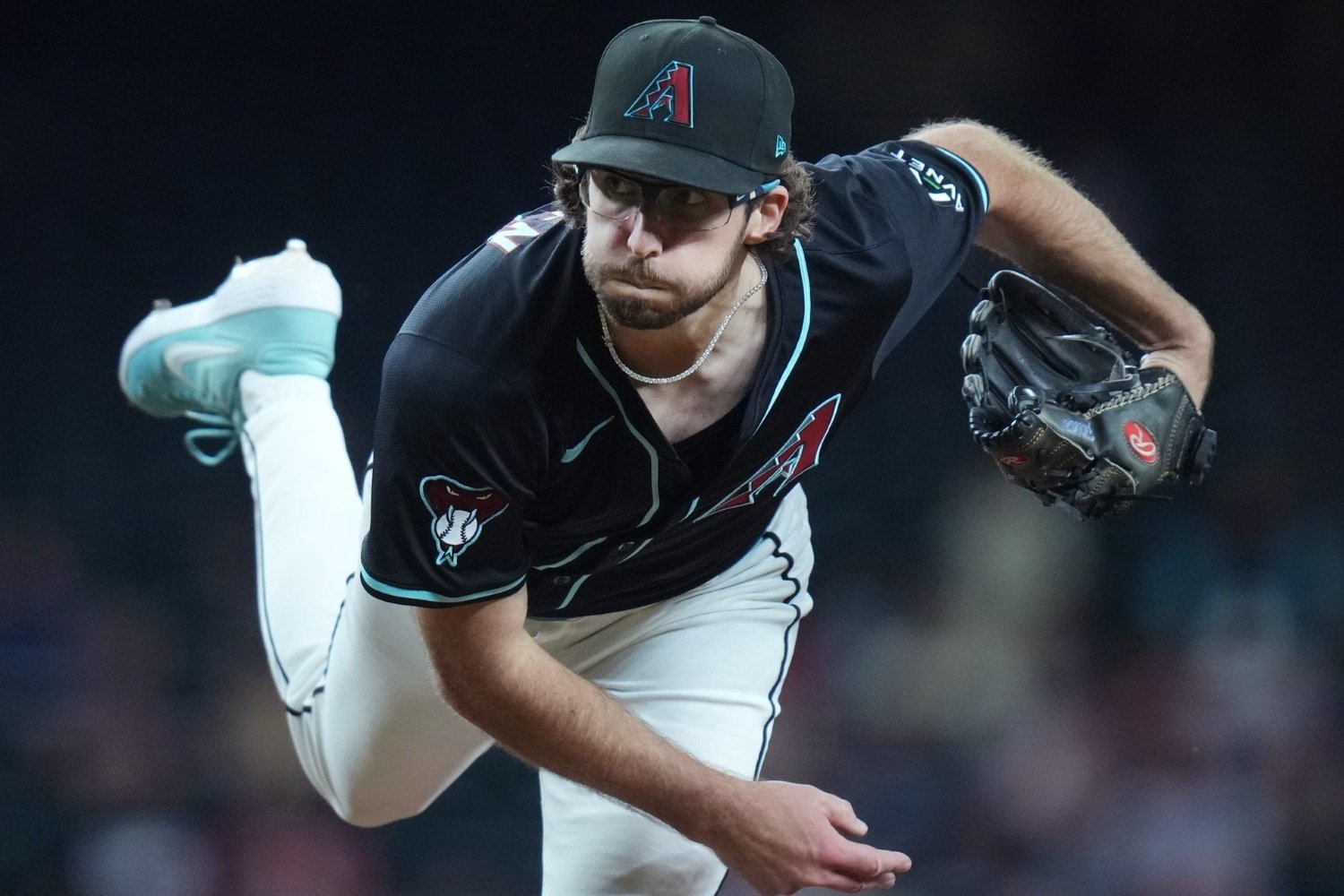
He wouldn’t have been the top name on many fans’ wish lists, but Zac Gallen has emerged as one of the Cubs’ top targets to address their starting rotation this winter. Reports of the team’s interest percolated at the end of the week, and on Saturday morning, Bob Nightengale of USA Today erroneously reported that the team had agreed to a multi-year deal with Gallen, with an annual average value north of $22 million.
Nightengale beat a hasty retreat, and ESPN’s Jeff Passan issued a rare tweet to certify that news was not afoot. Sources confirmed that Gallen is not in agreement with anyone (and certainly that the Cubs were not close to completing a deal) to North Side Baseball, too.
However, the team’s interest in Gallen—and their engagement with Scott Boras, who represents him—is legitimate. Gallen and Boras are angling for a deal similar to the one Kevin Gausman signed with the Blue Jays or the one Robbie Ray got with the Mariners, each in late November 2021. Gausman got a five-year deal worth $110 million. Ray signed for $115 million over five seasons, with a no-trade clause for the first two years of the pact and the ability to opt out after the third.
That’s not likely to come to fruition. Boras is aiming high, hoping to establish an anchor that will make some team satisfied to snare Gallen for four years at $88 million or so. In reality, he’s likely to come in a bit lower—and so far, the Cubs aren’t going that far, by any means.
A source familiar with the team’s plans said Jed Hoyer and company have so far offered Gallen something much more similar to the three-year, $71-million deal they struck with Marcus Stroman in 2021. Stroman got $25 million in each of the first two years of that deal, and was due $21 million for 2024, but he took advantage of an opt-out clause and hit the market after 2023, instead. Boras, of course, wants to extend that structure by a year. Another source indicated that if the Cubs were to go to four years for Gallen, they would want to reduce the annual average value of the contract to something under $20 million.
Escalators (like the clause in Stroman’s deal which could have pushed the value of his final season up to $25 million if he’d stayed healthy) might still give Gallen a chance to earn $90 million or more on such a deal. While talks aren’t yet advanced far enough that the two sides have discussed such details, an opt-out could give Gallen a chance to hit the market again after 2027. The Cubs could seek a fifth-year club option at a lower salary, should Gallen miss time for Tommy John surgery at any point. In essence, though, the Cubs are seeking to land him on a deal more akin to those of Stroman or Jameson Taillon than to what Gausman or Ray pulled down.
Let’s talk about why, given the apparent gap between how Gallen hopes to be valued and what the team hopes to pay, the Cubs are so prominently involved. To do so, we can start by observing three key truths about Gallen:
He’s a workhorse. Though a lat strain cost him almost a month in mid-2024, he’s averaged 31.5 starts and over 180 innings per year since 2022. In 2023, between the regular season and Arizona’s deep playoff run, he faced 987 batters and pitched 243 2/3 innings—remarkable numbers in the modern game.
At his best, he was dominant, but his best feels a bit lost in the fog. He had a 2.54 ERA in 2022 and a 3.47 in 2023. It was 3.12 when he suffered that lat injury in mid-2024, but after he returned, the number was 3.99. In 2025, it ballooned all the way to 4.83. His strikeout rate dipped sharply; he became prone to the home run.
As Dylan Cease‘s seven-year deal last month proved, though, ERA is not the statistic savvy front offices use to evaluate pitchers these days. Gallen’s stuff can still be tantalizing. His fastball sits in the 93-95 range. His curveball and changeup can be plus, and he boasts a deep arsenal. On the fundamentals beyond the surface-level numbers, he’s a starter with frontline upside.
Specifically, one thing seems to have derailed Gallen. It’s a very small thing, but a vital one, and the big question around him is whether it can be reversed. If so, he could get right back to dominating in 2026, and stay that way for the length of even a four- or five-year deal. If not, he’s probably doomed to a long period of trying to find a new winning formula. It’s all about fastball shape.
Zac Gallen, Four-Seam Fastballs, 2022-25
Season
Velocity
Horiz.
Ind. Vert.
2022
94.0
3.4
16.8
2023
93.5
3.0
16.5
2024
93.8
4.9
16.1
2025
93.5
4.5
16.3
Based on Gallen’s arm slot, in the first two seasons above, he enjoyed about 4.2 inches of relative cut on his fastball. In other words, though it technically faded a few inches toward the arm side between release and the plate, it did so by several fewer inches than a hitter would anticipate. Over the last two seasons, the pitch is running more—but that means it’s closer to what the hitter expects. He’s down to 2.2 inches of relative cut.
Every problem Gallen has experienced the last year and a half springs from that well. The heater doesn’t look as much like his curveball as it used to, and it doesn’t separate as well from the changeup as it used to. He’s not missing as many bats or managing contact as well with the fastball as he could two years ago. The Cubs have a pitching infrastructure that excels, typically, at helping pitchers find and emphasize the cut on their fastballs. They envision helping Gallen reclaim the shapes and relationships that made his pitches so devastating a few years ago.
In a market where Michael King is likely to get close to $20 million per year on a three- or four-year deal, Gallen makes some sense at the same price, even if he can’t quite get back to his former levels. He’s far more durable than King is, with similar upside. The Cubs don’t want to pay full freight for that upside, because that would be a big gamble on such a small thing. If you had to bet on a pitcher whose fastball has gone awry, though, you’d much rather face the need to fix their horizontal movement than their velocity or the rising action on that pitch.
Mechanical tweaks could turn Gallen around. He’s struggled with the timing of his hip and shoulder rotation, and his posture at foot strike has gotten a bit out of whack. Cleaning that up could turn Gallen into an ace again, and the Cubs feel they’re uniquely positioned to achieve that. Boras doesn’t offer discounts to teams with confidence in their player development, though, and Hoyer won’t overpay for a player whose recent track record creates real uncertainty. Thus, as the Winter Meetings get underway, the Cubs are in a familiar position: highly interested in a Boras client, and perhaps even in pole position, but waiting for the terms to match their valuation.