
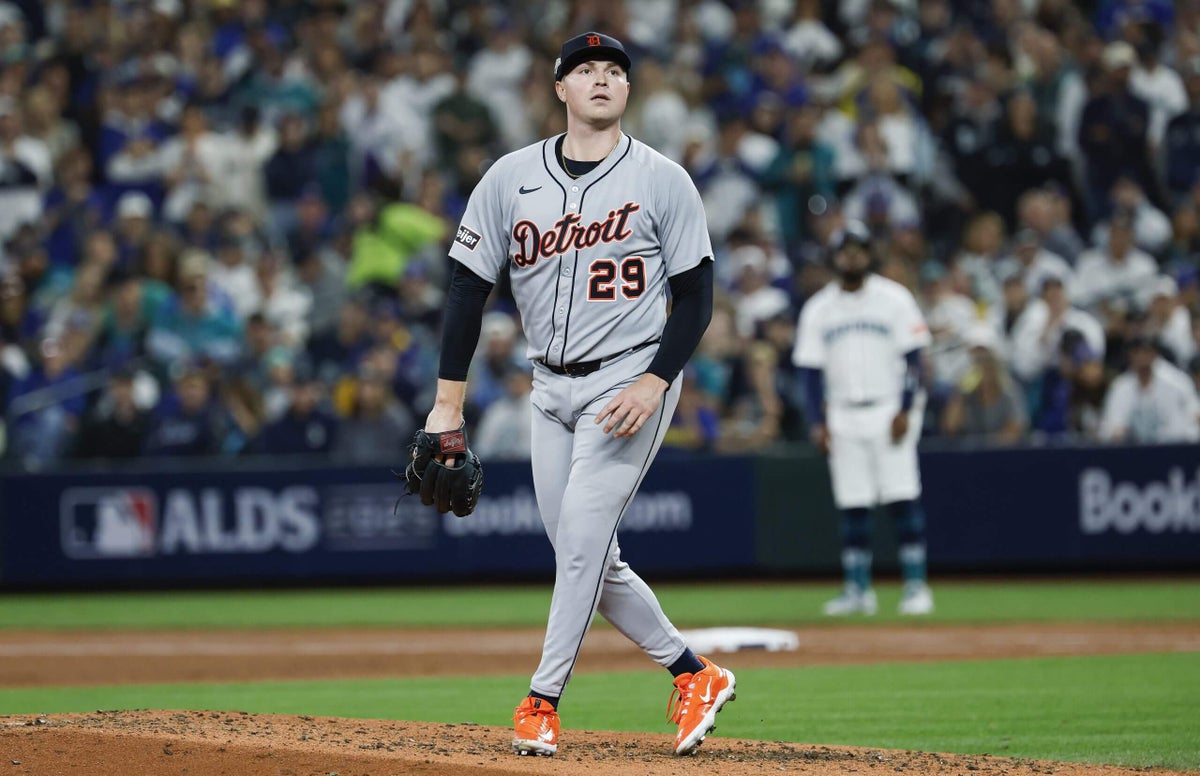
If the Detroit Tigers want to keep Tarik Skubal, president of baseball operations Scott Harris can’t stay in his preferred risk-averse mode. No more threading the needle. No more playing for tomorrow. If you’re keeping Skubal, you’re trying to win the World Series. So, take your best shot.
Harris deserves credit for restoring the Tigers to prominence. No one is suggesting he do anything reckless and make a free-agent splurge that could set back the franchise years if it goes awry. But if the Tigers keep Skubal – and they should, seeing as how rare opportunities are to win a World Series – it’s time for Harris to get uncomfortable.
He avoided doing that at the trade deadline, and the Tigers ended up blowing a 15 1/2-game lead over the Cleveland Guardians in the AL Central. The Tigers still made back-to-back postseason appearances for the first time since 2011 to ’14, then rallied to beat the Guardians in the wild-card round. They nearly reached the American League Championship Series, too, getting eliminated only after an unforgettable 15-inning loss to the Seattle Mariners in Game 5 of the Division Series.
Pretty good. Not good enough. And now, with Skubal entering his free-agent year at a projected arbitration salary in the $18 million range, the Tigers face a choice: Trade Skubal, adding to a burgeoning young core but almost certainly at the expense of their chances in 2026. Or, go for it with him, knowing that when Skubal likely departs for a $400 million-plus free-agent deal, the only return will be a draft pick.
In some ways, this is as much an ownership question as it is a Harris question. Detroit is not Kansas City, Cincinnati or Milwaukee. It is the nation’s 14th largest media market. Like many clubs, the Tigers are dealing with reduced local TV revenue. But the fact almost no one in the industry expects them to even be a player for Skubal as a free agent is an indictment of sorts.
Scott Boras is Skubal’s agent. An extension is and always has been almost out of the question. But just as the Hal Steinbrenner Yankees are not the George Steinbrenner Yankees, the Tigers were a different operation under the late Mike Ilitch than they are under his son, Chris. The last time they fielded a top-half Opening Day payroll was in 2017, the year of Mike’s passing. That completed a run of six straight seasons among the top six spenders.
The Tigers did make a big push for free-agent third baseman Alex Bregman last offseason, offering him a six-year, $171.5 million contract. Bregman instead chose a three-year, $120 million deal with opt-outs from the Boston Red Sox, and is now a free agent again, albeit one year older entering his age 32 season.
If Bregman said no once, he likely would say no again, presuming he had a competitive offer from a preferred destination, which likely will be the case. Bo Bichette, entering his age 28 season, might be a better choice for a Detroit club that expects to continue incorporating young position talent. Ha-Seong Kim, 30, might be the best fit of all. A number of Tigers prospects are second-base/third-base types, and Kim is better defensively than Bichette at short, the position the Tigers most need to address.
A No. 2 starter to slot behind Skubal in 2026 and perhaps move into the No. 1 slot after he departs would be an equally important addition; the Tigers’ presumed successor, righty Jackson Jobe, underwent Tommy John surgery in June. Maybe the addition should be a free-agent lefty such as Framber Valdez, who pitched for Tigers manager A.J. Hinch in Houston, or Ranger Suárez, who is expected to be more modestly priced. Or maybe it should be one of the many starting pitchers available in trade, though most are only one or two years away from free agency.
The bullpen also remains an area of focus. Harris mostly whiffed on the four relievers he acquired at the deadline, hitting only on Kyle Finnegan at a time when three top relievers under club control beyond 2025 – David Bednar, Jhoan Duran and Mason Miller – all moved. Finnegan is among the many relievers still available on the open market. Re-sign him and find at least one or two more.
Harris, in his first significant move of the offseason, reached agreement with free-agent right-hander Drew Anderson on a one-year deal with a club option. Anderson, who is returning from four seasons in Japan and Korea, struck out 245 in 171 2/3 innings last season in the KBO, but might prove more of a reliever than a starter. A reasonable addition, as long as the Tigers do more.
Will they?
Here is what Harris said after the deadline – a deadline in which he failed to acquire a hitter for an offense that was starting to struggle, struck out on starting pitchers Chris Paddack and Charlie Morton and largely neglected the swing and miss he needed to obtain for his bullpen:
“I think if you study every deadline over the last 10 years, I think one thing you’ll find is oftentimes the flashiest moves generate a lot of excitement at the time and fail to impact the team as much as you would have hoped, as much as you would have liked. I’m not saying that’s all the time. There are certain anecdotes of a move changing the trajectory of an organization. I’m just arguing that’s the exception, not the rule.”
Well, the exceptions often are the teams that wind up in the World Series. The Toronto Blue Jays last season with starter Shane Bieber and relievers Seranthony Domínguez and Louis Varland. The Los Angeles Dodgers in 2024 with Flaherty, infielder Tommy Edman and reliever Michael Kopech. The Texas Rangers in 2023 with righty Max Scherzer, lefty Jordan Montgomery, reliever Chris Stratton, catcher Austin Hedges.
Harris took over in September 2022. None of his free-agent additions – righty Jack Flaherty twice, second baseman Gleyber Torres twice, and righties Alex Cobb and Kenta Maeda, neither of whom worked out well – qualified as a splash. Bregman would have fit that description, but part of Harris’ overall hesitation stems from a reluctance to block top prospects such as infielder Kevin McGonigle and outfielder Max Clark, both of whom might turn out better than any mid-level free agent, and soon.
The Tigers’ approach resembles that of the Baltimore Orioles entering last season – we’ll be better in 2026 than in 2025, better in 2027 than in ’26, etc. Except time after time, the game demonstrates that the development of young players isn’t always linear. The Tigers know that from their experience with first baseman Spencer Torkelson. Even their All-Star left fielder, Riley Greene, is on something of a rocky course. Yes, Greene hit 36 homers last season. He also had the fifth-highest strikeout rate in the majors.
Of course, the Tigers also know, from their experience with Javier Báez, the dangers of signing the wrong player in free agency. Báez, who agreed to a six-year, $140 million contract the year before Harris took over, has accounted for just 3.4 fWAR in four seasons. That figure would be even lower without his stunning offensive turnaround before the All-Star Game last season. After the ASG, he reverted to his previous Tigers form.
One miss shouldn’t discourage the Tigers from taking other big swings, particularly when their time with Skubal, the back-to-back American League Cy Young winner, is running short. Those big swings need not be limited to a free-agent class that some executives view as just OK. The Tigers, after holding all of their top prospects at the deadline, are sitting on the game’s third-best farm system, according to Baseball America’s most recent talent rankings. As the Orioles have discovered, it’s better to trade certain prospects before they lose value.
If the Tigers want to keep Skubal, bravo. Their time with one of the best pitchers on the planet in their uniform is precious. They should not take it lightly, even if they can make a better trade than the Milwaukee Brewers did for one year of right-hander Corbin Burnes in 2024. The Brewers’ return – Joey Ortiz, a gifted defensive shortstop who last season had the lowest OPS in the majors; DL Hall, a still-inconsistent left-hander; and the 34th pick in the ’24 draft, who turned out to be first baseman Blake Burke, one of their lesser prospects – has produced mixed results.
In a game in which little is guaranteed, Skubal is perhaps as close as it gets to a sure thing. The Tigers almost certainly do not make the postseason the past two years without him. They stand at least a puncher’s chance chance of winning the World Series with him – particularly if they surround him with the right talent.
What was it Andrew Friedman once said? “If you’re always rational about every free agent, you will finish third on every free agent.” Time for Harris to get a little irrational, a little uncomfortable. If the Tigers are going to keep Tarik Skubal, a risk-averse approach makes no sense.