
As the MLB Winter Meetings start Sunday in Orlando, Fla., the Cubs look to add impactful players to their 2026 roster. That brings to mind the franchise’s offseason trade history as it enters its 150th year as a professional team.
One only needs to go back to last winter, when the North Siders made the blockbuster Kyle Tucker trade with the Houston Astros. Historically, it was one of the more meaningful short-term Cubs trades, as it took some nerve by the front office, considering they dealt away three players with a lot of upside for an All-Star slugger who was scheduled to be a free agent the next offseason. Like any deal, there was risk and reward.
As fate would have it, Tucker became an instant NL MVP candidate with monster numbers in the first three months last season. The Cubs rode his hot start and Pete Crow-Armstrong’s offensive ascension into a strong position to make the playoffs for the first time in five years. History, though, will judge if giving up 2023 No. 1 draft pick Cam Smith was worth the price of one year of Tucker’s services.
Let’s look at six Cubs offseason trade acquisitions who made a permanent impact on the franchise that next season and other campaigns to come. The in-season moves for Rick Sutcliffe, Jake Arrieta, Dizzy Dean, Ferguson Jenkins and Aramis Ramirez will remain in a different category.
The trade: The Cubs landed first baseman Lee from the Florida Marlins for first baseman Hee-Seop Choi and minor league right-hander Mike Nannini on Nov. 25, 2003.
How it happened: Cubs general manager Jim Hendry pulled off this highway robbery one week before the winter meetings, as the Marlins dumped salary after they won the 2003 World Series over the New York Yankees in six games. The Marlins defeated the Cubs that year in an infamous NLCS that Chicago at one point led three games to one.
The result: Lee was a Cubs catalyst on and off the field. He put up a monster 2005 All-Star season, leading the league in batting average (.335), slugging percentage (.662), hits (199), doubles (50), OPS (1.080) and total bases (393) while also winning his second of three career Gold Gloves. He finished third in NL MVP voting that year, too. Lee was one of the most productive players on the 2007 and 2008 NL Central-winning Cubs teams, and he was inducted into the franchise’s Hall of Fame in 2025.
The trade: The Cubs acquired outfielder Cuyler from the Pittsburgh Pirates for infielder Sparky Adams and outfielder Pete Scott on Nov. 27, 1927.
The result: This was the second big trade the teams made in three years, as the Cubs had acquired iconic first baseman Charlie Grimm and outfielder Rabbit Maranville from the Pirates in a 1924 blockbuster.
While neither Adams nor Scott lasted in the big leagues very long, Cuyler become a catalyst for the Cubs’ 1929 and 1932 NL pennant-winning clubs. He eventually was inducted in the Baseball Hall of Fame in 1968 after hitting .325 over eight seasons in Chicago, with 79 home runs and 161 stolen bases.
The trade: The Cubs received Brown and catcher Jack O’Neill from the St. Louis Cardinals for catcher/first baseman Larry McLean and pitcher/third baseman Jack Taylor on Dec. 12, 1903.
The result: What initially looked like a one-sided deal for the Cardinals turned into a franchise-altering Cubs win. Taylor had a monster 1904 season for the Cards, with a 2.22 ERA in 352 innings pitched (that’s not a typo). Brown, though, began a legendary Baseball Hall of Fame career with 206 complete games and 48 shutouts in 10 seasons, as the Cubs won four NL pennants and two World Series between 1906 and 1910. He won 188 games with a 1.80 ERA for Chicago.
Brown received his nickname because he lost parts of two fingers on his right hand in a farm machinery accident when he was 12. That enabled him to have an incredible spin rate on pitches, replicating a knuckleball movement.
The trade: The Cubs sent right-hander Andrew Cashner and minor-league outfielder Kyung-Min Na to the San Diego Padres for first baseman Rizzo and minor-league righty Zach Cates on Jan. 6, 2012.
How it happened: The new front-office combination of president of baseball operations Theo Epstein and GM Jed Hoyer made their first big offseason trade after taking over in October 2011. Cashner, a 2008 first-round draft pick by the Cubs, had begun to emerge as an elite power arm for Chicago. Epstein and Hoyer both knew Rizzo well, as Hoyer acquired the slugger from Epstein in a 2010 trade after leaving the Boston Red Sox to run the Padres’ baseball department.
The result: Cashner had an injury-plagued career with the Padres, while Rizzo became the Cubs’ leader and top hitter for 10 seasons, as a three-time All-Star and four-time Gold Glove winner. Rizzo was a true force off the field, too, raising millions of dollars for pediatric children’s cancer research and the Lurie’s Children’s Hospital of Chicago. He and his 2016 Cubs teammates always will be remembered for winning the World Series, breaking the franchise’s 108-year drought. Rizzo retired last season and rejoined the Cubs as a team ambassador.
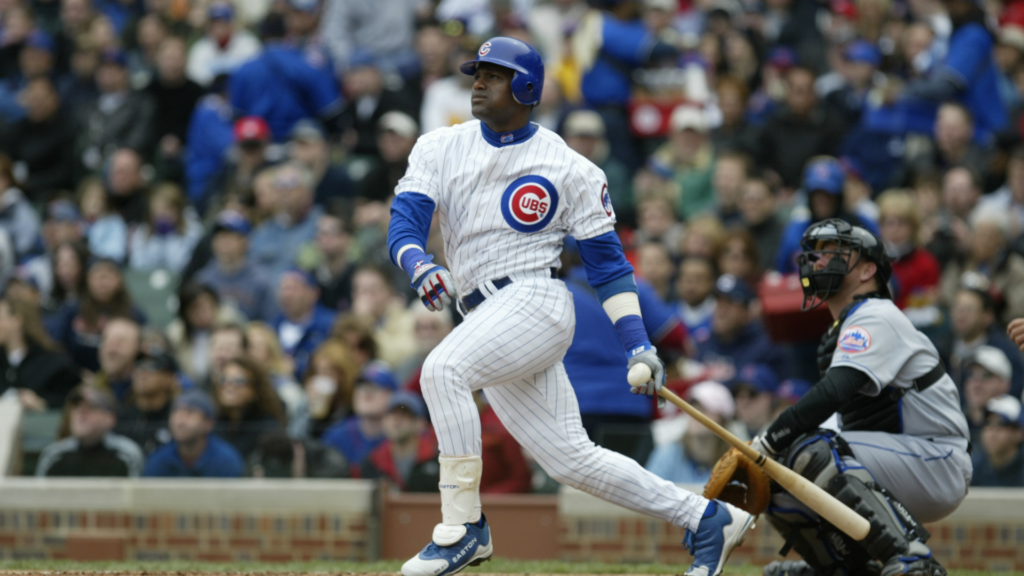
The trade: The Cubs shipped slugging outfielder George Bell to the White Sox for 23-year-old Dominican outfielder Sosa and left-hander Ken Patterson on March 30, 1992.
How it happened: Bell, a former AL MVP with the Toronto Blue Jays, was starting to decline when former White Sox GM Larry Himes, now in his first season as the Cubs’ GM, traded for Sosa for a second time in three years. Himes had traded future Hall of Fame designated hitter Harold Baines and infielder Fred Manrique to the Texas Rangers in 1989 for Sosa, left-hander Wilson Alvarez and infielder Scott Fletcher.
The result: Bell spent two seasons with the White Sox with marginal results before retiring. Sosa, meanwhile, blossomed into one of the greatest home run hitters in baseball history. His 545 homers are a Cubs franchise record, and though his career was clouded with suggestions of performance-enhancing drug use, Sosa became one of the most popular players in franchise history. The right fielder hit 60 or more homers in three different seasons — an MLB record — and he was inducted into the Cubs Hall of Fame in 2025.
The trade: The Cubs obtained 22-year-old infielder Sandberg and shortstop Larry Bowa from the Philadelphia Phillies for shortstop Ivan DeJesus on Jan. 27, 1982.
How it happened: Newly appointed Cubs GM Dallas Green was hired to start “Building a New Tradition,” as the team’s marketing campaign advertised, and pump a winning culture back into the once-dominant franchise. Green, a former top Phillies executive, first tried to acquire Julio Franco in the trade along with veteran Bowa, but Phillies brass balked at giving up their most-touted infield prospect (though they traded him to Cleveland 11 months later in a six-player Von Hayes deal). Green, who helped run the Phillies’ minor league system, then pivoted his attention to Sandberg, who played shortstop for Philadelphia.
The result: Bowa played shortstop for the Cubs through 1985 and helped them play postseason baseball for the first time in 39 years. DeJesus was an important player on the Phillies’ 1983 NL championship team. But Sandberg became arguably the best second baseman in Cubs history, playing in 10 All-Star Games and winning nine Gold Gloves and seven Silver Sluggers, and he was inducted into the Baseball Hall of Fame in 2005. He also won the 1984 NL MVP award for the East Division champions, and the Cubs erected a statue of him in 2024, one year before his death, on Gallagher Way at Wrigley Field.