
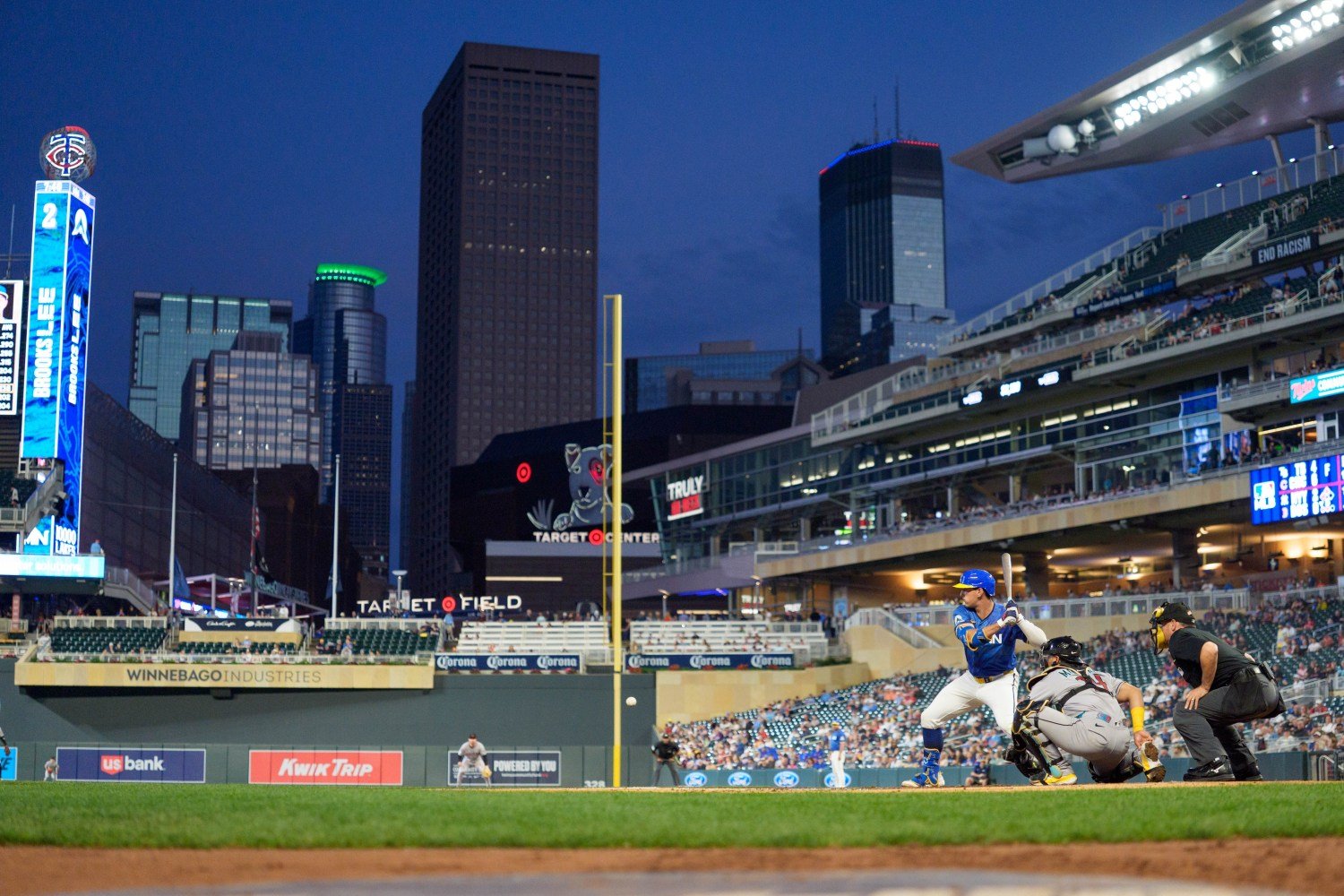
In mid-August, the Pohlad family announced they were no longer selling the team, and instead, would sell stakes in it to two limited partners. Then, for nearly four months, nothing.
On Saturday, Charley Walters of St. Paul Pioneer Press broke some news regarding the first of the two limited partner groups who will be purchasing part of the Twins.
“‘Look for Minneapolis-based Värde Partners, a worldwide multi-billion dollar credit investment corporation, to be announced soon as a limited partner with the Minnesota Twins,” Walters wrote. “The firm is one of at least two limited partners expected to assist in diminishing the team’s reported $500-million debt.”
Shortly after, Dustin Morse, the Twins Vice President of Communications and Content, told beat reporters that Walters’s reporting was inaccurate, but failed to elaborate. Cue the record scratch. That’s pretty significant news to get wrong—not quite to the level of “Dewey Defeats Truman”, but for Twins fans? Potentially huge. Also, $500 million in debt now? Yikes.
What should we make of this: the report, the rebuttal, and the refusal to say more? Let’s look at some bread crumbs, to better understands what we might expect. To be clear, before I get started, I’ll simply be working off quotes from Twins officials at the Winter Meetings, where Twins Daily’s own John Bonnes is at the scene searching for clues to this and myriad other topics that can inform the trajectory of the 2026 season and beyond.
Let’s start with clues directly addressing the limited partnership news. Bonnes asked Derek Falvey on Monday whether he is in conversations with the limited partners currently, and if Värde Partners are in fact the first group.
“it’s a fair question,” Falvey replied, but Morse interjected: “It’s an inaccurate report.” The follow-up: How inaccurate? Falvey deferred to Morse.
“Yeah, we’ll have this all wrapped up early next week. We’ll put a release out with the names and the LPs that you guys can write,” Morse said.
Based on that messaging, it seems as though both groups will be announced. That’s huge news, and will have potentially significant ramifications on the offseason.
For the first two months of the offseason (and really, dating back to the trade-deadline teardown), the assumption was the selloff would continue. Yet, Falvey was cagey about future plans, refusing to talk about a rebuild. Then, in yesterday’s presser, he added:
“I said this at GM Meetings, I was hoping to find a way to build around the core that we have. I think we have that ability now to try and navigate through that.”
When asked how sure Falvey was that he would be able to add pieces to the roster, he said:
“Now it involves a few more people that we get to talk to about it. I think that’s helpful to share some broader perspective around where we think our team is. I was hopeful, as I said at GM Meetings, that we’d get to this place … I think, at this stage, figuring a way to add to this group was clearly the best fit for all what we aligned around.”
Ok, great. Sounds like with the addition of the limited partners, there might be some payroll flexibility. How much, of course, remains to be seen. One of the major things we do not know (aside from the identity of the limited partners) is exactly how big a stake they are buying. Another crucial piece of missing information is how the cash will be used. Will it go toward eliminating the Pohlad family’s debt, perhaps in its entirety? Or will it be used to buy out specific Pohlad family members, who are less interested in owning part of the asset? Perhaps a combination of both? The answer to these questions is needed to have a better sense of the financial landscape of the team.
However, it does sound as though Falvey truly considers the Twins’ window of contention to be open, after all. He reiterated this in an interview on MLB Radio.
“My job is to try and educate [ownership] in aggregate, around the current state of our team and what it could look like if we invest in it, what it looks like going into [20270], ’28, ’29, because you’re never building for one year. You’re always thinking multiple years ahead.”
At the Winter Meetings, Falvey also spoke to his role, adding additional context about how it shifts slightly in light of the new limited partners. When asked specifically about what it will look like for him to make meaningful additions to the team:
“I’ll still continue to work with ownership to position different opportunities to them, that these are the right fits for us right now and what does it afford us. Some of that’s an education process. There’s a little bit more education that’s on my shoulders now, to make sure that I’m sharing what this looks like, what it means for our short-term team, what it means for long term. And that’ll be a big part of my role, to inform.”
From that, it’s clear that Falvey sees it as part of his role to sell ownership on the viability of adding. It also sure sounds like he’s working with someone new, rather than Joe Pohlad remaining essentially in charge. And, it sounds as though he sees that being successful, as Jeremy Zoll spoke to the types of players they are looking to pursue this offseason:
“Obviously, bullpen feels like the area that, after we went through what we did at the deadline, rebuilding that group and reinforcing in that space I think would give us a chance to push forward. And then on the offensive side, another bat or two with some thump, with some impact, to bolster a group that we’re excited about and that young core that we’re excited to keep growing with. That’s kind of the biggest opportunities and needs on our mind, trying to work for all that and making sure that we’re staying in sync with the market.”
So, we know the new limited partners will be announced next week; there’s some payroll flexibility; and the Twins intend to address the bullpen and potentially add (multiple?) impact bats. After the dark fall of our discontent, it seems there are reasons to be cautiously optimistic for the remainder of the offseason, and the 2026 season. Stay tuned.