
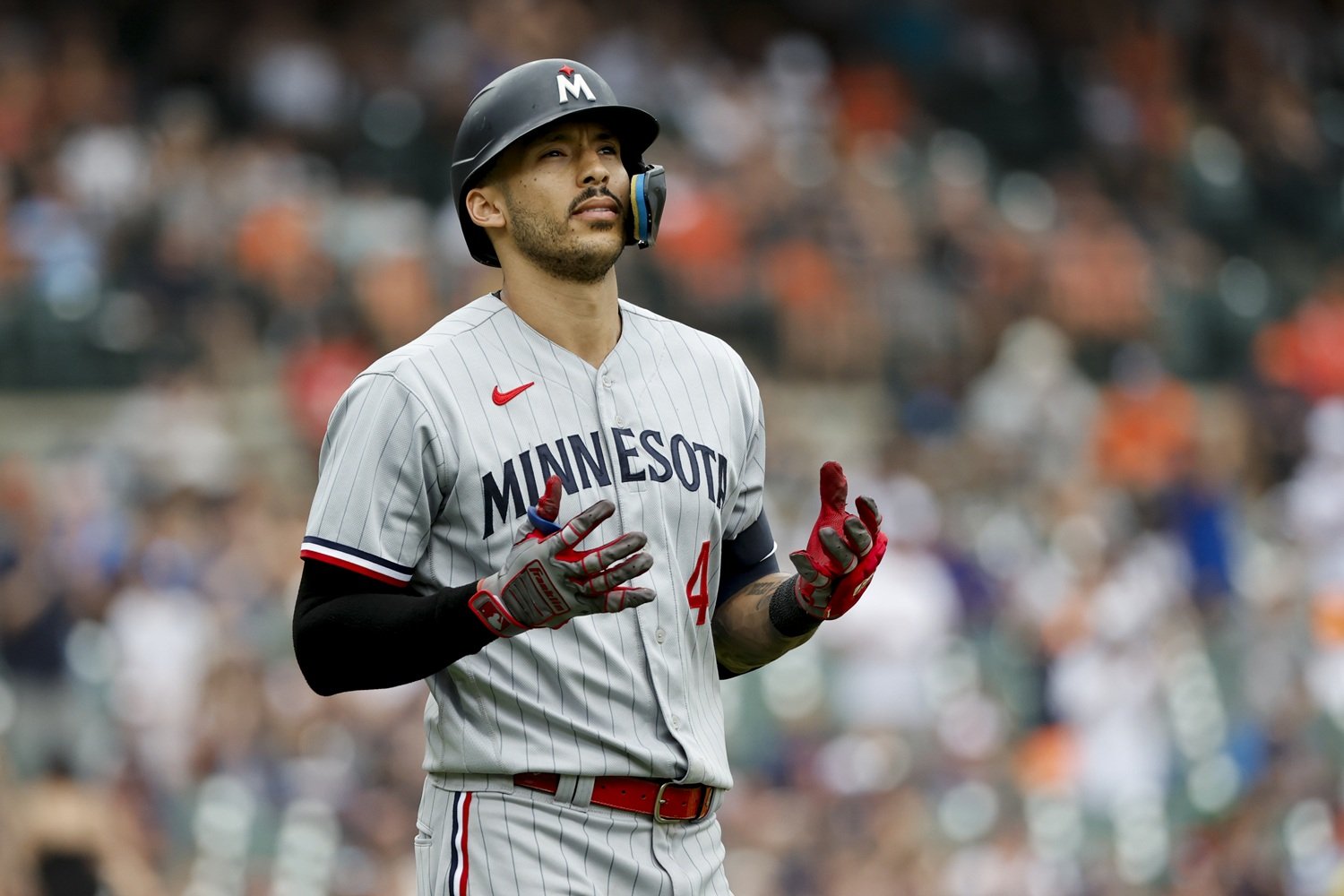
It is difficult to know from day-to-day in the offseason when your favorite team will spend some money. Well, Twins fans, we can guarantee you that the Twins will be spending money on Wednesday.
July 1 is, in the baseball world, known as Bobby Bonilla Day. Is this because of some sort of career milestone? Did he hit for the cycle in both games of a double header? Hit his 300th career home run? Swipe three bases in one game? No, it’s not any of those things. Perhaps he did something noteworthy that day? Rescue a cat from a tree, maybe? Save someone from a burning building? Nope. None of the above. Rather, it’s the day each year that he collects a $1.19 million paycheck from the Mets as part of his deferred-money deal when they cut him in 1999. He began collecting this in 2011, and will continue to do so until 2035, when he will be 72 years old. Pretty sweet deal for him, but less so for the Mets.
You might be asking yourself why this bit of baseball trivia is on Twins Daily, as it’s not at all related to the Twins. Or is it? Well, buckle up. Starting today and for the next three years, December 15th will henceforth be known in Twins circles as Carlos Correa Day, the day in which the Twins make one of their largest capital outlays of the season, and for a player that hasn’t played for them in some time. In fact, the Twins will be paying the Astros their final payment nearly three months after his contract has ended.
On this day, we as fans can collectively celebrate that the Twins are paying more for Carlos Correa to not play for them than they are likely paying any free agent to make their roster complete. In fact, they are paying the Astros more, on average, than they have for any free agent since Joey Gallo signed his one year, $11 million deal in 2022.
December 15 is also the day that we can collectively celebrate the Pohlad family for singlehandedly hamstringing Derek Falvey’s ability to build a functional roster around the slightly aging superstar they had greenlit the second signing of less than three years earlier. Were it not for this, in hindsight, ill-advised signing, the Twins very well may have been able to retool their roster heading into the 2024 offseason, instead of doing nothing. They may have been able to trade for a couple of players on bad deals at the 2024 deadline when it was clear they needed bullpen help. Falvey may have been able to set his sights a bit higher than Ty France at first base going into the 2025 season and perhaps could have signed a real DH as well. So, thanks Pohlads, for letting Falvey sign a superstar the likes of which they had never been able to before, then taking away fans’ glee.
Finally, December 15 is the day to rejoice in knowing that the Twins will be paying the Astros, on an average annual value basis, more than they are paying any of their players currently on the 2026 roster, excluding Pablo Lopez and Byron Buxton. That seems bad.
Oh. You might be wondering the actual terms of the annual payments. It’s $3 million this year, the $10 million each of the next three years, for a total of $33 million. Separately from this, it’s worth noting that by trading Correa when they did, the Twins avoided crossing the $100 million paid on the contract threshold while he was playing for the Twins. In doing so, Joe Mauer remains the only member of the Twins to make more than that number on a single deal, which is a bit noteworthy in its own regard.
Ok. Lighthearted griping and obligatory ownership-bashing aside, as much as it’s annoying to devote any part of a limited budget to dead money, trading Correa’s contract when there are payroll constraints makes sense. Knowing Falvey’s declaration that he would like to solve the bullpen and add an impact bat (or two), what can this savings actually accomplish? Well, in paying the $10 million a year over each of the next three seasons, the Twins are saving $21.5 million, $20.5 million, and $20 million in the next three seasons of what Correa was owed.
What can they get with that money? For starters, $10 million can sign a perfectly serviceable slugging first baseman. You know, the sort the Twins are perpetually in need of. In this case, say, Rhys Hoskins. Not world-beating, but probably an upgrade over Kody Clemens. And, another $11.5 million could get them a second-tier closer, a setup caliber arm, and a lefty reliever who could slot in ahead of Kody Funderburk, in case his post-deadline breakout is a bit overhyped. Think: Pete Fairbanks, Danny Coulombe, and…I dunno, someone who’s not quite a scrap heap pickup, but is sneaky good and cheap. Post firesale, the Twins are in need of three or four of those types of pitchers.
Yeah, it turns out the savings, if spent smartly, could very well get them to a team that’s better than .500. Is that enough for a postseason run? Probably not. But, if the new limited partners truly give some additional payroll flexibility, then one more impact bat and one more decent reliever would probably do it. Using the same math from above, that means the Carlos Correa trade, by itself, probably gives the Twins half the payroll the need to actually compete in 2026.
Having Correa was fun while it lasted. Singing him was unexpected, indeed; the second time more than the first. And, his exodus could bring this beleaguered team (and fanbase) some hope when it’s most needed. That is, of course, if the savings is truly spent. Should they money be spent, it’s worth asking: will any of the signings the money is used for treat fans to slick scoops from deep short? Or make tone-deaf comments about shopping at Dior? Probably not. But hopefully, fans will be able to enjoy competitive baseball late in the season rather than searching for any excuse to spend a nice summer night anywhere but at the ballpark or watching a game on TV.
Let’s hope the savings is reinvested.