
For those of you who haven’t heard of it before, ZiPS is a fun projection system that Dan Szymborski, senior writer at FanGraphs, built to predict how teams and players will do in the upcoming year. It has been around for more than 20 years, and Szymborski’s write-ups of the results have become an annual tradition. If you’re curious about the origin of ZiPS and how it works, check out his introduction for this year’s set of predictions.
Szymborski released his projections for the Brewers a few days ago, and as always, it’s quite comprehensive. It’s easy to get lost in the sea of numbers, and for those who don’t have time to dive deep, I wanted to point out some of the highlights.
First, it’s important to acknowledge that it is difficult to predict the future. While ZiPS has been remarkably accurate in the long run and over large samples, it’s not perfect. The system is based on data, so it’s not pure guesswork, but anomalous teams like the Brewers tend to exceed expectations quite a bit. That’s why Milwaukee was estimated to win just 86-90 games in 2025, but actually won 97.
Secondly, the Brewers are especially frustrating because ZiPS depends heavily on estimating how much certain individuals play and Milwaukee almost always deploys unexpected players to great effect. Szymborski says as much in his most recent write-up:
Quote
Over the last five or six years, the ZiPS projected standings have tended to underrate the Brewers, but not because of the projections themselves. Instead, this has mostly been because of me. ZiPS is neither systemically high nor low on Brewers players, but I tend to be way too conservative when making depth charts for the simulations in the spring. Typically, when ZiPS spits out a bunch of interesting projections for fringy guys on Milwaukee, I tell myself, “Sure, but no way the Brewers actually gamble and play those guys.” And then, well, they do.
This year, ZiPS is slightly more optimistic about next season, projecting the Brewers to win between 86 and 94 games. That’s a solid start, but Szymborski also notes that their team floor is incredibly high. They may not reach the same heights as they did this season, but they’re certainly the favorites to win the NL Central again.
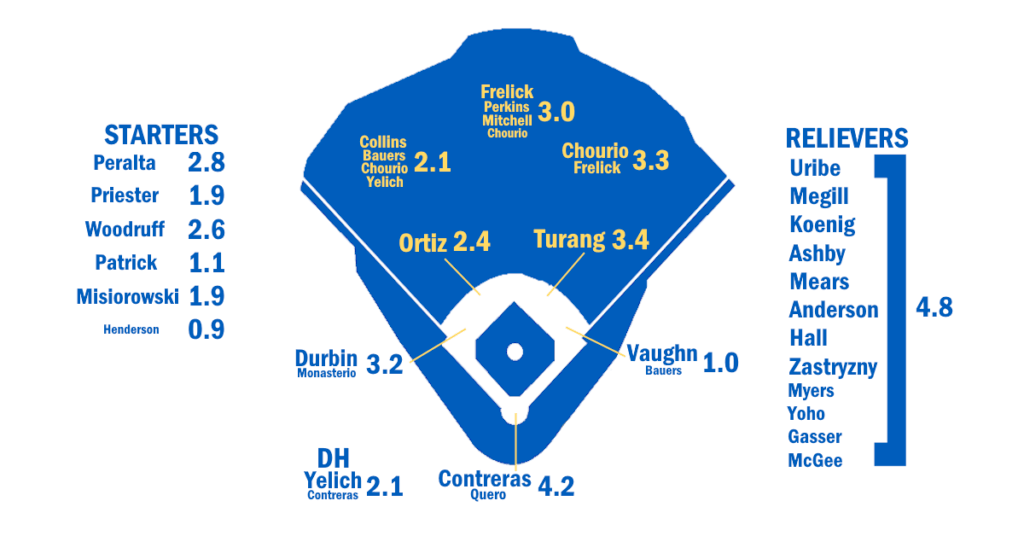
However, there are some question marks—the biggest, perhaps, being Andrew Vaughn. By now, we’re all aware of the sudden transformation from draft bust to unstoppable power hitter Vaughn achieved after being acquired by Milwaukee, but it remains to be seen whether that was a fluke or real change. ZiPS thinks it’s the former, projecting him to slash .244/.305/.413 over 577 plate appearances for a lackluster 99 OPS+.
The projection system loves the other eight starters in the lineup, projecting them to be worth 2-3 WAR each. (Note: ZiPS uses its own WAR metric, sometimes referred to as zWAR. This is different from the more common rWAR and fWAR metrics.) Interestingly, despite making massive offensive strides this year and posting a 121 OPS+ for the season, Brice Turang is projected to regress back to a 99 OPS+. In defense of the system, Turang’s first two years are still a drag on his career numbers, such that he only has a 93 OPS+ as a big-leaguer.
ZiPS is also confident that Joey Ortiz is much better than the 66 OPS+ he posted last season. Ortiz is projected to return to form and post a 90 OPS+, still below average, but a big step forward—and a solid mark for a shortstop.
The system has also turned a corner on Caleb Durbin. In 2025, Durbin was projected to post a 90 OPS+ while being slightly below average on defense. In 2026, he’s now expected to post a 99 OPS+, while being an above-average defender.
Further down the depth chart, the projection system is extremely bullish on both Jesús Made and Cooper Pratt being ready for the majors very soon. Made already has the reputation of a top prospect in all of baseball, but Pratt’s 2025 season didn’t quite live up to the hype. He posted a .691 OPS over 527 plate appearances with Double-A Biloxi, but ZiPS remains optimistic about his future contributions to the team.
When it comes to the team’s pitching, the projection system agrees with what many have been saying, which is that in the absence of one or two dominant starters, the Brewers have created a group of eight pitchers who could slot into the rotation without too much issue. ZiPS expects Logan Henderson, Robert Gasser, and Tobias Myers to be the sixth, seventh, and eighth options, respectively. This falls in line with how they were used throughout 2025.
The Brewers are also projected to have an elite bullpen ERA. Trevor Megill had the best projected FIP of any reliever at just 3.21, but in the event that he’s traded this offseason, Abner Uribe is a very close second with a projected FIP of 3.33 and a slightly better ERA+ of 134 (to Megill’s 132).
As usual, it’s clear that Milwaukee’s strength is being more well-rounded than a perfect snowball. In a day and age wherein it seems like baseball wins are bought more than they are earned, the Brewers continue to be an example of how to be successful on a relatively shoestring budget. They’re so cutting-edge that even projection systems have a hard time fairly evaluating them.
Despite humanity’s best efforts to predict the future, time remains the ultimate deciding factor. It would be shocking if the Brewers failed to meet their expectations; it’s more likely that they’ll exceed them. However, injuries happen, and baseball is rife with chaos and entropy. We’ll just have to see how the cookies crumble. In the meantime, we can only hope the organization does what it needs to build an even stronger roster.