
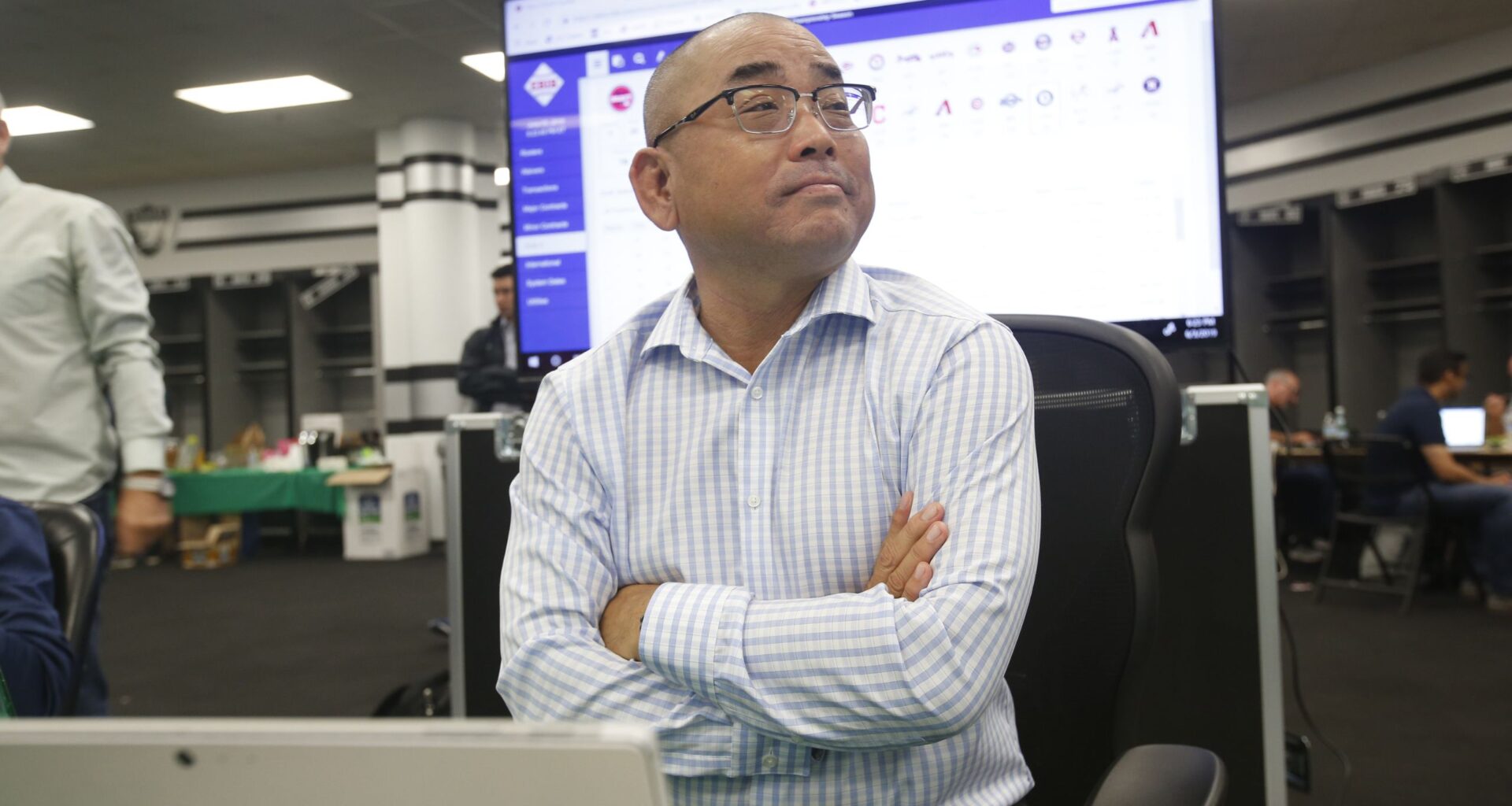
The actor portraying Athletics scouting director Eric Kubota in the movie “Moneyball” has a brief, humorous exchange with Brad Pitt, who plays the role of general manager Billy Beane.
Beane: Kubota, you’ve never played ball, right?
Kubota: Well, I played a little tee ball when I was a kid…
Beane: You’re the new head scout. Congratulations.
It was a moment that garnered plenty of chuckles when Kubota and the A’s staff saw the movie premiere in Oakland in 2011. However, like much of Hollywood, that scene was fluffed up for the big screen, and it shares little resemblance with the way in which Kubota actually earned his “head scout” job—and everything he’s been able to accomplish with the organization since.
Kubota ascended to scouting director by seizing a sliver of opportunity. He started as an A’s intern in 1984 while studying at the University of California, brought on to help promote a Cal student night at the Oakland Coliseum.
That small opening was enough to get his foot in the door, and it set up what has become a 41-year career with the A’s. In that time, Kubota has gone from a media relations intern to the longest-tenured scouting director in MLB. During that time, 41 players have been drafted, signed and played with the big league club.
For those reasons and more, Kubota is the 2025 Baseball America Tony Gwynn Award winner.
“It’s overwhelming to be recognized for this award,” Kubota said, “but it’s a reflection of all these other people who are part of me. I was really fortunate to come across people who were before me and my current contemporaries. It’s a product of all the people I surrounded myself with.”
During his time with the A’s, Kubota has watched scouting evolve from handwritten reports and constant travel to a data-driven operation. He recalls a time when there was only one computer in the entire A’s office. Now, nearly every imaginable piece of information on a player is available at the touch of a button.
From the 1989 World Series title to the “Moneyball” era to the club’s impending move from Oakland to Las Vegas via West Sacramento, Kubota has been there for every step of the franchise’s evolution.
Through the highest highs and the lowest lows, and across a career that is long and accomplished, he has continued to push the scouting department forward—always looking for ways to refine the process and identify the next wave of talent.
As fortunate as Kubota is to have turned his passion into a career, he admits that working in baseball never crossed his mind in his youth.
Growing up in Aptos, Calif., a small coastal town in Santa Cruz County about 70 miles from the Oakland Coliseum, Kubota enjoyed a classic, sports-filled childhood. He played catch with his father, spent evenings at the local field and watched or listened to baseball whenever he could.
Baseball was just a hobby, so when he left for Cal, he planned to pursue a practical career in something such as pharmacy, engineering or science at a top university.
He didn’t realize those early baseball memories had planted something deeper. So when a small opportunity with the A’s arose during his time at Cal, he took it. It was an unexpected choice that ended up shaping the next four decades of his life.
“I was super fortunate that when I started at the A’s, it felt like a mom-and-pop shop organization,” Kubota said. “We had 30 to 40 people working in the front office, and at the time, we were a big-market team. I was just fortunate that I was able to dabble in different things in the organization when I was young.”
The intimacy of the Athletics’ front office allowed him to hear conversations from different areas of the organization, something most entry-level media relations professionals normally couldn’t access.
Kubota formed strong ties in the A’s front office, especially with Dick Bogard, the team’s scouting director, and Grady Fuson, then an area scout on his way to becoming scouting director. Today, Fuson is an A’s special advisor.
Back then, scouts often sought Kubota’s insight, gradually steering him toward scouting. A small assignment to evaluate a catcher at Cabrillo JC made him realize his true passion was working in the field, not behind a desk, and it sparked a mentorship with Bogard that shaped his approach.
“It’s easy for the guys who work for him to look and see that he’s been in their shoes,” Athletics GM David Forst said. “He has their back and supports them. That’s kind of the most important thing when you’re in a leadership position.”
In the early 1990s, Kubota became an area scout in Hawaii before moving into international scouting by covering the Pacific Rim, Latin America and the Caribbean. Along the way, he saw future stars like a 15-year-old Miguel Cabrera and future closer Francisco Rodriguez, experiences that taught him that elite talent can be found anywhere with the dedication to search for it.
His work abroad also deepened his understanding of the identity of the Athletics, an organization that often had to outwork and outthink its competitors.
“As an organization, we took on that underdog challenge,” Kubota said. “We bond around that, and in a lot of cases, we bond around the fact that people don’t perceive us outside the organization the way we do on the inside.”
That mentality shaped how Kubota approached his work, especially during his first season as scouting director in 2002, drawing on the wisdom he absorbed from Bogard—who died in 2003—and from Fuson.
He knew that evaluating players, studying numbers and having conversations could only take the A’s so far, given their payroll constraints. So he borrowed a page from the playbook of Beane, someone Kubota calls one of the most influential figures in his career and life.
“I’m sitting here in my house and have been able to raise a family,” Kubota said. “There’s no way I’m here without Billy Beane. He’s a very, very loyal person who cares about his employees and made this organization special.”
It started with making sure his staff felt appreciated, seen and respected for the miles they logged on the road and the time spent away from family—all in hopes that one of the players they scouted would help the franchise succeed.
It’s a reason why scouts Neil Avent, Marc Sauer and Scott Kidd have remained with the A’s for so long.
“He takes so much pride in the people on his staff,” Forst said. “He has an incredibly diverse scouting staff, and that’s always been super important to him. That’s one thing I’ve learned from him—how important it is to care about your people and make sure they know that.”
It takes a special person to work for the A’s. From the outside, it’s easy to focus on the challenges that have long defined the team. They operate on a tight budget. They played in the aging Oakland Coliseum before taking up temporary residence in West Sacramento. The franchise will erase the constant specter of relocation when it moves to Las Vegas.
But for Kubota, whose lifelong ties to the franchise are rooted deeply, those challenges were never deterrents. They were part of the team’s identity.
During Kubota’s time as scouting director, the A’s consistently remained competitive.
The early 2000s teams included impact position players Jason Giambi, Eric Chavez and Ben Grieve, not to mention the pitching big three of Tim Hudson, Barry Zito and Mark Mulder. Every one of them was an A’s draft pick.
In 2006, Oakland reached the American League Championship Series with homegrown talent including Chavez and Zito and a new generation of draft successes, led by Huston Street, Nick Swisher and Joe Blanton.
The early-2010s A’s playoff teams were fueled by pro scouting successes, but during that same stretch, Kubota drafted Matt Olson in 2012 and Matt Chapman in 2014. Both of them played integral roles in the team’s three playoff runs between 2018 and 2020, including back-to-back 97-win seasons.
“It means the world how those guys represent the team,” Kubota said. “We were the little underdogs that just kept up. Seeing the product on the big league field is the greatest reward, but having those relationships with these guys is what is almost equally important.”
It’s about the work behind the scenes. The countless hours on the road. The careful evaluation of young talent. And the relationships forged along the way.
It’s about spotting the next stars before anyone else sees them and helping them become the players fans cheer for decades later.
As the franchise looks toward Las Vegas in 2028, that philosophy remains unchanged. The same dedication that built championship contenders, developed homegrown stars and nurtured a culture of loyalty and resilience is alive in the team Kubota oversees today.
As new talent such as Nick Kurtz, Jacob Wilson, Tyler Soderstrom and Lawrence Butler rises through the ranks, Kubota’s influence is felt in every roster decision, every scouting trip and every success on the field.
Kubota’s career began with an internship in 1984. His stature in the industry today is the culmination of more than four decades of vision, mentorship and unwavering commitment.
His story is about building something lasting—one player, one relationship and one decision at a time.