
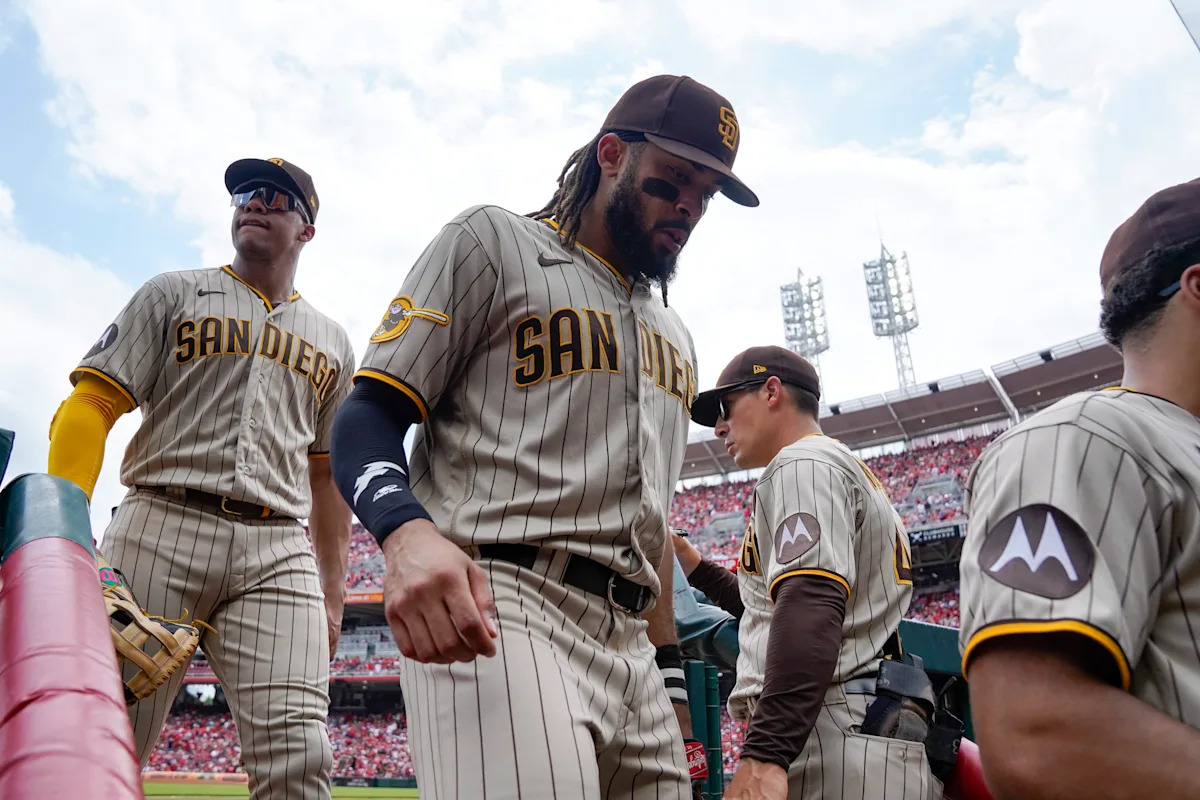
For nearly the entirety of his tenure as president of baseball operations of the Padres, AJ Preller has ensured that San Diego is one of the most active teams in MLB when it comes to transactions, whether that means swinging major deals at the trade deadline or adding aggressively in free agency.
But as the Padres franchise continues to move into a new era of leadership above Preller following the death of owner Peter Seidler — an ambitious steward willing to spend bountifully — San Diego’s comfort with throwing cash around has seemingly been reduced significantly over the past year. That means Preller is now tasked with creating a competitive roster around the collection of massive contracts already on the books, rather than escalating the payroll to new heights.
Advertisement
This dynamic makes the Padres a particularly interesting team to monitor as the offseason activity picks up. San Diego is fresh off a second consecutive postseason appearance and still in hot pursuit of its first World Series title, but the team is also in severe need of addressing some sizable holes on the roster — without much financial flexibility.
There’s a lot of work to be done, and considering the circumstances, this might be Preller’s toughest task yet. Although he hasn’t made a major move this offseason, buzz was building during the winter meetings that the Padres could have another industry-rattling transaction in store, most likely in the form of a trade.
Here’s a look at the five biggest questions facing the Padres this offseason.
1. How much will they add to their rotation?
With Dylan Cease and Michael King reaching free agency and Yu Darvish needing elbow surgery that will render him unavailable in 2026, there is ample uncertainty regarding San Diego’s starting staff. Nick Pivetta thrived in his first year as a Padre and could remain at or near the top of the rotation if he isn’t traded (more on that later), but it gets dicey after that; San Diego currently ranks 28th in projected starting pitching fWAR via FanGraphs’ Depth Charts. One familiar face scheduled to return is Joe Musgrove, who missed all of 2025 following elbow surgery, but expecting him to immediately resume his role as a No. 2 starter feels optimistic. Otherwise, it’s the enigmatic Randy Vasquez and southpaw JP Sears slotting in behind Pivetta, and both project better as backend options than no-doubt members of a contender’s rotation.
Advertisement
There was some speculation entering the winter about recently acquired relief ace Mason Miller and another All-Star bullpen arm, Adrian Morejon, making a transition back to starting to help matters, but new manager Craig Stammen shot that idea down when speaking to reports at the winter meetings:
“It’s a risky proposition, health-wise and just performance-wise. I think using those guys strategically in the bullpen is probably what’s best for us,” Stammen said. “It’s best for them also. I think that’s what they want to do, and that’s a big piece of this, too. The player knows what he really wants to do and what he’s going to be best at … We’ve tried Adrian in a starting role before. He had different variants of success. We put him in the bullpen, and he’s been dominant. I think keeping him in a dominant place is going to be important for the Padres.”
[Get more San Diego news: Padres team feed]
Keeping Miller and Morejon in the later innings is a totally reasonable choice, but it doesn’t negate the need in the rotation. Stammen acknowledged as much:
Advertisement
“I think depth-wise we’re definitely not where we want to be in that spot,” he said. “Having more pitchers that are capable of starting is definitely important for us. We also value the guys that we currently have … I’m not going to discredit those guys at all and say we need somebody that’s better than them.”
Other than re-signing left-hander Kyle Hart after an underwhelming first campaign in his return from the KBO (5.86 ERA in 43 IP), the Padres have yet to add any pitchers who could be candidates to start in 2026. Such an addition is bound to happen one way or another, but starting pitching is expensive, so how Preller navigates that market on a tight budget will be fascinating to watch.
2. Is another bullpen arm required to help replace Robert Suarez as closer, or are the in-house options good enough?
If Miller and Morejon are slated to remain high-leverage options late in games, that’s good news for Stammen’s inaugural journey managing a major-league bullpen. But Suarez, who this week signed a three-year, $45 million deal to join Atlanta’s bullpen, has been a staple of San Diego’s game-ending strategy in recent seasons, and his absence will be felt even if the acquisition of Miller and the emergence of Morejon give Stammen two highly qualified candidates to assume the closer role.
Advertisement
It’s also not just those two arms that should give Stammen confidence, as Jeremiah Estrada is a strikeout machine, and homegrown right-handers David Morgan and Bradgley Rodriguez look ready to take the next step after promising debuts in 2025. Plus, veteran lefty Wandy Peralta can still yield groundballs as well as anyone, and the Padres have already made two lower-profile major-league signings that could bolster the bullpen in Ty Adcock and Daison Acosta.
Even sans Suarez, the San Diego bullpen projects to be a strong unit. But the reality is that any concern in this arena is not necessarily about Suarez’s departure as much as it is about the rotation’s weakened state. An elite bullpen can be effective only if the rotation is able to get the game to the relievers with a lead, and that could be a challenge for San Diego given the current personnel. Of course, another way for the Padres to improve their chances of having a late lead would be to score more than the 4.33 runs per game they averaged in 2025, which ranked 18th in MLB and 11th among 12 postseason teams. Which brings us to …
3. If adding pitching is the priority, can the Padres bring in a bat as well?
While a good amount of star power remains in place atop San Diego’s projected lineup, it’s undeniable that the Padres’ run production underwhelmed in 2025. They ranked 28th in home runs with just 152, a paltry total relative to the other high-powered offenses that qualified for the postseason. A healthier Jackson Merrill should help matters next season, and Fernando Tatis Jr. (25 HR) and Manny Machado (27 HR) remain excellent players, but the lineup falls off fairly quickly after that terrific trio, especially with the expected departures of Luis Arraez and deadline acquisition Ryan O’Hearn in free agency. Arraez didn’t contribute much to San Diego’s slugging efforts in 2025 — and generally disappointed relative to his career norms — but he was still a consistent presence near the top of the lineup, a contact maven who made opposing pitchers work.
Advertisement
Without Arraez and O’Hearn, there are also glaring holes at first base and designated hitter, positions that are traditionally counted on for consistent offensive production. One of those spots could be filled by Gavin Sheets, who was a nice find, considering the minimal acquisition cost, but his output at the plate was highly volatile, with big production in May and August compensating for woeful showings in July and September. And even if Sheets is good, that’s just one guy; there are no obvious internal candidates who warrant every-day at-bats at first or DH. (Tirso Ornelas and Will Wagner: Prove me wrong.)
All of which is to say: San Diego might be right to focus its efforts on upgrading on the mound, but this is an ultra-thin position-player group that needs bolstering all the same.
4. Will the Padres trade prospects or deal from their major-league roster?
One of the most remarkable features of Preller’s tenure leading San Diego’s front office has been his ability to conjure up the requisite packages of prospects to land major-league talent in trades, despite depleting his farm system so often with such transactions. We often go into trade deadlines and offseasons wondering how the Padres will possibly come up with enough enticing minor-league talent to reel in a big fish on the trade market, yet time and time again, that’s exactly what occurs.
Advertisement
That’s largely a credit to the club’s ability to consistently draft and develop players who are valued league-wide, but even so, it’s clear that the depth from which to trade is notably diminished as things stand, especially after another round of deals in July. Top catching prospect Ethan Salas’ value has plummeted after several underwhelming and injury-marred seasons, and while there are some exciting hurlers at the lower levels, such as Kruz Schoolcraft and Kash Mayfield, it’s difficult to imagine San Diego winning a young talent bidding war to trade for a top-end arm such as MacKenzie Gore or Edward Cabrera.
Perhaps that assumption will be proven wrong in short order, but a more likely scenario, based on the reporting and the tight budget, is that San Diego attempts to ease its payroll burden by trading some combination of big leaguers with sizable salaries for younger, cheaper players who can help right away. The challenge is that some of these contracts are more onerous than others, meaning Preller might need to attach prospects to offset the cost in certain cases — if he can find trade partners willing to absorb such contracts to begin with.
With the megadeal of Xander Bogaerts likely untradeable and a trade of Tatis simply unthinkable, Pivetta (owed $51 million over the next three seasons) and infielder Jake Cronenworth (owed $60 million over the next five) are the most sensible candidates to be moved among the contracts on the books. That said, trading Pivetta while attempting to bolster the rotation is a tricky proposition — one that exemplifies the unpleasant hoops Preller might be attempting to jump through this winter.
5. Will we get more clarity on the ownership direction before Opening Day?
All these references to payroll and tight budgets are a sobering shift in tone from how the Padres operated under Peter Seidler, but it’s a crucial reality to monitor as things progress, not only with the roster this winter but also for the big-picture future of the franchise. In November, John Seidler, Peter’s brother and current chairman of the team, announced his family’s intentions of exploring “strategic options” for the Padres, including a potential sale of the team. This is a possibly enormous development that could completely alter the direction and state of affairs for baseball in San Diego.
Advertisement
It’s possible that this process results in the Seidler family maintaining a majority stake in the Padres and continuing to proceed with their newly cautious ways. Or perhaps there’s a new ownership group on the horizon, one that is eager to invest in a franchise with a fan base known to pack their picturesque ballpark when the team gives them reason to. Add the enticing pursuit of a first championship, and it’s not hard to envision the right wealthy individual (or group of individuals) being enthused about the possibility of owning the Padres. That said, their market size and unusually large portion of long-term contracts already on the books could be obstacles when it comes to attracting potential investors.
While we’re still at the earliest stages of this process, how it unfolds is likely far more important than how Preller addresses the rotation or who is the starting DH on Opening Day. Whether we get any clarity on said process in the coming months in a way that alters the club’s offseason strategy remains to be seen, but either way, this is a storyline to keep in mind when discussing anything involving the Padres moving forward.