
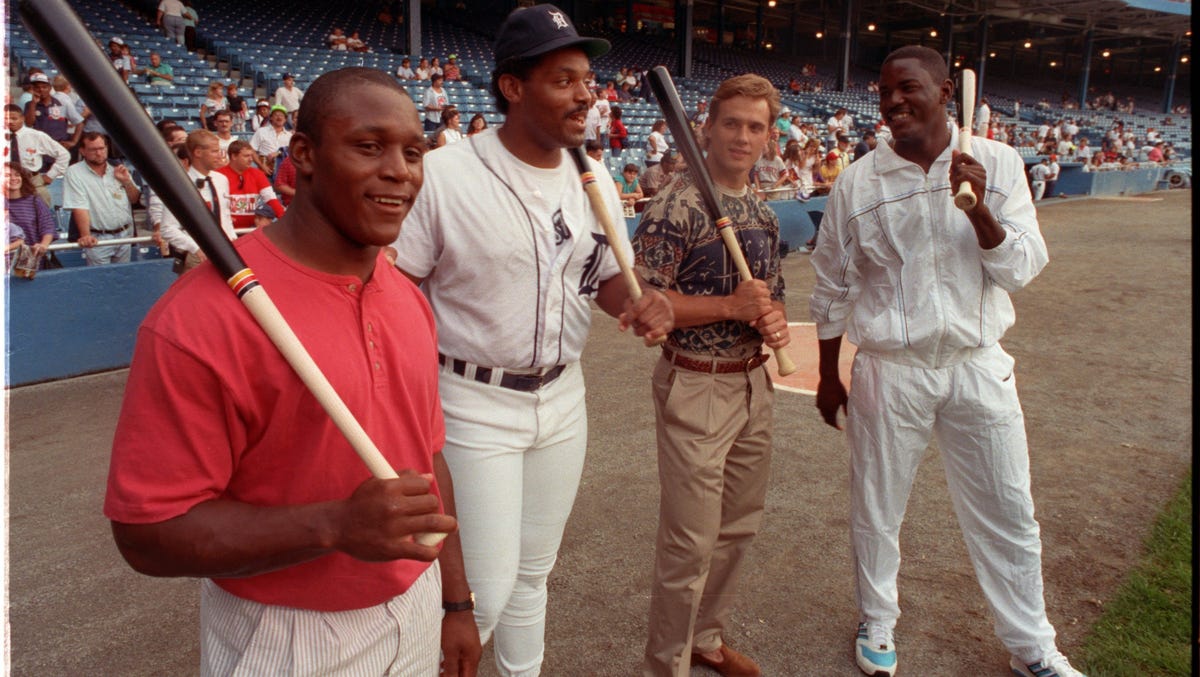


Detroit Tigers’ Lance Parrish tried to be switch-hitting third baseman
Detroit Tigers legend Lance Parrish joined the “Days of Roar” podcast, sharing the story of his brief stint as a switch-hitting third baseman.
This is an excerpt from the Free Press’ new book, “Roar of 125: The Epic History of the Detroit Tigers!” This 208-page, full-color, hardcover book celebrates the 125 seasons of Detroit’s first big-league squad, from The Corner to The CoPa. Available now at Tigers125.PictorialBook.com, it makes a great holiday present for the special Tigers fan in your life!
In baseball, as in life, it pays to have a backup plan. And so, just as we’ve put together a 26-man roster of the greatest Detroit Tigers to wear the Old English “D” … it probably wouldn’t hurt to have some backups ready to suit up for our imaginary squad in case of injury, matchup, or, heck, just wanting to watch a ball soar one more time over the roof of Imaginary Tiger Stadium, on The Imaginary Corner of Imaginary Michigan and Imaginary Trumbull.
Celebrate 125 seasons of the Tigers with our new book!
These are the six players who just missed the cut for the big squad despite playing outsized roles in the 125-season history of the Tigers — no imagination necessary.
C/1B: Rudy York
Years with Detroit: 1934-45.
After a trio of games at age 20, York burst onto the AL scene with a career-high 35 homers as a rookie in 1937 at age 23. Despite not having an established position until Hank Greenberg moved off first base for him in 1940, York mashed the ball for a decade. He finished with 239 homers — including an MLB-high 34 in 1943 (when he finished third in AL MVP voting) — in 1,268 games as a Tiger and made seven All-Star squads.
1B/DH: Cecil Fielder
Years with Detroit: 1990-96.
Few Tigers have burst onto the Motor City sporting scene like “Big Daddy” did in 1990. Signed after a season in Japan, Fielder went 3-for-22 in his first five games — then hit 51 homers in his next 154, capped by a two-homer game in New York in the season finale to become the AL’s first 50-homer slugger since 1961. Fielder also drove in 132 runs to finish third in AL MVP voting that season, then repeated in third place the next year (when he merely hit 44 homers and drove in 133 runs). He hit at least 26 homers in every season as a Tiger, including 1996, when he was dealt to the Yankees at the trade deadline.
OF: Sam Crawford
Years with Detroit: 1903-17.
Playing in MLB’s Deadball era, “Wahoo Sam” — so nicknamed for his hometown of Wahoo, Nebraska — sprayed the ball around the outfield at Navin Field, leading the AL in triples five times and finishing in the top 10 in slugging percentage every year from 1903-15. That included a 26-triple season in 1914, when he also hit .314 and led the AL with 104 RBIs to finish second in AL MVP voting (behind A’s second baseman Eddie Collins, who hit .344 with an AL-best 122 runs scored). Over 15 seasons with the Tigers, the Hall of Famer (inducted in 1957) hit .309, drove in 1,262 runs (sixth in franchise history) and smashed 249 triples (second in franchise history).
OF: Kirk Gibson
Years with Detroit: 1979-87; ’93-95.
A two-sport star at Michigan State, this Pontiac native spent parts of just two seasons in the minors before debuting a few months after the Tigers hired Sparky Anderson as manager. Gibson put together his blend of power and speed for good in 1984, slamming 27 homers and stealing 29 bases while hitting .282 during the Tigers’ run to the World Series (where he delivered arguably the most iconic homer in franchise history, in Game 5 of the Series at Tiger Stadium), and finished sixth in AL MVP voting. Over parts of 12 seasons in Detroit, he hit 195 homers and stole 194 bases (still sixth in franchise history).
PH: Gates Brown
Years with Detroit: 1963-75.
At first glance, Brown’s stats over his 13 seasons — a .257/.330/.420 slash line, 84 home runs and 322 RBIs — are those of a backup outfielder. And, indeed, Brown started just 503 of his 1,051 big-league games. That’s because of his particular skill: Brown was one of the game’s great pinch-hitters — he posted a .777 OPS (including 16 homers) in 423 pinch-hit at-bats, along with 70 walks. That was highlighted by his 1968 season in which he hit .450 with a 1.392 OPS in 40 at-bats off the bench. Among all hitters with at least 300 career at-bats as a pinch-hitter, only three — Orlando Merced (.798), Smoky Burgess (.810) and Matt Stairs (.833) — in MLB history have a better OPS than Brown’s .777.
SP: Mark Fidrych
Years with Detroit: 1976-80.
What “The Bird” lacked in longevity — he was injured in his second season and never fully recovered —he made up for in star power. Despite not starting a game until mid-May in his rookie season, Fidrych captured the imagination of the nation with his high energy, pitch-to-contact approach and, well, his antics while pitching that included talking to the ball and sculpting the mound. Along the way, he posted an MLB-leading 2.34 ERA over 250 1/3 innings, thanks to an AL-best 24 complete games. He packed parks around the country, started the All-Star Game for the AL, won AL Rookie of the Year and finished second in Cy Young voting and 11th in MVP voting.
Ryan Ford is acting sports editor for the Free Press and has been with Freep Sports since January 2006. Contact him at rford@freepress.com or follow him on X (which used to be Twitter, y’know?) @theford and on BlueSky at @theford.bsky.social.