
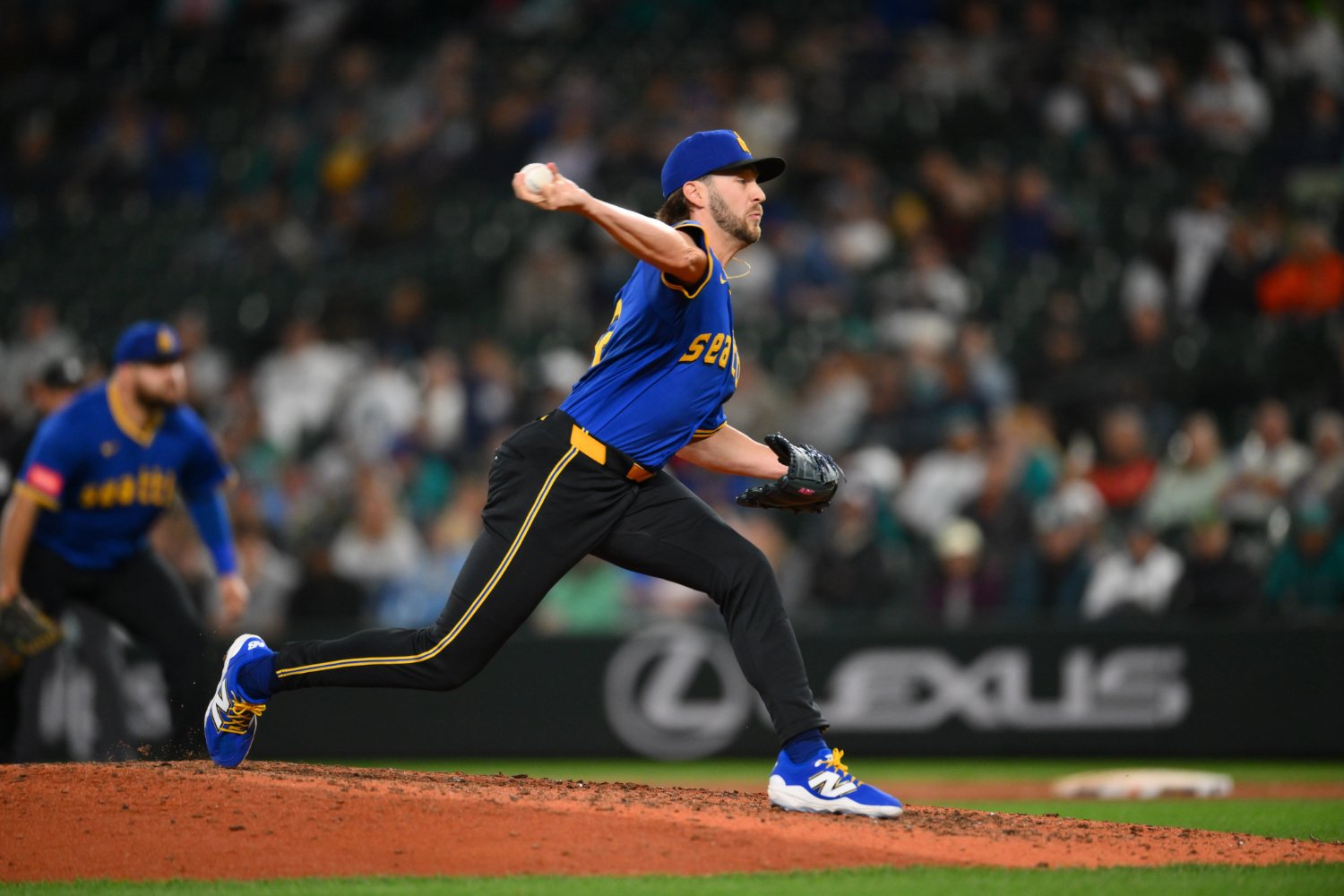
The MLB Winter Meetings have come and gone with a general whimper for the Chicago Cubs, their only major-league transaction of the week being their recent signing of veteran left-handed reliever Hoby Milner on Thursday. They did, however, complete a minor-league deal signing Collin Snider, formerly of the Seattle Mariners. It’s easy to have some cynicism when it comes to contracts like Sniders’, especially due to the timing; the Orioles are signing Pete Alonso and the Cubs are throwing pasta at the wall on Collin Snider — the headline writes itself for the most part. But beyond the initial reaction of “who cares?”, I think there is a genuinely interesting pitcher in Collin Snider, and one who could find his way into the Cubs’ bullpen plans in 2026.
First, it’s probably important to point out that Snider isn’t a particularly new name to those in the Cubs organization. While it’s true the reliever has never been a Cub, he’s worked with Tread Athletics and Tyler Zombro in the past (we’ll come back to this later). So, while it’s true that he’s yet to wear the royal pinstripes, there’s an air of familiarity for what he does well and how to work with him already.
ZW5QeUFfV0ZRVkV3dEdEUT09X0FRaFJBVmRRQXdRQVdsQUxWZ0FBQ1FBQUFGa0NWMWtBQndaUVVnWUhWd0FIQmdBRg==.mp4
Beyond just some familiar vibes, Snider has had major-league success in the past, specifically in 2024. Over 40 innings, the right-handed reliever was able to post a 1.94 ERA, 3.41 FIP, 3.52 xFIP and a sparkling 27.8 K%. He was unable to keep up the good times in 2025, though, struggling in just 25 innings with the M’s, being unceremoniously designated for assignment mid-summer. Attempting to diagnose what went wrong is key to figuring out how to get him back to his best.
The most obvious thing that went off the rails was Snider’s fastball. One of the things he did so well in 2024 was couple a low-release point with solid velocity to surprise hitters by attacking them up in the zone. Only 26 pitchers in baseball had a lower release point on their fastball in 2024, which makes his usage of the fastball at the top of the zone a bit of an awkward look for hitters — it has a “rising” action (look at how Luis Robert Jr. swings right through his fastball in the video above). Last year, the velocity on the fastball waned, dropping two full mph, and his shape dropped as well; an issue for someone who throws this pitch one-third of the time. Based on FanGraphs’ Stuff+ model, it fell from a pretty excellent 111 Stuff+ to a below-average 97 Stuff+. Getting this pitch back to peak velocity and shape is a key to unlocking the 2024 version of the pitcher.
Snider also dabbled with splitting his sweeper into two distinct pitches last year; his traditional one with more horizontal movement, and another with more vertical movement, classified as a slurve. This was a pitch designed to play nicely with his cutter-fastball combination and create a little extra depth in his arsenal.
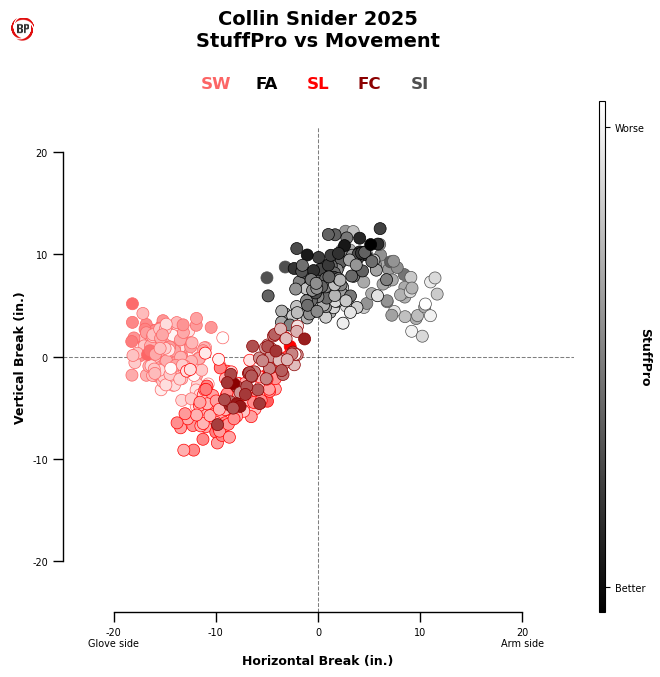
While solid in theory, this pitch was kind of a mess all season — MLB hitters crushed the thing, to a tune of a .351 xwOBA and a slugging percentage well north of .500. After he was DFA’d, he entirely lost feel for the thing, so while his velocity may have been up half a MPH while in Tacoma, this pitch became a real problem for him:
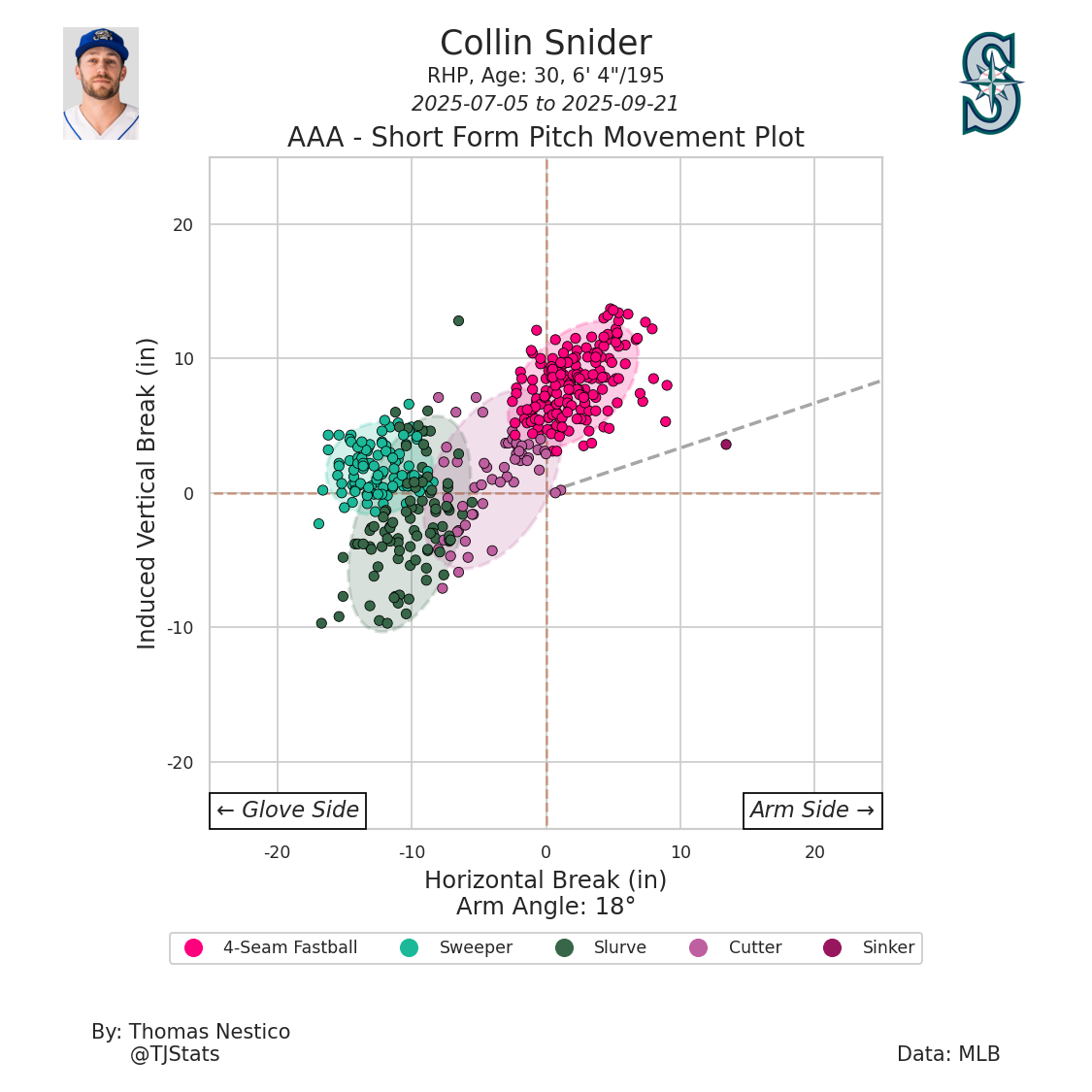
It became too close to his actual sweeper much of the time, making it hard to differentiate, while also getting too far away from his cutter and fastball to create a difficult decision point for the hitter. It really might behoove everyone to entirely scrap this thing and go back to the 2024 pitch mix.
One of the issues that we can point to when it comes to velocity and shape is that the pitcher spent nearly two months on the shelf for a lower-arm issue. Snider is a supinator and a pretty extreme one at that; he engages his lower arm to create the motion and the shapes of his pitches. This causes stress in that area, meaning that it’s both not surprising that he suffered an injury here, but also gives us a place to point as to what went wrong last season. A healthy forearm may fix much of what was ailing the righty all on it’s own, meaning less outside intervention required.
The vision for Snider is likely something akin to what Tyson Miller was for the Cubs in 2024 (who they also acquired from Seattle). Miller was a slider-fastball pitcher with a low arm slot who the team used, especially, against RHH. When both relievers are going well, they uses a high fastball to play off their slider/sweeper to great effect. To get there, the fastball velocity will have to get back to where it was, and Snider’s likely going to scrap the slurve (it’s just a bad pitch). These pitches interact with each other very well and create difficult decision points for hitters, but if one of them isn’t working, then the others will falter on their own merits. Snider would play really well with Hoby Milner, who’s devastating against LHH. While they both may fit in more as “specialists”. they can thrive in those defined roles.
Bigger picture, I think Collin Snider helps us understand the types of pitchers the Cubs are targeting. While we can’t say every pitcher is going to have the exact same profile, there are a lot of things that we can glean from this. Namely, that low arm slot Snider uses to great effect (when healthy). Thus far, the Cubs have signed three pitchers for their 2026 bullpen: Phil Maton, Hoby Milner, and Collin Snider, all three of whom have extremely low arm slots. They use them differently; Maton kills you horizontally, Snider attacks you at the top of the zone and then changes your eye level with a sweeper, and Milner is just funky as hell. I don’t think it’s an accident that they all have this type of arm slot. Further driving the point home: The Cubs signed Matthew Boyd last year and lowered the arm slot of Colin Rea to great effect,
Let’s not make a mountain out of a molehill, though. Collin Snider is a dart throw and will likely be one of many the Cubs attempt this offseason as they look to rebuild their bullpen. Given their track record, we should probably give them some runway, but it’s very possible that even after reuniting with Tread Athletics and Tyle Zombro, Snider just cannot get back to what he was in 2024. The hope here is that as he gets beyond the forearm issue that clearly hurt his feel last season, he can get back to making his unique profile work.
With as many 40-man spots as the Cubs have, there’s a real path for the right-hander to make the Cubs out of spring training if he can show he’s gotten himself right. While I doubt he’s as good as Brad Keller, who they really struck gold with last season, there’s probably a good reason to believe that despite the MiLB nature of his deal, the Cubs can at least strike silver with Snider.
What do you think of Collin Snider? Do you think the Cubs can extract as much value from him as they did with Tyson Miller? Let us know in the comment section below!