
Certainly, the list of teams that have yet to sign a major league free agent is trying to tell us something. It always is. When that list includes the Nationals and Rockies — two clubs that spent 2025 playing out the string and still managed to finish a combined 80 games out of first place — the message isn’t exactly encrypted. Those organizations have made peace with their current reality, and free agency is apparently not the place where they plan to fix it.
As a reminder, Major League Baseball ownership is not required to spend money in any sort of equitable or competitive way. There are luxury tax penalties, sure, but many teams treat those like speed bumps — something to hit harder so you get airborne on the other side. The Dodgers, perched at the top of the payroll food chain, pay a luxury tax larger than the entire payrolls of 12 other teams. This is not an accident. It’s a choice.
None of this is meant as an excuse for the Pohlad family. They are free to spend as much as they’d like. In fact, it would probably make them more money in the long run. There’s research on fandom psychology showing that when teams win championships during a child’s formative years (roughly ages 8 to 12), the emotional attachment is basically permanent. Speaking as someone who was 8 and 10 when the Twins last won the World Series, I can say with some confidence that without those titles, I probably wouldn’t be sitting here banging away at a keyboard explaining why this organization should win baseball games.
You can argue, and people often do, that baseball in Minnesota presents unique challenges. Cold spring weather. Cabin weekends. A population that wants to be outside the second the snow melts. Pepper in the lingering perception that downtown isn’t safe. (I’d argue that’s at least partially manufactured, but the response to it is very real. Target Field’s surrounding infrastructure is designed so fans can exit their cars, enter a ramp, cross a skyway, and reach their seats without ever really interacting with downtown at all.) Then there’s the simple, unavoidable cost of taking a family to a game. Wrap that all in a fetid burrito shell of losing baseball and you can see how the attendance has shrunk to near nothing.
All of that is to say: winning could solve a lot of those problems. Grabbing attention in a positive way would help awake a dormant fanbase.
It would be easy — and honestly pretty cathartic — to wallow in the reality that the Twins aren’t going to “play the spend game.” The ongoing team sale saga only reinforces why blowing past self-imposed guardrails might not be prudent when buyers never quite materialize. This is simply the world the Twins have chosen to operate in. We can be mad about it. We can tweet about it. But we don’t control it.
Which brings us to the first immutable truth of the Twins’ offseason: they are not shopping in the premium free agent aisle. You can point to Carlos Correa as evidence that they’ll chase elite talent, but even there the market was softened by injury concerns. Acknowledging that, you’d still think there should be some options in the next tier, those players who fit a team publicly committed to building around its existing core.
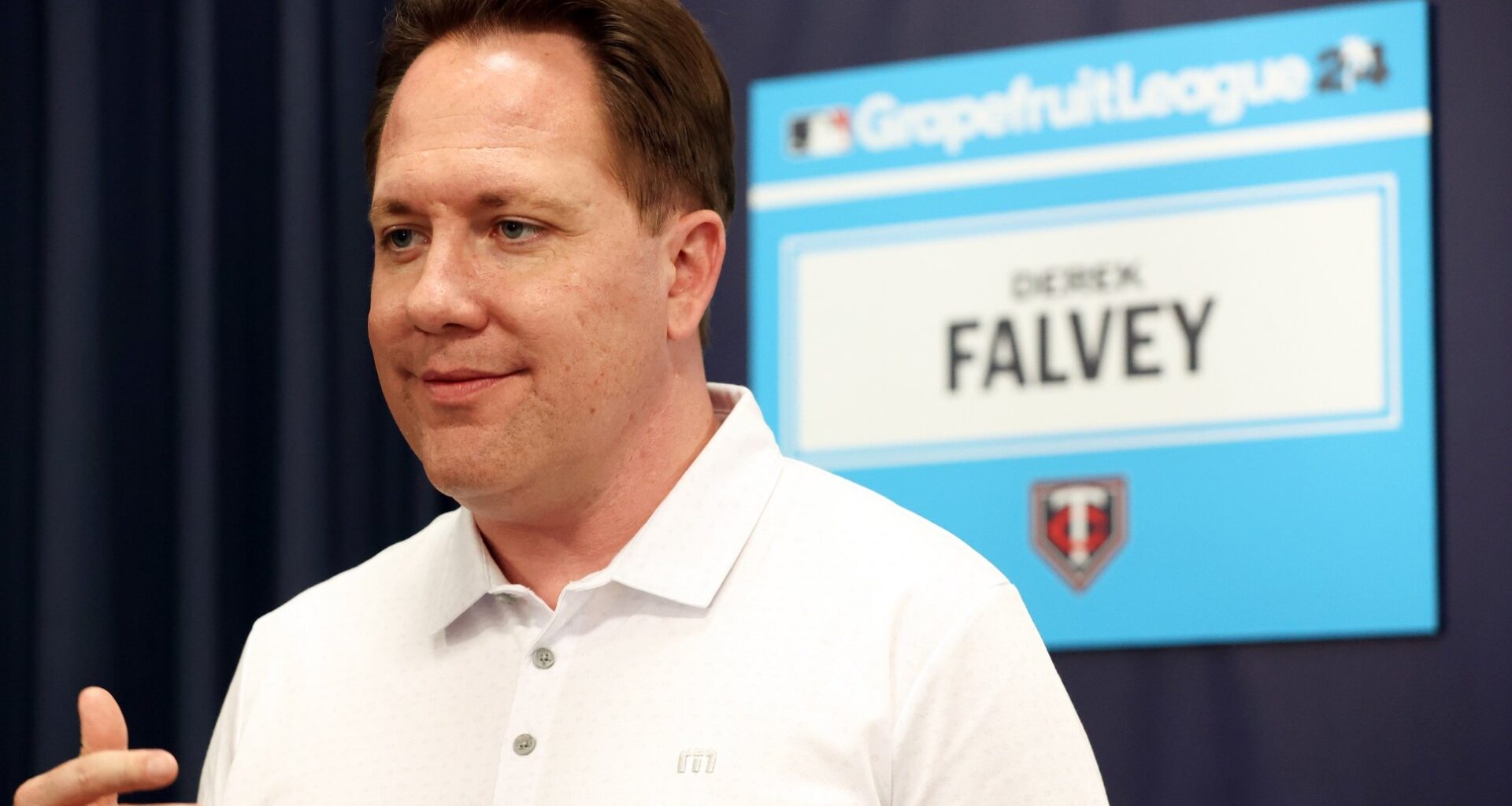
As Derek Falvey explained during the Winter Meetings, this is just how the market works now.
Quote
“There’s premium free agents every cycle seeking some of the most significant contracts every offseason. You’d be surprised how many guys behind that all think they peg off of that. Some teams might say ‘I know this team has a lot of money to spend on this player but if they don’t get him we’re right in the mix in the next band.’ That’s six players who all think they’re getting the next band of money. There’s a bit of a domino effect that doesn’t necessarily mean bargain bin or guys that are cheaper. It’s just the reality of the sequence of events.”
The Twins have openly acknowledged the need for a power bat, but the odds of that bat being the market-setter — someone like Pete Alonso — were always close to zero. Yes, it would have been fun to watch the Polar Bear deposit baseballs into the Target Field seats for a couple of summers. It’s also true that aging corner infielders on long-term deals have a tendency to stop aging gracefully right around the time the contract gets uncomfortable. The real question is whether similar production can be found in the next tier — the Ryan O’Hearn or Carlos Santana types who sat just behind Alonso in WAR in 2025.
That doesn’t mean help isn’t coming. As Falvey noted, conversations with late-signing free agents often begin far earlier than fans realize.
Quote
“There will be plenty of time where we make an offer on a player in late November or early December and be told ‘We’re not ready to engage on the offer.’ You go with no feedback for a period of time. That happens plenty. Eventually, you get to it later. Last year, Harrison Bader was a guy we liked… We ultimately came to a place where we could agree on a deal until much later. Danny Coulombe, a good fit for us, and even Ty France later on, a guy we monitored through the offseason. All those guys came later in the offseason, but we were talking about them in December.”
It’s not sexy, but it’s worth remembering that Bader’s 4.4 WAR in 2025 ranked among the best of any current free agent center fielder — and 2.7 of that came in a Twins uniform. Taken together, the Bader, Coulombe, and France trio produced 5.1 WAR at a combined cost of roughly $8.75 million. That’s not a terrible return for waiting out the market. That said, there’s a fine line between acknowledging efficient roster construction and applauding austerity, and celebrating miserly decision-making by front offices might be the most lasting — and frustrating — legacy Moneyball left an entire generation of fans.
The second notable offseason trend is the reliever market, where top-end arms have been scooped up like James Woods following a trail of candy — and the Twins haven’t even been rumored participants. This is especially confusing given that the front office effectively emptied the bullpen at last year’s trade deadline. It’s also a team that operates squarely in the modern philosophy of shortening games and leaning heavily on relievers. In 2025, Twins relievers threw multiple innings just 109 times. Only the Cubs and Phillies used their bullpen in shorter bursts.
If there were ever a roster primed for a bullpen reload, it’s this one.
There are reasons for the restraint. Historically, Falvey’s front office has avoided multi-year deals for free agent relievers. Most additions come late in the offseason, on one-year contracts. Given the volatility of bullpen arms, that logic tracks. Pitching is the most expensive commodity on the open market, and the Twins have invested heavily in an “arm barn” designed to produce options internally at a fraction of the cost.
There’s also confidence in the current wave of young arms. Just as Griffin Jax and Louis Varland before them, several starting pitching prospects are likely to be converted into relievers. Scroll through the list of arms acquired or already in the system, and it’s almost a certainty that one or more will be asked to handle late-inning duties by season’s end.
The Twins will continue to take shots on one-year relievers and waiver claims they believe can be molded into something more. It hasn’t always worked, but keeping long-term money off the bullpen preserves flexibility elsewhere.
Still, it’s hard not to feel exhausted by the annual exercise of justifying all of this. From a fan’s perspective, the math is simple: identify the best players and go get them. The Twins’ ownership and front office have chosen a different equation, complete with clearly defined guardrails. And like it or not, they’ll continue operating within them — come hell, high water, or another quiet winter.