
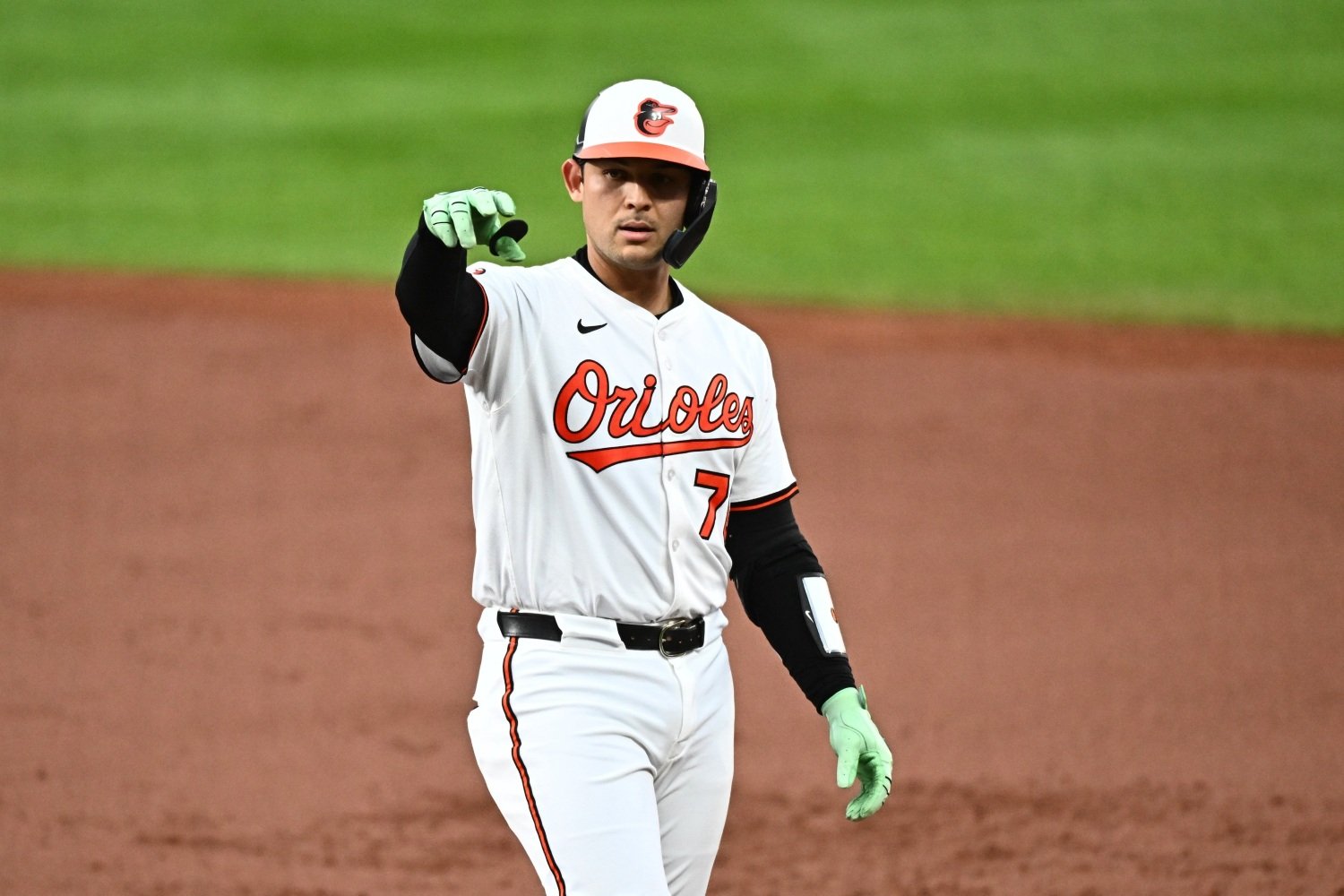
In the last 50 years, only one catcher has had at least 400 big-league plate appearances in their 20s with a materially worse OPS+ than Alex Jackson‘s career mark of 46. Twins fans needn’t strain themselves to imagine such a player, though, for that one special case was Drew Butera (36 OPS+). That’s the caliber of player the Twins acquired from the Orioles earlier this winter—one of the worst hitters in baseball history.
That’s a bit reductive, though. It ignores some important facts about Jackson, and it gives a bit too much credit to the past. Firstly, while Jackson has undeniably been a bust since being taken sixth overall in the 2014 MLB Draft, it hasn’t been because he didn’t develop as a defender, and it hasn’t been because he lacked athleticism. He’s an above-average framer and thrower, and he’s shown plus power potential even en route to some of the ugliest stat lines in recent memory. He even runs well, especially for a catcher. Jackson is an elite rotational, explosive athlete; he just swings and misses too damn much to convert that capacity into production.
Secondly, but more importantly, we live in the fastest-changing and least hidebound baseball environment the world has ever known. It’s an age of technological evaluation and development, and in it, teams are not slaves to players’ track records. What happens on the field still makes up the lion’s share of a club’s assessment of a player, to be sure, but ‘what happens on the field’ no longer needs to be messily summarized by an examination of the results. Teams can evaluate players’ tools, skills, and approaches in ways that allow them to imagine a future even for a player with a truly moribund past.
In Jackson, the Twins see at least some chance of a turnaround, despite his .153/.239/.288 career batting line and the fact that he’ll turn 30 on Christmas. They have three key reasons for that hope:
Jackson’s bat speed increased from 74.4 miles per hour in 2024 to 76.1 this season.
He got much more selective in 2025, swinging less at pitches outside the strike zone and improving his balance between patience and aggressiveness.
He has an upper-tier throwing arm behind the plate and a Statcast Sprint Speed of 27.5 feet per second.
Let’s talk about the implications of each of those. The increase in bat speed took Jackson from plus to elite in swing speed, making him a more dangerous power hitter in 2025 than he’d ever been in the majors before. You can measure that by results (13 extra-base hits in 100 big-league plate appearances), but it’s just as evident in markers of process. Jackson pulled the ball more often, especially in the air. He posted a 107-mph 90th-percentile exit velocity, up a full 5 miles per hour from 2024. His slugging average on contact shot up, from .543 to .721. Guys who swing faster than 76 mph on average don’t all succeed, but they’re practically all dangerous, and they tend to get lots of chances to figure things out—because swinging that fast gives one access to elite power.
Of course, sheer bat speed matters little if one never comes into contact with the ball, and Jackson whiffs as much as just about any hitter in baseball. That’s been his greatest limiting factor as a professional hitter, and it’s not getting better, except in very limited ways. For instance, he whiffed on sliders much less often in 2025 (32% of swings, down from 43.1% and 46.2% in the previous two years), but whiffed more per swing, overall—nearly 40% of the time. That’s why the changes he made to his approach this season were crucial.
Taking Triple-A and big-league plate appearances together, Jackson swung at 39.6% of pitches outside the strike zone in 2023, 38.3% of them in 2024, and just 34.5% in 2025. He increased his SEAGER (a metric designed by Robert Orr of Baseball Prospectus to evaluate a hitter’s selective aggressiveness, by assigning decision value to each swing/take decision based on pitch location and subtracting their share of bad takes among all pitches taken from their share of good decisions consisting of good takes) from 11.0 in 2023 to 17.0 in 2024 and 17.4 in 2025; an average SEAGER is roughly 12.5. For a player with extreme swing-and-miss issues, that ability to avoid an undue number of deep counts without getting oneself out by chasing everything is vital. In the past, he didn’t do that well enough. In 2025, he was better at it.
Now, though, Jackson is set to enter his 30s. Even good catchers usually aren’t good in their 30s. Bad ones never, ever turn into good ones—not really. The guys who survive being execrable hitters in their 20s (Luke Maile, Jeff Mathis, Butera) are defensive specialists. You can admire the fact that Jackson swatted 13 extra-base hits in 100 big-league plate appearances in 2025, but that’s in the past, now. The Twins’ question, when weighing acquiring him, needed to be whether he could do something similar in 2026.
To that end, it’s important to know that Jackson averages 86.1 miles per hour on his throws to second base, the 12th-best figure among 84 catchers who qualified for Baseball Savant’s leaderboard in 2025. It’s important to know that he runs more like a left fielder than like a catcher. Jackson made adjustments to get more out of his swing last season, both by increasing its intensity and by more judiciously managing the zone. There’s hope that he can make the most of that, because he also remains a plus athlete, capable of moving exceptionally well even among the cohort of big-league players.
There is, actually, one relevant precedent for what Jackson and the Twins hope the catcher will be over the next few years: Christian Bethancourt. After being a highly touted young backstop in the first half of last decade, Bethancourt got a good number of opportunities in the first half of his 20s, from 2013-17. He was a disaster, batting .222/.252/.316. He crashed out of the majors and ended up playing the 2019 season in Korea. He didn’t appear in a big-league game from 2018-21. However, Bethancourt also has an exceptional arm—so much so that he clawed his way back into the game at age 30 as a possible two-way player. He didn’t end up making much of a run as a pitcher, but his athleticism and power shone through when he got back to the majors. From 2022-24, he batted .233/.264/.390 in the majors. That’s still lousy, but it’s a much bigger step forward than most bad-hitting catchers take when they reach that phase of their careers. Jackson was better than that in 2025. Could he carry that over for another few years?
All the historical evidence says ‘no’. In 2025 (and beyond), though, the historical evidence isn’t the most salient information at hand. The Twins are looking for precedents and opportunities by studying bat speed, physical capacity, and approach to the game, rather than by studying statistics accumulated in past games. Jackson doesn’t have star-level upside. On his own fundamentals, though, he does have a chance to be a viable big-league backstop—even if there’s hardly anyone in baseball history on whose numbers to model that future for him.