
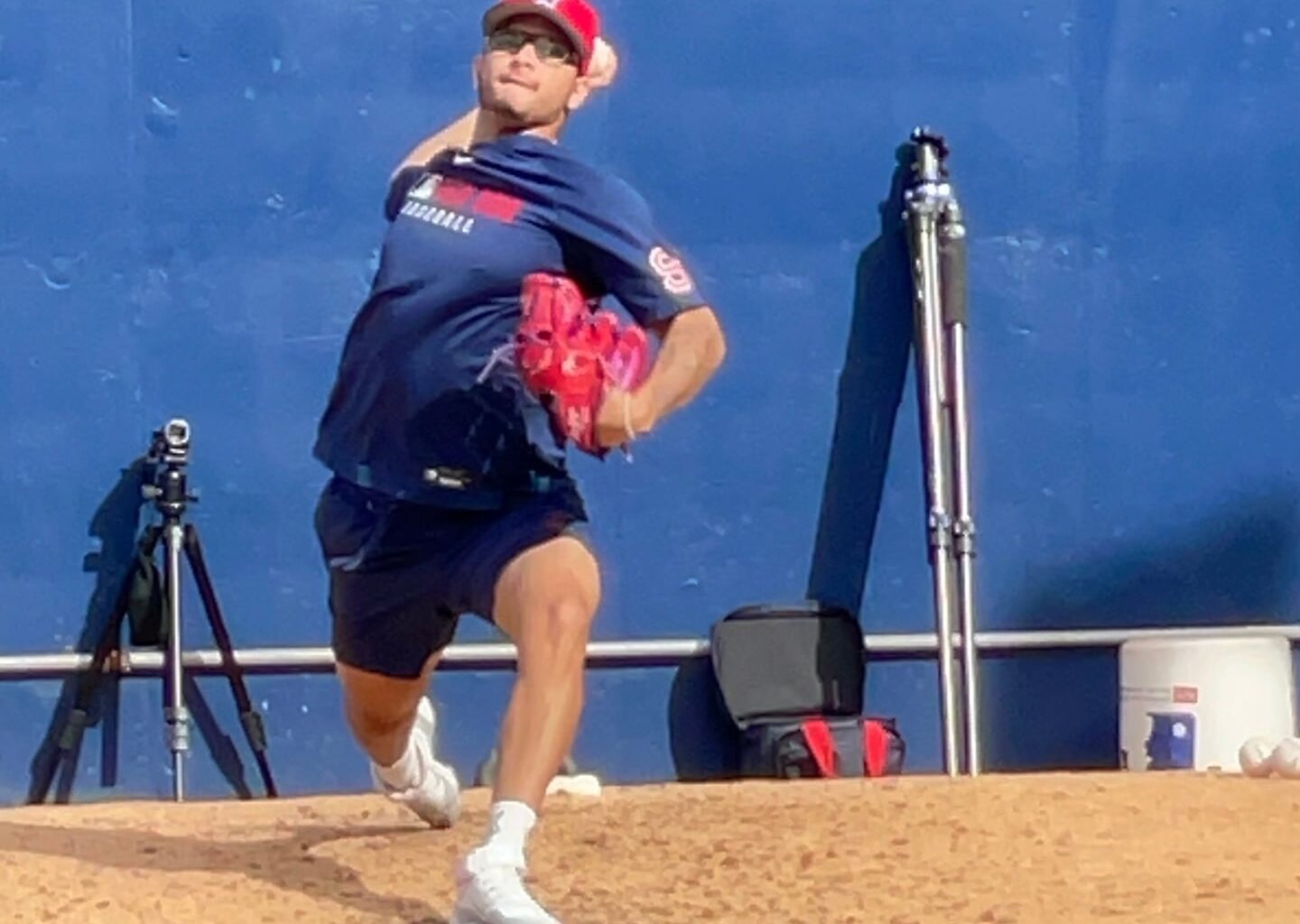
But while he unleashed 100-plus mph comets in his late-2025 return from Tommy John surgery, he’s still working to regain feel of his pitches. His fastball/cutter/slider/splitter combination suggest a ceiling as a No. 3 or even a No. 2 starter, but with significant questions about whether he’ll harness his mix in the strike zone well enough to stick in the rotation.
Get Starting Point
A guide through the most important stories of the morning, delivered Monday through Friday.
Given that injuries have limited the 22-year-old to 175 professional innings, Perales might not be ready to lock down a big league rotation spot for a contender in 2026 — or even by the beginning of 2027, if ever. For the Sox, that timetable is problematic.
Perales has just one minor league option remaining. He can be shuttled between Triple A and the big leagues in 2026, but can’t be sent back to the minors to refine his craft in 2027.
For the Sox, who are eyeing contention in 2026 and beyond, his roster status might force him to the bullpen by 2027. He could be dazzling in such a role, but not as valuable as a starter.
The Nationals, by contrast, are early in a rebuild. They have greater latitude to let Perales absorb lumps in the big leagues in 2027 to realize his fullest potential.
That’s not a guarantee that Perales will be able to hold down a rotation spot in the future, but his best chance of becoming a starter is likely with a team that can afford patience.
Bennett, a second-round pick by the Nationals out of the University of Oklahoma in 2022, has fewer professional innings (158 between the minors and the Arizona Fall League) than Perales, having missed much of 2023 and all of 2024 while recovering from Tommy John surgery. Given that his fastball sits around 93 miles per hour (while topping out at 96), he doesn’t match the ceiling of the ex-Sox righthander.
Yet several traits drew the Sox to Bennett — who has three options remaining, and thus can be shuttled between the minors and big leagues while completing his development.
He’s lefthanded, and has the size (6 feet 6 inches, 235 pounds) the Sox increasingly have coveted in pitchers. He uses that frame to get on top of hitters, releasing his fastball an average of 7.2 feet from the rubber — comparable to Aroldis Chapman, with a mark that would rank among the top 10 percent of big league lefties.
Bennett is also farther along in his rehab than Perales, having made it back to the mound and worked through some delivery issues to re-establish himself as an excellent strike-thrower by the time he finished 2025 in Double A, his last of three levels.
“When he got to [Double A], he did express to me that he felt like his delivery was out of whack. He didn’t feel like he was able to repeat like he has in the past,” said Harrisburg pitching coach Rigo Beltrán. “It was amazing to see him put in the work.”
Beltrán and Bennett looked at the pitcher’s mechanics at Oklahoma, and found he wasn’t involving his lower half as he had in college. He focused his training efforts on adding power from his legs, which translated to improved extension and strike-throwing.
In his final eight starts with Harrisburg, Bennett posted a 1.41 ERA with a 17 percent strikeout rate and 5 percent walk rate. He then led the Arizona Fall League with 25 strikeouts (in 20 innings).
“We made those delivery adjustments, and after that, he really took off,” said Beltrán.
Though Bennett is two years older than Perales, he has atypical room to improve for a 25-year-old. For now, he employs a repertoire — four-seam and two-seam fastballs; a changeup that produced a 43 percent whiff rate in 2025; a slider that he started throwing harder in 2025, turning it into more of a cutter; and a sweeper — that has allowed him to work efficiently while getting bad contact, a starting kit for a back-of-the-rotation starter.
But based on his size, the Sox believe Bennett can add power to his arsenal once on a structured velocity program like the one that yielded sizable gains with Payton Tolle and Connelly Early. If Bennett can add power, and if he can refine the shapes of his evolving secondary pitches, he could emerge as a No. 4 or even No. 3 starter — not quite the ceiling of Perales, but close enough that the Sox were drawn to his more solid floor.
“I love his demeanor. I like his competitive nature,” said Beltrán. “I see him as a No. 3 starter. He’ll be helping [the Sox] in the big leagues this year.”
Alex Speier can be reached at alex.speier@globe.com. Follow him @alexspeier.