
The 2024 MLB Draft could turn out to be one of the most loaded classes in recent memory. Two of the top four picks have already established their places as potential franchise cornerstones, and the other two aren’t far behind. The #1 prospect in baseball was also taken in the first round, as were 17 other top-100 prospects.
All of that talent doesn’t even take into account the player who was the consensus #1 player to pick in First Year Player Drafts.
It’s impossible to perfectly predict how each of those picks will turn out as big league players before selecting them. Perceived flaws can be improved upon in the minors, and overlooked traits could result in unforeseen breakouts. That said, “hindsight is 20/20”. Now, after a year of production/development, under their belt, it’s time to re-rank the names that were selected by fantasy managers last offseason.
Trying to redraft an entire new class of players is impossible, and even selected a top 25 was a challenge. There’s still time for players who missed out to prove me wrong. Players who were picked could still turn out to fall below the value I’ve predicted for them too.
With that in mind, here’s how I have ranked the top-25 performers from last year’s FYPD class.
The “A” Tier
These players have either established themselves as all-league level performers in the major leagues or are on the verge of doing so in the next few years. The names in this section are names MLB teams build franchises around.
1. Nick Kurtz, 1B – Athletics
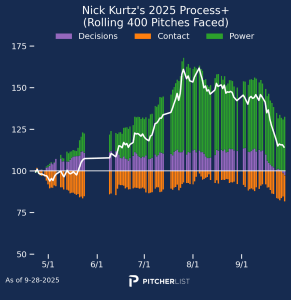
…Is that good?
Nick Kurtz was the runaway Rookie of the Year in the American League this season. His 36 home runs are the fourth most among rookies since 2015, alongside Pete Alonso, Cody Bellinger, and Aaron Judge. That’s pretty good company to keep for a player who was still in college less than a year before his debut. Kurtz is the prototypical modern slugger. There’s some swing-and-miss in his game (14.2% SwStr), but he has the elite power to make up for it (18.3% Barrel, .525 xSLG). After his first season, Kurtz is in the top 20 in NFBC’s ADP, the highest mark of anyone on this list. The 22-year-old has lived up to his hype, and then some. He likely wasn’t the #1 overall pick in your FYPDs, given some other names on the board at the time, but he’ll reward managers who did take him with elite production for years to come.
2. Konnor Griffin, SS – Pittsburgh Pirates
When the Pirates drafted Griffin at pick nine, they had a future superstar fall into their lap. After just 122 professional appearances, Griffin is the consensus #1 prospect in baseball, and could be in line for the Pirates’ starting shortstop position come Opening Day. Griffin has little else to prove on the farm. He can hit (49% Hard-Hit rate in Single-A) and hit for power (91.2 AVG EV, 7.3% Barrel), while avoiding strikeouts. There are minor knocks on his game, like a low fly-ball rate (26.2%) and a higher whiff rate in AA (12.6% SwStr), but those could be addressed as he matures and sees more professional reps. Griffin has the power and speed to threaten the 30/30 club, while providing solid on-base/extra-base hit production as well. He’s going to be the franchise cornerstone of the Pirates organization whenever they decide to call him up.
3. JJ Wetherholt, SS – St. Louis Cardinals
Kurtz and Griffin make up the “A1” tier, while the #7 pick in the Draft will have to settle for the “A2” tier. Wetherholt, like the three other names in this section, doesn’t quite have the franchise-altering ceiling that the first two names have, but will still be an All-Star-level player for the foreseeable future. Wetherholt’s first full professional season ended with Cardinals fans clamoring for their top prospect to join the big league team, and it’s easy to see why. Wetherholt mashed 17 home runs, stole 23 bases, and posted a 154 wRC+ over three levels, ending with a .428 wOBA in AAA. He has the power (91.4 AVG EV, 48.1% Hard Hit) to stick in the middle of the order, and doesn’t have the swing-and-miss issues that plague other sluggers (83.3% Z-Con, 8.0% SwStr). Given the Cardinals’ current roster situation (and the Arenado/Donovan trade sagas), Wetherholt could slot into an infield role and mid-lineup spot early in 2026.
4. Roki Sasaki, RHP – Los Angeles Dodgers
The World Series Champion lived up to the hype thrust upon him, establishing himself as a high-leverage weapon on the game’s biggest stage. The rookie picked up three saves in nine appearances, holding his opponents to just one earned run in 10.1 innings. Saying that his postseason performance (which resulted in the game’s biggest prize) could serve as a confidence boost seems strange, but the Dodgers will view it as that. Sasaki has already been tapped for a rotation spot next year, a role he struggled in to begin his career. He posted some ugly numbers as a starter (4.72 ERA, 22 BB in 34.1 IP), and didn’t improve much in the minors (6.10 ERA, 5.66 BB/9). A full offseason without the pressures that come with being a rookie could allow him to develop back into a starting role. Sasaki undoubtedly has the stuff to succeed there, and he’ll have plenty of protection around him in one of the best rotations in the sport.
5. Chase Burns, RHP – Cincinnati Reds
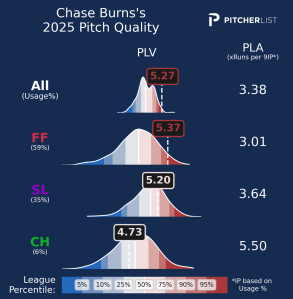
Reds fans were hoping that they’d have a future ace on their hands when Burns was selected 2nd in 2024, but I doubt they thought he’d make his debut less than a year later. Since his first appearance, Burns’ 35.6% strikeout rate topped the charts among big league starters. Even with a slightly high 8.5% walk rate, his 27.1% K-BB rate was in the top six among MLB arms, ahead of Tarik Skubal and Bryan Woo. If that’s not elite production, I don’t know what is. He had two bad outings, which inflated his ERA to over 4.00, but he allowed three or fewer runs in every other start. His fastball sits comfortably in the upper 90s with some natural cut, which makes it hard to barrel up. Burns’ best strikeout pitch was his 90-mile-an-hour slider, though, which generated a 43.7% whiff rate. His next step will be developing a true third weapon outside of those two elite offerings, but he hasn’t needed one yet.
6. Trey Yesavage, RHP – Toronto Blue Jays
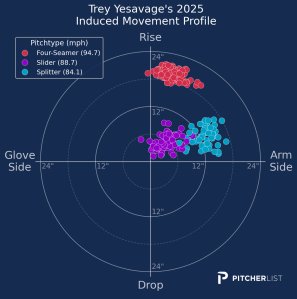
The legend of Trey Yesavage started with an 11-strikeout performance in 5.1 scoreless innings against the rival Yankees. Three weeks later, it ended with him allowing just two runs in 9.2 World Series innings, striking out 12 in the process. Now, Yesavage projects to be a key member of the Blue Jay rotation that has serious aspirations about returning to the postseason. Yesavage’s extreme over-the-top arm angle, with a dominant fastball/splitter tunnel, makes him incredibly challenging to barrel up. Whether that changes with more exposure to big-league hitters remains to be seen, but a 35.4% whiff rate, 36.3% chase rate, and 56.4% ground-ball rate give Yesavage a solid foundation to build upon.
The “B” Tier
These players either are or will be MLB regulars for most of their careers and will be in All-Star conversations every year. They hold plenty of fantasy value, but may not reach the heights of those in the “A” Tier.
7. Travis Bazzana, 2B – Cleveland Guardians
When starting the stash list last year, I predicted that (outside of Cam Smith, who was already on the MLB roster) Bazzana would be the first member of the 2024 draft to make his debut. While I was proven wrong on that, my faith in Bazzana’s abilities hasn’t diminished. His last season at Oregon State was ludicrous (.407 AVG, 28 HR, 229 wRC+), and he carried that hot streak into his professional debut (126 wRC+ in first 27 games). When Bazzana makes contact, it’s often productive. In 2025, 41% of Bazzana’s hits went for extra bases. His 27% line-drive rate and 48% pull rate indicate he’s able to make meaningful contact, even if he doesn’t have the same power tool that elite sluggers have (39.7% Hard Hit, 89.3 AVG EV). Still, at a position where power is at a premium (6 players hit 20+ HR in ’25), Bazzana makes enough meaningful contact to be a power factor at second base.
8. Cam Smith, 3B/OF – Houston Astros
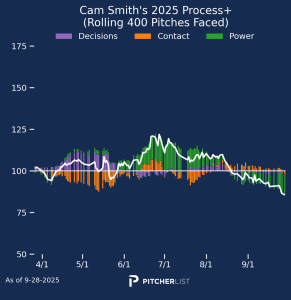
To say Cam Smith hit the ground running after being drafted out of Florida State would be an understatement. The 21-year-old put together a 181 wRC+ in 32 games after signing with seven homers and a 1.004 OPS. That was enough for the Astros to make him an Opening Day starter, and he remained on the roster all season. While a .671 OPS and 27.8% strikeout rate aren’t good, he has the tools to bounce back. His 74.5 mile an hour bat speed is 84th percentile in the league. If he can tap into his power to pair up with his average-but-developing swing decisions (29.6% Chase) and bat-to-ball ability (82.6% Z-Con), he could take a massive leap in 2026.
9. Carson Benge, OF – New York Mets
David Stearns made headlines at the Winter Meetings for several reasons, but one of them was stating that Carson Benge could win a spot on the Opening Day roster with a strong spring. For fantasy managers who have tracked baseball’s #21 prospect, that’s not a surprise. The larger surprise was the Mets not giving Benge a shot in 2025 after he dominated the minor leagues. Benge was one of 12 players 22 or younger with a 150 wRC+, and one of three players in that group to reach AAA. Benge has above-average power (92.1 AVG EV, 52.8% HardHit) with impressive contact skills (88.7% Z-Con), which make up for average plate discipline (27.6% Chase). That mix of skills, plus the ability to play center field, make him a viable candidate for a Mets team that’s already lost Cedric Mullins and Brandon Nimmo this offseason.
10. Jac Caglianone, OF – Kansas City Royals
Caglianone was thought of as a good consolation prize if fantasy managers missed out on Sasaki/Kurtz/Bazzana. He still has the tools and talent to serve as that going forward, even if his first foray into the major leagues didn’t go to plan. His 46 wRC+ and .157 AVG jump off the page as catastrophic, but the underlying numbers paint a different picture. His .157 BABIP doesn’t line up with his 42.4% hard-hit rate and 12% barrel rate. Much of that drop in production between AAA (186 wRC+) and the majors was down to an increase in ground balls (50% GB in MLB) and a 9% drop in line drives. There’s still some swing-and-miss to be wary of (12.9% SwStr), but Caglianone’s production should bounce back in 2026, provided his luck changes.
11. Gage Jump, LHP – Athletics
Jump started his first professional season in High-A, which proved to be detrimental to the hitters he faced there. Jump struck out 37% of the batters he faced (and only walked 4%) in his six appearances with Lansing before heading to AA. He wasn’t quite as dominant, but still posted a 3.64 ERA, striking out 86 in 81.1 innings with Midland. The fastball will be his calling card, sitting in the upper 90s and touching triple digits. He also has a mid-80s curveball that, while loopy at times, forces hitters to decide on the vertical plane, which causes them trouble. He limited fly balls effectively in 2025 (33.3%), with only 7.4% of balls in the air leaving the yard. Jump has historically shown good command, too, a downfall of several other pitchers on this list. The former LSU Tiger has the build and tools to join Luis Morales as the young guns in an Athletics’ pitching staff that could use some additional upside.
12. Ryan Waldschmidt, OF – Arizona Diamondbacks
The former Kentucky Wildcat showed flashes of what to expect from him immediately after signing. In 14 games in Single-A, Waldschmidt posted a 143 wRC+, walking almost 23% of the time. He wasn’t able to showcase his power during that spell (.045 ISO), but it was present in 2025. Waldschmidt mashed 18 home runs (.184 ISO) with an .892 OPS, .412 wOBA, and 29 steals. Only two other minor leaguers reached those marks last season: Griffin and Eduardo Quintero. Sharing comparisons with two other top-100 prospects is high praise, even if Waldschmidt may not have the ceiling that the pair of 19-year-olds do. Waldschmidt should start the year in AAA and could be on track to break into a Diamondbacks lineup in dire need of an outfielder early in 2026. When he does, he should be a threat for 15-20 homers and steals immediately.
13. Bryce Rainer, SS – Detroit Tigers
Admittedly, this feels harsh. Rainer’s career has barely started, as he was forced to undergo surgery in June that ended his debut season after 35 games. He was good in Single-A as a 19-year-old, posting a 134 wRC+ with an .831 OPS and .395 wOBA. The underlying data was strong too (52.% Hard Hit, 10.1% Barrel). The Tigers’ track record of developing bats works in Rainer’s favor. He projects to be a “jack-of-all-trades” type of player, with the potential to add 20+ homers and steals at the big league level.
14. Charlie Condon, OF – Colorado Rockies
Condon posted a .230 ISO, 11 home runs, and a .807 OPS in his first 55 AA games. The pop in his bat is clearly his best attribute, building on his 62 long balls in college. That amount of power, being paired up with the hitter’s heaven that is Coors Field, seemed like the perfect match. It still could be, but Condon hasn’t experienced the same rapid ascent as some of his classmates. Condon still has to develop his bat-to-ball skills (13.5% SwStr in AA), but he has the tools to establish himself in Colorado in 2026.
15. Braden Montgomery, OF – Chicago White Sox
The youth movement is underway in Chicago, and Braden Montgomery could be the next exciting prospect to join the fray on the South Side. In his first professional season, Montgomery hit 12 home runs, stole 14 bases, and posted a .804 OPS. Considering he was a year removed from a serious ankle injury and made it to AA in his first year, that’s impressive. The 25% strikeout rate and 14.8% swinging-strike rate are concerns, especially against better pitching, but Montgomery’s power tool (107 EV90 in college) makes up for it with the damage he can do at the plate. White Sox GM Chris Getz has already made it clear that he expects Montgomery to see big league playing time next season.
The “C” Tier
Although it may sound harsh, it’s not meant to be. These players are still going to be MLB contributors. Players in this section have high ceilings and have shown solid production in their professional careers, but they have more volatility in their games than those in the higher tiers.
16. Payton Tolle, LHP – Boston Red Sox
The 6’6″ southpaw flew through the minor leagues with a 3.04 ERA and 36.5% strikeout rate in 18 starts. His seven appearances with the big league club were less successful. Tolle posted a 7.84 ERA in three starts with a 1.65 WHIP and 12.8% walk rate. He was marginally better in four bullpen appearances (2.83 xFIP, .417 SLG), but is far from a lock to start 2026 on the big league roster. Tolle’s arsenal and build are starter-level, but he will be on the outside looking in with Sonny Gray (and maybe more) joining the fray.
17. Ryan Sloan, LHP – Seattle Mariners
The first of two Mariners farmhands in this section is Ryan Sloan, a second-round pick out of Chicagoland. You might be asking why he’s in front of the player drafted a full round ahead of him. The stats make it clear. Sloan posted a 3.73 ERA in 21 starts last season with a 27% strikeout rate and a walk rate under 5%. Those numbers, in tandem with a high-90s fastball, nasty splitter, and wipeout slider coming from a 6’5″ 220-pound frame, make for a profile to dream on. Sloan’s 5.56 ERA in High-A stands out, but his xFIP (2.90) paints a different picture. Sloan, working with Seattle’s pitching development team, should make the rest of the league very scared.
18. Jurrangelo Cijntje, P – Seattle Mariners
The lone ambidextrous pitcher in the sport made a compelling case to be in the “B” tier in 2025, but he fell just short. He put together a solid season overall, striking out 26% of the hitters he faced and inducing a 46% ground-ball rate. His AA starts were impressive too, posting a 2.67 ERA in seven appearances. At the same time, he has a BB/9 over four at the professional level and had an xFIP above four in AA. He dominated righty hitters (76 K, 0.78 WHIP in 66.2 IP) but struggled against lefties (39 BB, 1.98 WHIP in 40.1 IP). There’s plenty to be excited about with Cijntje, but also plenty of flaws to clean up.
19. Hagen Smith, LHP – Chicago White Sox
The former Arkansas ace was overshadowed by the immediate success of Yesavage and Burns, and by the potential of Noah Schultz in his own organization, but Smith is going to be a productive pitcher, too. The high 90s fastball and sweeper are already plus offerings that get results (34% strikeout rate), and provide a good base to build the rest of his arsenal around. That said, his 17.6% walk rate needs to come down. More command and another pitch could unlock Smith’s true potential, but he’ll make a major-league impact in 2026 if he can stay healthy.
20. Kaelen Culpepper, SS – Minnesota Twins
Culpepper was one of the breakout stars in the minor leagues last season, as one of 16 players in the 20/20 club, and one of seven 22 years old or younger. That said, he’ll be 23 next season and is yet to face AAA pitching. My concern is that his performance level drops off, and he stagnates in AAA. At the same time, he could very well prove me wrong and continue to produce once he reaches the upper levels. Given the depth the Twins have in the infield (Brooks Lee, Luke Keaschall, Royce Lewis), he’ll have to wait for consistent MLB time either way.
21. Dasan Hill, LHP – Minnesota Twins
The 6’5″ southpaw has all the tools to be a successful starter, but there’s a lot of development needed to reach that level. The plus fastball and slider stand out immediately, and his 31% strikeout rate is impressive for a 19-year-old. However, his 15% walk rate is equally as unique, and not in a good way. Hill will have to refine his command without sacrificing the pitch shapes that create the whiff rate he has. At 19, there’s plenty of time for him to do that, but it’s an easier task on paper than it is in practice.
22. Caleb Bonemer, SS – Chicago White Sox
The 2o24 second-rounder exploded onto the scene in 2025, posting a 151 wRC+ in 107 games between Single-A and High-A. He doesn’t have a standout tool, but he does everything well. His bat-to-ball ability is average to good (8.4% SwStr, 78.3% contact), and his 12 home runs and 29 steals are a testament to his power and athleticism. There’s still plenty of work to be done, but Bonemer has a solid base to build on in 2026.
23. Mike Sirota, OF – Los Angeles Dodgers
Sirota remains one of my favorite prospects to track. He undoubtedly has the talent to make an impact in the major leagues with plus power (.282 ISO), plate discipline (17.8% BB), and athleticism (60-grade speed per Fangraphs). While his immediate breakout has been impressive, he’s still in High-A. He could fly up this ranking next season, but there are other players with more impressive existing resumes than Sirota.
24. Hyeseong Kim, INF – Los Angeles Dodgers
Kim found himself in a utility role for the Dodgers in 2025, but is projected to start 2026 as the everyday second baseman as things stand. In 71 games in the majors last season, Kim posted a 95 wRC+, hitting three home runs and stealing 13 bases. Kim’s .280 AVG and .396 BABIP indicate he’s able to generate base hits, although his quality of contact (28.2% Hard Hit, 2.7% Barrel) is poor. He’s not a “must-have” fantasy asset, but his status with the Dodgers and ability to produce base hits make him an intriguing player.
25. Christian Moore, 2B – Los Angeles Angels
Widely regarded as a first-round pick in FYPD going into 2025, Moore has been underwhelming as a prospect since being drafted out of Tennessee. He was always touted as a power-over-hit prospect, but Moore’s failure to make contact in the strike zone (16.6% SwStr%) or consistent hard contact (36.3% Hard Hit) is worrying. More exposure to MLB pitching will help raise his .655 OPS, and he still possesses above-average power. However, he may not be the future All-Star Angels fans were hoping for.
Honorable Mentions
These players have too much volatility and too many question marks to be in the top 25, but they’re still intriguing names to follow from the 2025 draft. This is not an exclusive list. These are just names that have caught my eye since being drafted.
James Tibbs III (LAD), Seaver King (WSN), Bryce Meccage (MIL), Griffin Burkholder (PHI), Tyson Lewis (CIN), Braylon Payne (MIL), Slade Caldwell (ARI), Khal Stephen (TOR), Dakota Jordan (SFG), David Shields (KCR), Nate George (BAL), Austin Overn (BAL), Devin Fitz-Gerald (TEX), Ethan Dorchies (MIL), Dillon Lewis (NYY), Ryan Lambert (NYM), Sam Antonacci (CWS).