
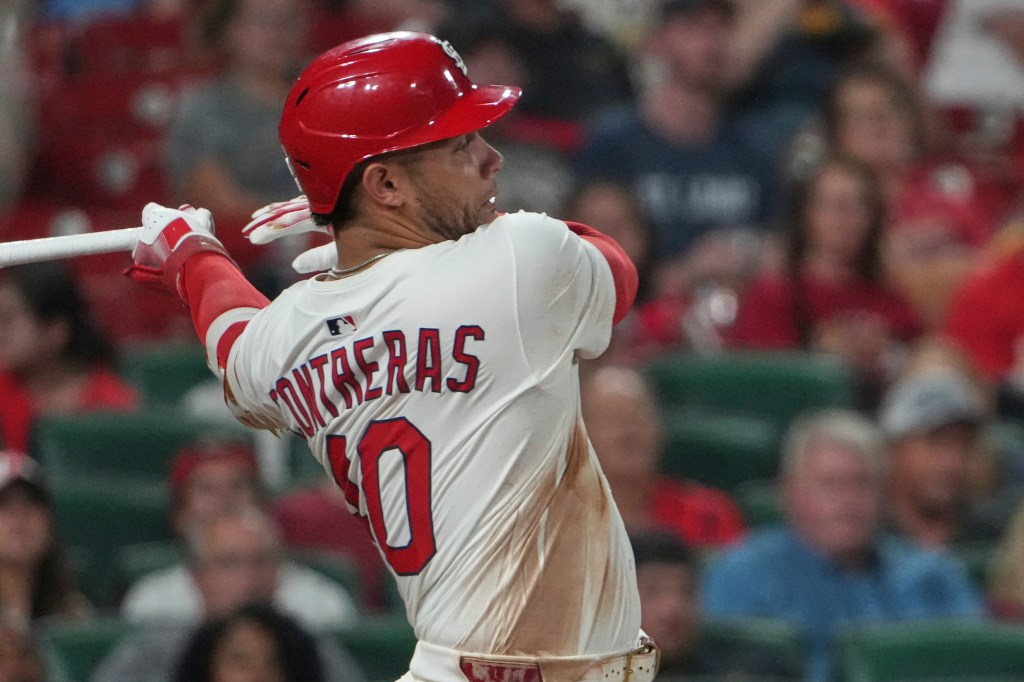
On Sunday, after two months of prioritizing pitching and being outbid for free-agent sluggers, the Boston Red Sox landed their first bat of the offseason.
In their second trade with the Cardinals in the last month, the Red Sox swapped right-handed rookie Hunter Dobbins and pitching prospects Yhoiker Fajardo and Blake Aita for veteran catcher-turned-first-baseman Willson Contreras and cash considerations.
Contreras may, at least partially, solve several key Red Sox problems. His arrival also creates new questions for the front office to answer.
Here are some of the many angles and layers to the latest Red Sox move:
Cost-effective consistency at first base
The Orioles outbid the Red Sox for Pete Alonso, but Contreras is more than a mere consolation prize.
In Contreras, the Red Sox are getting one of the most consistent hitters of the last half-decade; he’s one of 15 hitters with an OPS+ of 120 or better in each of the last four seasons. (Rafael Devers is also on this list.)
Contreras and Alonso are comparable hitters in several metrics. Since the start of 2023, Contreras has a 127 OPS+, Alonso 130+. They have averaged 3.5 and 3.7 at-bats per strikeout, respectively.
Over the last two seasons, the two first basemen had identical .354 wOBA (weighted on-base percentage determined by each method of reaching base’s unique value as it pertains to run-scoring). Alonso was worth 5.6 Wins Above Replacement, Contreras 5.4.
Alonso is younger and offers more power, but Contreras gets on base and despite only becoming a full-time first baseman this year, is a more capable defender; his plus-6 Outs Above Average tied for fourth among qualified major league first basemen while Alonso’s minus-9 OAA ranked 39th out of 40.
There’s no comparison to the ‘25 Red Sox first-base setup: Triston Casas, until his season-ending injury in early May, then a hodgepodge of Abraham Toro, Romy Gonzalez, and late-season pickup Nathaniel Lowe. They combined for negative-0.7 WAR; Contreras was worth 2.8.
Furthermore, subtracting the $8 million in cash considerations from the Cardinals, Boston will owe Contreras $28.5 million for the remaining two years of his contract, and either his $20 million club option for ’28 or $7.5 million buyout. Baltimore is on the hook to Alonso for five years and $155 million.
Pitching depth is taking a hit (literally)
As of 7 p.m. ET on Monday, Red Sox have yet to spend a single penny in free agency this offseason. Only the Colorado Rockies can say the same.
Instead they’ve relied on trades to reshape the roster, and given up a significant amount of their newfound pitching depth (though they’ve hung on to top lefty prospects, Payton Tolle and Connelly Early). In the two Cardinals deals alone, the Red Sox have shipped off five pitchers, including three of their top prospects; Baseball American planned to include Clarke, Fajardo and Aita in their upcoming preseason Top 30 Red Sox prospect rankings.
It speaks volumes, not only about the pitchers themselves, but the improvements to Red Sox pitching development in the two years since Craig Breslow succeeded Chaim Bloom as chief baseball officer and began overhauling the department.
Bloom, who’s now at the helm in St. Louis, spearheaded the first few years of the Red Sox farm system rebuild but had more success with position players; of the five pitchers sent to St. Louis in these trades, Dobbins was the only one from Bloom’s Boston tenure.
A balanced Boston lineup
The Red Sox have been a lefty-heavy lineup for the last several years, and manager Alex Cora hasn’t shied away from discussing the pitfalls. Three of the eight Boston batters who played at least 90 games this year are lefties – Jarren Duran, Wilyer Abreu, and David Hamilton – as are Roman Anthony and Devers, who overlapped for about a week in mid-June between the former’s debut and the latter’s trade. Masataka Yoshida and Marcelo Mayer, two players who could factor more prominently into next year’s equation, are also lefties.
Contreras, a righty, will presumably take the starting first-base gig from the lefty-hitting Casas.
Casas finished third in AL Rookie of the Year voting in ‘23, but missed the bulk of the subsequent two seasons with severe rib and knee injuries. It’s unclear if he will be ready for Opening Day, after undergoing surgery to repair a torn patellar tendon in May. The Red Sox have voiced support for the homegrown Casas, but they also attempted to trade him last winter. They entered this offseason noncommittal and eyeing alternatives.
Experience and mentorship
Contreras brings four years and 30 games of postseason experience to a clubhouse full of young players whose entire October resumés are this year’s three-game loss to the Yankees in the Wild Card series. As a rookie on the 2016 Chicago Cubs team that ended a 108-year World Series drought, he knows firsthand what it’s like to navigate the highest of high stakes.
The trade also creates a special mentorship opportunity for Contreras, who worked primarily as a catcher for the first nine years of his decade in the majors. He’s one of fewer than 500 Venezuelan players in major league history. New teammate Carlos Narváez, a fellow catcher, is another.
What’s next?
Contreras is a strong first step in the right direction, position-player-wise, but the Red Sox have other unmet needs.
Since his team’s elimination from the postseason at the hands of the Yankees, Breslow has reiterated the need for more power in the lineup. Contreras offers a solid amount – he hit 20 homers and 31 doubles in 135 games this year – but unless the Red Sox keep adding, he will essentially be no more than a replacement for Alex Bregman (28 doubles, 18 home runs in 114 games).
Boston’s most recent long-term free agent signing was Masataka Yoshida’s five-year, $90 million deal during the 2022-23 offseason, under Bloom.
By unloading Devers’ contract in June and making affordable trades throughout this offseason, the Red Sox are in a prime position to make a commitment.