
DETROIT — Before he won back-to-back Cy Youngs, before Grady Little left him in too long, before he finally helped break a fearsome curse and ended his career with a spot in Cooperstown, Pedro Martinez was a Montreal Expo.
The year was 1997, and Martinez was coming off his first of his three Cy Young Award seasons. The Expos had a tight budget and a team that had won only 78 games. Martinez, who had already been traded from the Dodgers to the Expos earlier in his career, had one year left before free agency.
“We had good players around him,” former Expos general manager Jim Beattie said. “But little by little, they were leaving, too. He said, ‘I’d love to stay in Montreal and would be willing to sign, but I don’t want to be the only guy you sign and the only guy you keep.’”
In his final year before free agency, the Expos shipped Martinez to the Boston Red Sox, a team he was initially reluctant to play for, in exchange for Carl Pavano and Tony Armas, Jr.
Martinez promptly signed a six-year, $75 million extension in Boston. The rest is history. Martinez is one of only four reigning Cy Young Award winners — joining David Cone, Roger Clemens and R.A. Dickey — to be traded in the offseason after they claimed their crowns.
This offseason, could there be a fifth?
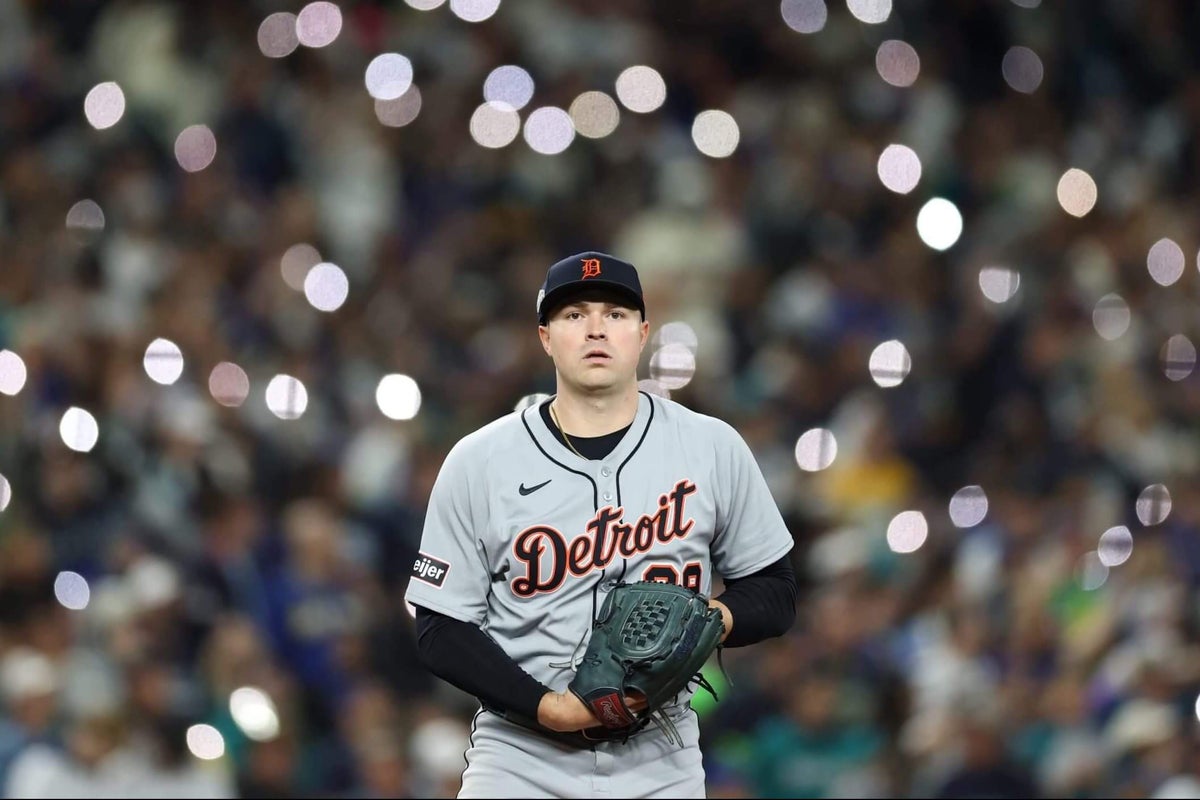
When it comes to Tarik Skubal — the talk of the winter, the spectre looming over the entire market, a topic brought up in nearly every conversation at MLB’s Winter Meetings — the Detroit Tigers are in an interesting position. They are not rebuilding or under any pressure to cut costs. They are coming off 87 wins and a second straight trip to the ALDS.
Rumors have swirled nonetheless, even as evidence of serious trade talks remains thin. For the record, Tigers president of baseball operations Scott Harris has indicated the Tigers will listen to offers, if only because they want to operate with a philosophy that no idea is ever off the table. “Some are maybe very likely moves, and some are going to be extremely unlikely,” Harris said. “But you can’t actually fully vet those opportunities unless you are willing to listen.”
To hear it from those who have been there before, these are not easy waters to navigate. Trade him now? Trade him midseason? Hold him for a playoff run? They are all reasonable options, and all potentially franchise-damaging missteps.
“Trading essentially the best pitcher in baseball when he’s been healthy, he’s a great competitor, he makes everybody around you better, you know every fifth day you have a great chance to win, that’s a very tough spot to be in,” Beattie said.
When the Kansas City Royals traded a young Cone to the Blue Jays in exchange for three minor leaguers, they were cutting costs in the aftermath of the 1994 strike.
When the Toronto Blue Jays traded Clemens to the Yankees for David Wells, Homer Bush and Graeme Lloyd, it was because Clemens demanded to be traded to a contender.
In 2012, when the Mets traded Dickey to the Blue Jays for a four-player package that included Noah Syndergaard and Travis d’Arnaud, New York was coming off a 74-win season and looking to rebuild.
Martinez is perhaps the closest comparison to Skubal — a young ace still on the rise, with one remaining year of team control and the odds of an extension slim to none. But even that was a different time, in a baseball market that no longer exists. The Expos became the Washington Nationals in 2005. When Beattie was dealing Martinez, there was no qualifying offer, and each league only had four playoff spots. Montreal would not have even received a draft pick in return had Martinez walked in free agency.
Montreal considered keeping Martinez until the trade deadline but feared the pool of buying contenders might be too small to swing a good deal.
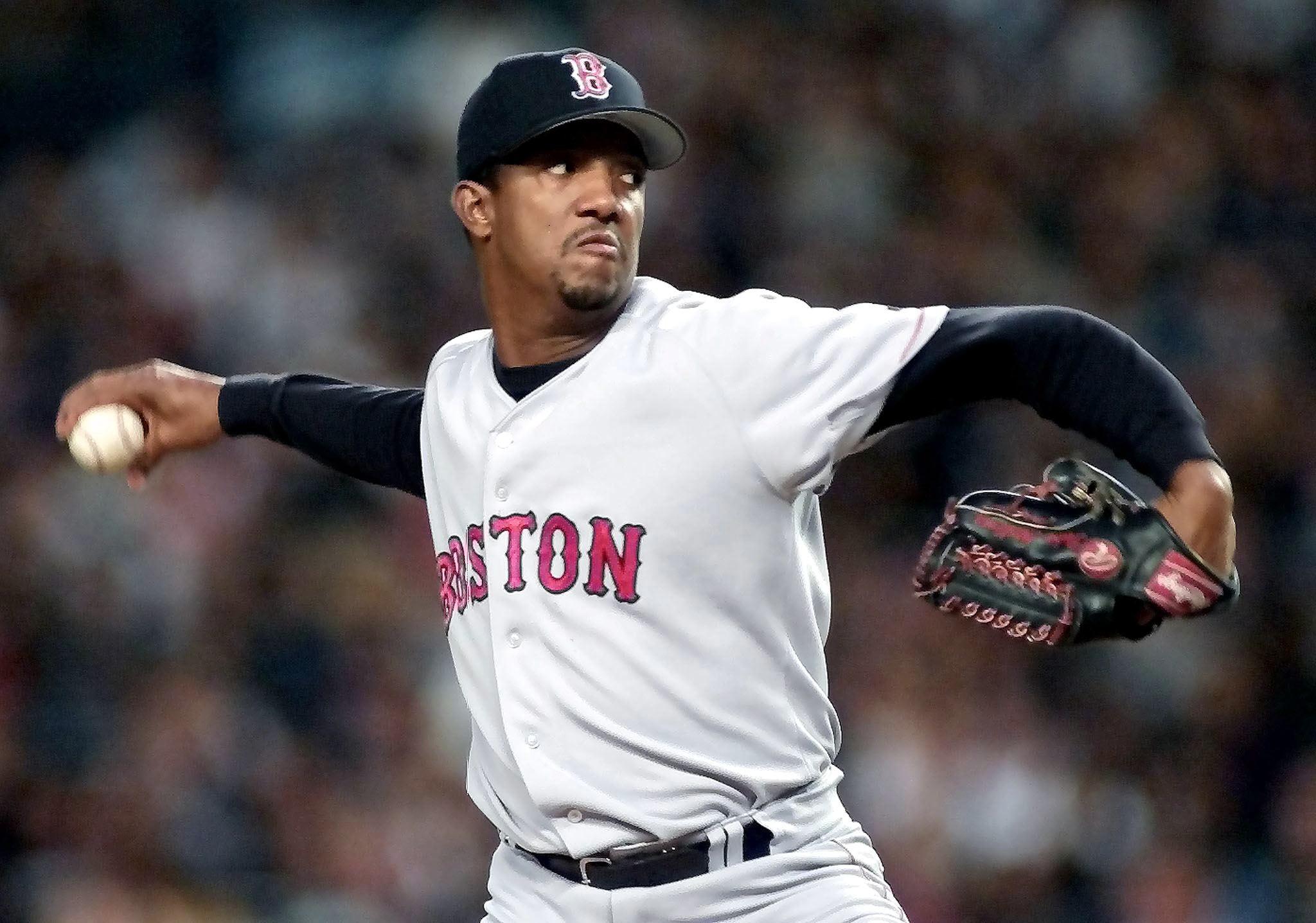
Pedro Martinez went from Montreal to Boston, where he carved out a Hall of Fame resume. (MATT CAMPBELL/AFP via Getty Images)
Modern executives who have faced similar scenarios — trade a star player or risk losing them for almost nothing — have faced the reality that there is no blueprint for these scenarios.
The Cleveland Guardians have a reputation as one of baseball’s shrewdest front offices. With the exception of excellent third baseman José Ramirez, they have largely dealt away players in their primes, capitalizing on the chance to get talent in return and bolstering their smaller-market, low-payroll style.
“We’ve all been through what Scott (Harris) is going through,” said Antonetti, president of the Guardians. “But, at the same time, it’s a really good position to be in. He has one of, or arguably, the best pitcher in baseball, who is on his roster. I think the other 29 teams would sign up for the position that he’s in.”
“What Chris is trying to say,” Mike Chernoff, Cleveland’s general manager, joked, “is we don’t ever feel badly for Detroit.”
Cleveland’s greatest example of a similar moment came in the 2020-21 offseason, when Francisco Lindor was arguably the best young shortstop in the game. A trade long seemed inevitable, but Cleveland kept its options open. Any front office that ties itself to the mast — we have to trade this player no matter what — loses all leverage. In January, the Guardians finally dealt Lindor and Carlos Carrasco to the Mets for Andrés Giménez, Amed Rosario, Isaiah Greene and Josh Wolf.
“Had it not crossed the threshold of value with Francisco, we wouldn’t have traded him,” Cleveland president of baseball operations Chris Antonetti said earlier this month. “We would have just kept him.”
Often, finding the answer depends on an organization’s status, its financial situation and its competitive window.
“There’s not one right answer that fits all situations,” Antonetti said. “You have to look at each individual circumstance and weigh all of those factors. Maybe you weigh them differently based upon what’s happening at that moment. There’s no formula for it.”
When it goes right
About a month before the 2022 trade deadline, Nationals general manager Mike Rizzo, manager Davey Martinez and star outfielder Juan Soto sat in Martinez’s office. Team officials and ownership had already engaged in lengthy talks with Soto’s agent, Scott Boras, about the possibility of an extension. There have been Boras clients such as Altuve who have signed extensions, but Boras — who also represents Skubal — most often prefers his biggest clients to test free-agent waters.
The Nationals wanted Soto to hold their best offer in his hands. Team officials passed him an envelope. Inside were the numbers: A 15-year extension worth $440 million.
When the offer was eventually declined, reality set in. The Nationals would have to look at every option, starting with the possibility of a trade. Soto was still under team control for 2 ½ more years, but the Nationals were already tearing down what was left of their 2019 World Series team. If they could get value, they’d ship Soto out.
Eventually, San Diego executive A.J. Preller, a constant disruptor, offered a massive haul that set a new standard for prospect returns. The final deal: Soto and first baseman Josh Bell for CJ Abrams, MacKenzie Gore, Robert Hassell III, James Wood, Jarlin Susana and Luke Voit. Wood, Gore and Abrams have all made All-Star teams in their young careers. Rizzo was fired this past season as the Nationals seek to modernize their organization. But the team has a core to work with, arguably a much better spot than if they had Soto and an otherwise empty cupboard.
“There was no way (at the time) the Nationals could win that trade,” a rival executive told The Athletic in 2023. “And it turns out they did.”
The Padres kept Soto for 1 ½ seasons before they, too, traded Soto and Trent Grisham to the Yankees in exchange for Jhony Brito, Kyle Higashioka, Michael King, Drew Thorpe and Randy Vásquez.
“He’s kind of a generational, Hall of Fame player,” Preller said recently. “So both trading for him and then trading Juan, we learned a lot. But it’s like, ‘Yeah, you better make sure that you hit in terms of trading for him, because you gave up a lot of value to get him.’”
When it goes wrong
The Red Sox trade of Mookie Betts to the Dodgers lingers as a cautionary tale to executives sitting in the seat the Tigers now occupy. In 2019, Betts had one year left of team control. The Red Sox were no longer operating as a big-market power. Chaim Bloom, in his first year leading the organization, traded a star at his peak in exchange for Alex Verdugo, Jeter Downs and Connor Wong.
“This trade is a very hard one to make,” Bloom said at the time. “But our mission, our charge as a department, is to compete consistently, year in and year out, and to put ourselves in a position to win as many championships as we can … We can only accomplish that goal with a talent base at all levels of the organization that is deep, broad and sustainable.”
Verdugo actually generated 8.1 bWAR in his time with Boston. Downs was worth -0.6, and Wong worth 3.3. Bloom was fired in September 2023, and all three players have since departed the organization, hardly the franchise-changing outcome teams seek when dealing a bona fide star. Betts, meanwhile, signed a 12-year extension in Los Angeles as the Dodgers built a gaudy dynasty.
Last winter, with the Astros facing a bloated payroll and an aging roster but hoping to extend their competitive window, Houston traded star outfielder Kyle Tucker to the Chicago Cubs for Cam Smith, Isaac Paredes and Hayden Wesneski.
Trading a player of Tucker’s caliber symbolized a reshaping of the Houston franchise. The Astros won 87 games last season but missed the playoffs for the first time since 2016. The club — which held on to prized left-hander Framber Valdez, now a free agent — also viewed it as the best baseball move at the time.
Tucker posted a 4.2 bWAR season for a Cubs team that won 92 games. Tucker is now the most coveted free-agent hitter on the open market, while the Astros are still in the process of reconfiguring their roster and trying to keep their window open.
“In some ways,” Cubs executive Carter Hawkins recently said, “if you’re always on one of the particular sides of a deal like that — like the quote-unquote ‘Tucker side’ or the ‘prospect side’ — if you do that over and over and over again, it’s probably not good for your organizational health.
“If you’re never, ever taking on risk in terms of giving future talent away, you might miss the chance for some upside seasons. And vice versa — if you’re always just accumulating asset value, you never actually have that come to fruition.”
Long out of the game, at his home in Hanover, N.H., Beattie knows how difficult these decisions are. These are the moves that can swing baseball history.
In Montreal, Pavano had a 4.83 ERA in four-plus seasons. Armas battled injuries and had a 4.45 ERA with the franchise. Beattie resigned from his post with the Expos near the end of the 2001 season.
In Boston, Martinez won two more Cy Youngs and the 2004 World Series. He’s enshrined in Cooperstown, one of the greatest pitchers to ever do it.
On occasions where old friends have entered the Hall of Fame, Beattie has sometimes crossed paths with Martinez at induction weekend. They have exchanged friendly banter.
“I thought you were the stupidest GM in the game,” Martinez said, per Beattie. “Now I look back on it, and I think you were the smartest GM.”
Said Beattie: “Pedro, making you happy was not the biggest part of what I was trying to do there.”