
Let’s take a moment and remember the Colson Montgomery of just nine months ago. His year started with a prospect report from FanGraphs in which the very first sentence was, “Montgomery is in a free fall.” It was more scathing than a Pitchfork review of Raffi’s “Bananaphone.”
Things got worse when the season started. Montgomery finished April with a Triple-A slash line of .149/.223/.255 and a strikeout rate of more than 40%. To our collective dismay, it seemed like he had regressed. It was the worst-case scenario for a three true outcomes hitter. I call it the Joe Borchard.
You know the rest, of course: Getz and his assistant GM, Josh Barfield, sent Montgomery to an extended Spring Training with director of hitting Ryan Fuller. (Josh Barfield had done something similar with Geraldo Perdomo before jumping from the D-Backs to the White Sox), he came back rejuvenated, and slugged .529 in 71 big league games via some of the most disrespectful contact I’ve ever seen. I say that with affection.
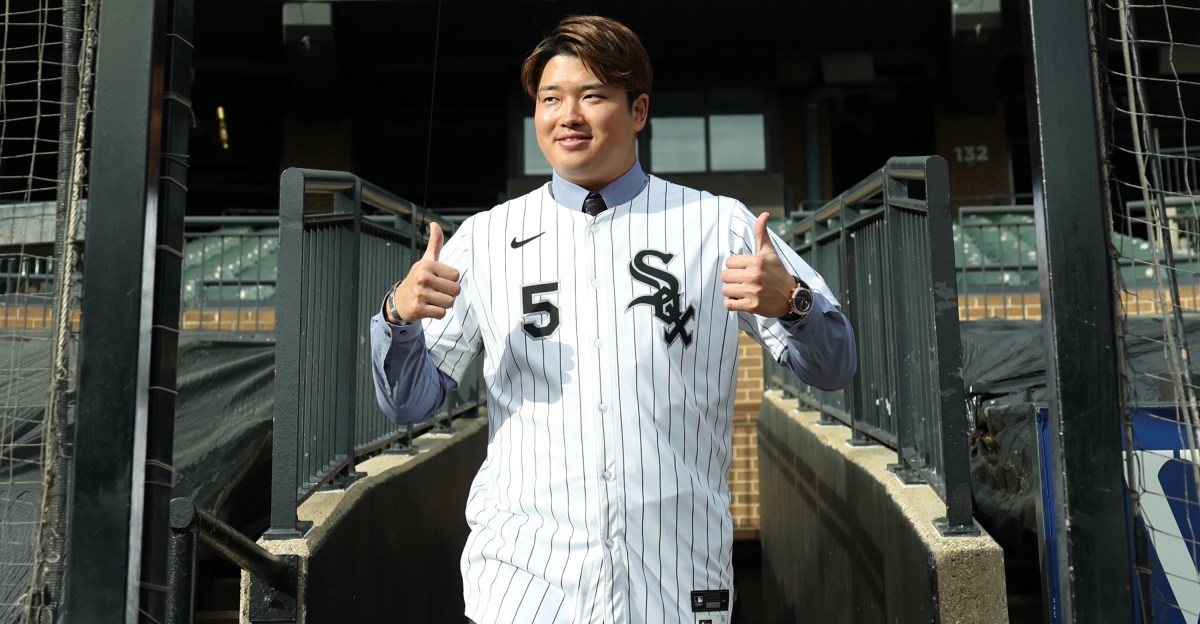
Next, let’s take stock of Munetaka Murakami at this moment. We’ll begin with an approximate measure of my enthusiasm:
Murakami smashed 56 home runs in 2022, at the age of 22. His trajectory has gone down since, owing to some very real flaws in his approach, which is why the White Sox got him on a bargain, two-year contract. His Nippon Professional Baseball (NPB) season numbers were still outstanding:
2023 140 games, .256/.375/.500, 31 home runs
2024 143 games, .244/.379/.472, 33 home runs
2025 56 games, .273/.379/.663, 22 home runs
It’s OK to get excited when you see these numbers. I sure am!
Murakami’s underlying metrics are going to be incomplete until he gets some MLB games under his belt, as Statcast metrics are difficult to find for NPB. Thankfully, I have managed to discover some of Murakami’s numbers for 2025 courtesy of Yakyu Cosmopolitan and David Adler.
The Good
A fly-ball percentage of 55.8 coupled with a home run to fly ball ratio of 31.4%. Basically, half his hits were fly balls and one in every three fly balls was a home run. Roughly speaking, that’s a home run for every six balls put in play. ONE HOME RUN FOR EVERY SIX BALLS PUT IN PLAY!
The Bad
Murakami’s strikeout rate is already high (28.6%), so that puts a damper on “balls in play” as a plus-metric. The issue extends across all pitch types, and the conventional wisdom is that MLB pitching is going to be a step up for Mure. Here are his NPB whiff numbers by pitch type, compared to Colson’s MLB stats:
Montgomery v. Murakami: Whiff %
Fastball 23.8 v 27.1
Off-speed 42.2 v 48.1
Breaking 39.4 v 45.9
The Ugly
Murakami’s zone contact percentage (Z-Contact%) was a dismal 73.4% in 2025. That would have been second-worst in MLB. In fairness, great power hitters tend to do poorly in this category: Rafael Devers had the worst z-contact% in 2025 while Kyle Schwarber, Shohei Ohtani, Aaron Judge and Oneil Cruz were also in the bottom 10. Still, the concern around Murakami going full Borchard is valid, especially when you factor in MLB’s higher average pitch velocity.
The Upshot
By signing Murakami, Chris Getz has made a very public declaration of confidence in his developmental staff. Those he brought in at the end of 2023 — Barfield, Fuller and director of player development Paul Janish — all assisted in Colson Montgomery’s glow-up from Hopeless Hacker to Monster Masher. Murakami’s signing has put a bright spotlight on Getz’s development team and he’s given them simple marching orders: