
Editor’s Note: This is Jakhob’s first piece for our site. Welcome, Jakhob!
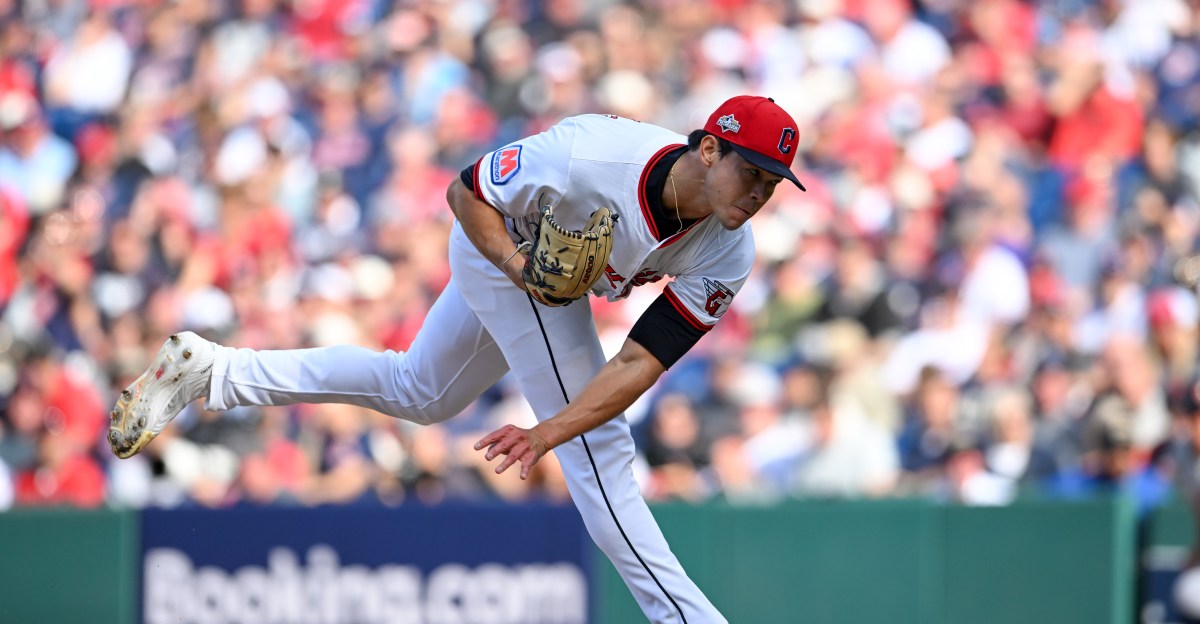
Joey Cantillo pitched 95.1 innings for the Guardians in 2025. He appeared in 34 games total, and started 13 of those games. The 26-year-old 6’4” lefty posted a 3.21 ERA in those 95.1 innings. These numbers sound great on the surface for a player without a full MLB season under their belt, but is this success sustainable or just a product of being new to a league that has yet to get a book on him? Let’s take a look under the hood and see how Cantillo is getting outs, and maybe we can come to an answer.
Joey Cantillo uses a four-pitch mix on the mound. His arsenal consists of a four-seam fastball, a changeup, a curveball, and a slider. In 2025 (for the purposes of this exercise you can assume unless stated otherwise any data is from the 2025 regular season) he threw the fastball 42% of the time, the changeup 30.5%, the curveball 18.8%, and the slider 8.7%. Cantillo’s fastball averaged 91.7 mph which was well below the league average of 93.1. This put Cantillo at 17th percentile fastball velocity, but as many of us know his strength is not his fastball but his secondary offerings. Cantillo’s put away rate (The number of times the pitch got a strikeout for every time it was thrown with 2 strikes) was 28.4% on the changeup and 22.7% on the curveball. The fastball lagged close behind at 21.9%, and lastly the slider sat at 6.1%. The low fastball velocity combined with the high usage of secondary pitches for outs would generally classify him as a Finesse Secondary Pitch Finisher if we want to narrow down to a pitching archetype. To summarize, this style of pitcher gets outs primarily by punishing timing errors hitters make with velocity and vertical separation differences between their pitches.
Let’s take a broad view for a moment before getting into the very complex details. Cantillo’s best weapon is his changeup. Hitters had a .169 xBA against that pitch and a massive 49.4 whiff rate. His Barrel rate of 7.2% is above average at a 67th percentile, and his extension of 7.5 is tops in the league at a 99th percentile where he just notches out Cade Smith. On the negative side, his walk rate of 10.5% is incredibly high. This ranks 16th percentile. The last of these to point out is his very low 22.7 Chase% which is 2nd percentile among the worst in the league. The low chase rate explains the high BB rate, but we’ll need to dig a bit deeper to know for sure.We know Cantillo’s best pitch is his changeup so how do we get maximum value off of a great changeup? Well, as I’m sure many know or have guessed it all starts with the fastball.
Let’s look at some numbers on Cantillo’s fastball. The pitch had an in-zone rate of 61.3% and was swung at 57.7% of the time in the zone. The in-zone rate is above average (56%), and the swing rate is roughly average (57%). The Whiff rate was 14.9%, and in the zone it was 13.2%. These are also a bit above average (11% for a 91-92 mph fastball). The last numbers we will look at are edge rate (that is the number of times a pitch crosses the plate within 1 ball width of the edge of the strike zone) which is 45.9%, and the chase rate which is 14.7%. Comparing these again to league average for a LHP the chase rate is about average (15%) and the edge rate is slightly above average (42%). Now let’s compare those numbers to the ones for the changeup. Now that we know what everything is from our fastball analysis we can go a bit quicker here. The in-zone rate is 46.6%, in-zone swing rate is 70.4%, whiff rate is 49.4%, in the zone whiff rate is 48.8%, chase rate is 30.3%, and edge rate is 41%. The in-zone rate is right at league average (47%), the in zone swing rate is above average (67%), the whiff rates are elite being at or over double the percentage of whiffs the league average changeup gets from LHP (23%), the chase rate is well above average (25%), and the edge rate is above average (37%).
So what does all this tell us? On the surface it looks like we have a solid fastball complemented nicely with an elite changeup. Earlier we talked about Cantillo’s very low fastball velocity. Intuition would tell you a 91 mph fastball that ends up in the strike zone more often than the average 93 mph one should be easy pickings for modern hitters that frequently have to face off against 97+ mph. The lower speed should give hitters more time to react and make contact, but Cantillo has a fairly high whiff rate on his fastball relative to league average for that velocity.
There are three major factors that make this whiff success possible. The first is extension. We looked at this earlier, and learned Cantillo is tops in the league in extension. How does this affect his fastball? To avoid a lot of complicated math the level of extension Cantillo has reduces a hitter’s reaction window. This effectively makes his fastball feel much closer to 94 mph than 91-92. That alone just bumped the fastball to being above average in velocity. Now we move on to the second factor: Induced Vertical Movement (IVM). Explained simply this statistic is a measurement in inches of how much a pitch moves vertically relative to a spinless pitch affected only by gravity. Cantillo’s IVM is 16.9 and league average is around 13-14. A high IVM makes the ball appear to be rising slightly to the hitter relative to the average fastball. The hitter has less time to react and it makes the pitch harder to square up due to the deception in the pitch’s movement. The third factor of what makes the fastball effective is the massive velocity difference between the fastball and the changeup. Cantillo’s elite extension increases the effective velocity of his fastball more than it does for his changeup. This is because slower pitches take longer to reach the plate, and releasing them closer to the hitter does not reduce the reaction window by the same proportion as it does for fastballs. With a fastball feeling about 94 mph from the extension and the changeup even after factoring an extension effect sits around 79 mph (78 without the extension effect) this difference of 15 mph is well above the league average difference of 6-8 mph. This is the real crux of what makes both the fastball and changeup so good. The hitter has to decide to swing early because the fastball appears to get on the hitter really fast, but the changeup’s massive velocity difference makes it nearly impossible to adjust by the time you can pick up the spin. The hitter has already begun their swing motion and the ball may as well freeze in midair at that point. This is the main pitching strategy. These two pitches made up 73% of Cantillo’s pitches thrown in 2025.
We now move on to our third pitch in the arsenal, the curveball. Cantillo threw his curveball 18.8% of the time. Going back to our put away rates this was his second best pitch for getting strikeouts. In order to explain why the curveball works so well we’re going to need to look at the release point for all three pitches we’ve looked at so far. There are three major factors in release point. Vertical release is the height off the ground to the point where the ball is released, horizontal release is the distance from the center of the rubber, and extension is the distance from the front of the rubber. We will mainly focus on the first two for this analysis. The effectiveness of the curveball is largely due to tunneling (the concept of releasing the ball at the same spot as consistently as possible). On average the difference between Cantillo’s release point for his fastball and changeup are 0.1 ft vertically and 0.01 ft horizontally. These numbers are absolutely elite examples of tunneling and it’s another reason why the changeup and fastball complement each other so well, but why is this relevant to the curveball?
Let’s look at the vertical tunneling difference between the fastball and the curveball. It’s 0.16, which is slightly higher than the difference between the fastball and changeup. “So that must be one of the reasons why the curveball isn’t as good of a putaway pitch as the changeup, right?” What if I told you that’s not right? What if the answer is it has the exact opposite effect?
The ultimate truth is that a 0.16 ft release point difference is indistinguishable for hitters, but that ever-so-slightly higher release for the curveball actually keeps it on the same plane as the fastball slightly longer. This makes the curveball look like the fastball longer. The hitter is tricked into thinking it’s a fastball and the ball ends up in a different location than the hitter expects. It seems very similar to the reason the changeup works so well, but there is a very subtle difference.
When you put all three pitches together the changeup looks like the fastball but arrives much slower in the same location, and the curveball looks like the fastball and arrives much slower as well but in a different location. The former makes the hitter question their velocity reads, and makes them more vulnerable to depth misjudgements while the latter exploits that depth uncertainty.This gives Cantillo two solid put away pitches he can use, but it’s even better than that. Both of these pitches play off the fastball. The way the changeup punishes a hitter for sitting fastball works in the opposite way too. Sitting changeup can make you way late on the fastball. The curveball works the same way complementing both other pitches.
Cantillo’s last pitch is the slider. This pitch sits at a very low 8.7% usage. It’s hard to say for sure, but the data leads me to believe this pitch is still a little bit of a work in progress. The 8.7% is a little deceptive. This pitch sees 21% usage vs LHH and a paltry 4% usage vs RHHs. Why is this? To answer that we need to look at our tunneling data again. Specifically the horizontal release difference. The slider’s average horizontal release is 0.25 ft away from the fastball release. Cantillo is a LHP so this difference is toward the first base side and thus on the side of the LH batter’s box. This actually makes the slider much more effective vs LHH and much less effective against RHH. RHH put up a .368 xBA vs the slider, and LHH managed only a .250 xBA. The difference is even more staggering if we compare xSLG: LHH sat at a .327, and RHH slugged a massive .588 against the slider. The sample size for this pitch is small but the stark difference is backed up by the movement of the pitch and our tunneling data.I think if Cantillo is able to improve the horizontal release of his slider and make it more in line with his other pitches that could significantly improve the effectiveness of the slider against RHH. Getting that pitch working as a legit putaway pitch could really take him to the next level.
For now Cantillo looks like he can be a solid number-three in most pitching staffs. If the walk numbers can come down and the fastball command can stay where it’s at or improve that raises the ceiling. Being able to stay on the edges and be aggressive there is also key, but it needs to be to induce swings for whiffs and weak contact. Too much nibbling and trying to throw perfect pitches will just lead to more walks. The pitch quality is there. He just needs to keep them in the zone and near the edges. Pitching how he does now, he can absolutely be a solid Major League starting pitcher, but figuring out the slider and avoiding the walks that could bump him up a slot. I don’t see him being able to be an ace, but these improvements could help him reach the level of a low-end number-two or a definitive great number-three starter in most starting rotations.