
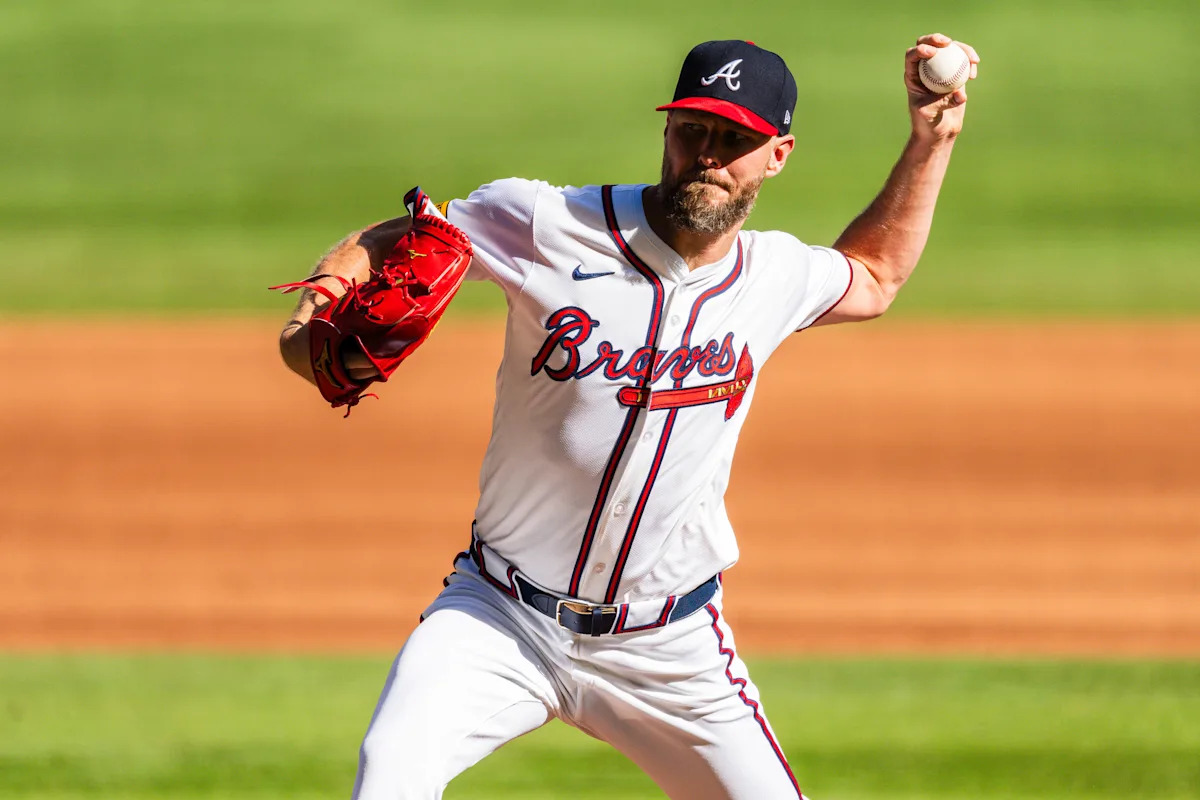
For the Atlanta Braves, 2025 was an avalanche of disappointment.
Entering the season on a seven-year postseason streak, the Braves were considered championship contenders, the National League’s best chance at unseating the juggernaut Dodgers. With a strong core of experienced position players, the NL’s reigning Cy Young in Chris Sale and a pair of superstars coming back from injury in Ronald Acuña Jr. and Spencer Strider, Atlanta began the season with 93.4% playoff odds, according to FanGraphs.
Advertisement
Instead, a depleted, injury-plagued Braves club trudged to a shocking 76-86 record and a fourth-place finish in a down NL East.
Thankfully, the autopsy is pretty straightforward. Sale and key rotation piece Spencer Schwellenbach both spent long stretches on the IL. The same was true for third baseman Austin Riley, who underperformed when available. Strider looked rusty and out of sync upon his return from Tommy John. Stalwarts such as Ozzie Albies, Michael Harris II, Marcel Ozuna and Sean Murphy all struggled offensively. The emergence of NL Rookie of the Year Drake Baldwin was an invigorating development, but it wasn’t enough to overcome the simple fact that too many important players spent too much time watching baseball instead of playing it.
But the future, at Truist Park, is not lost.
Because as disappointing as last season was for Atlanta, the club’s front office has conducted business this winter like a team fully expecting to contend in 2026. President of baseball operations Alex Anthopoulos is clearly treating 2025 as a blip, an aberration, a fluke. With the new year still a week away, Atlanta’s head honcho has arguably done more to reinforce his roster than any other exec.
The Braves have signed six MLB free agents, a tally that ranks second so far this offseason behind the Cubs. To that sextet, Atlanta has guaranteed more than $106 million, the fifth-largest outlay as of Tuesday. The spending itself is not particularly shocking — the Braves have always run a top-10 payroll under Anthopoulos — but the team’s unflinching aggression is a reminder that the Braves are still a formidable presence in the National League.
Advertisement
To be fair, none of Atlanta’s additions was significant enough to warrant an in-person, jersey-unveiling press conference. But the Braves are undoubtedly a better, more complete and deeper team now than they were two months ago.
[Get more Atlanta news: Braves team feed]
Former Padres closer Robert Suárez was probably the newsiest acquisition, with the soon-to-be 35-year-old flamethrower joining on a three-year, $45 million contract. It’s a long commitment for a reliever approaching his baseball golden years, but Suárez still throws absolute gas and has been one of the league’s most reliable closers over the past few years. His 76 saves since the start of 2024 are the most in baseball.
But don’t expect that number to rise much higher, as Suárez won’t begin the year as Atlanta’s closer. That’s because the Braves also re-signed Raisel Iglesias, their longtime closer, on a one-year, $16 million deal. He’ll continue to handle the ninth, and new skipper Walt Weiss will deploy Suárez in the Swiss Army knife, fireman role. Veterans Joel Payamps and Danny Young were also brought in on one-year deals to bolster a bullpen that finished 19th in baseball with a 4.19 ERA in 2025.
Anthopoulos and Co. have been busy refurbishing the offensive side as well. Back in November, Atlanta swung a one-for-one deal with Houston, acquiring utilityman Mauricio Dubón in exchange for defensive wizard Nick Allen. Dubón isn’t a particularly good hitter, but he provides a lot of defensive versatility and is a perfectly capable bat. The Braves followed that deal with a pair of more needle-moving signings in shortstop Ha-Seong Kim and outfielder Mike Yastrzemski.
Advertisement
Kim spent the final month of 2025 with the Braves after the club claimed him off waivers from the Tampa Bay Rays. That move was motivated by the hope that Kim wouldn’t activate his opt-out and Atlanta would have itself an every-day shortstop for 2026. Instead, the Korean glovesmith decided to test free agency, a smart decision as it turned out. Kim, who was set to receive $16 million, ended up back in Atlanta on a one-year, $20 million deal.
That’s a hefty investment for a player who was both hurt and bad in 2025, but Kim has been an average big-league hitter for most of his career while providing ample value at the game’s most difficult infield spot. For the Braves, whose shortstops finished dead last in baseball a year ago, with a putrid 56 wRC+, it’s a price worth paying.
Yastrzemski, who joined on a two-year, $23 million deal, is an unspectacular yet remarkably consistent corner outfielder. The 35-year-old has been worth at least 2.0 bWAR in every one of his seven big-league seasons and has a career .809 OPS against right-handed pitching. Although he’ll likely sit against most lefty starters, Yaz will provide depth in the corners behind Acuña and Jurickson Profar while mixing in at designated hitter.
Advertisement
That Atlanta has DH at-bats to dole out is a development in its own right. Since Opening Day 2023, Marcell Ozuna has started 445 of Atlanta’s 502 games, postseason included. Now a free agent for the first time in his career, Ozuna usually hit enough to justify clogging up the Braves’ DH spot. But at this point, a reunion feels unlikely, as the Braves can use that space to cycle through Yastrzemski, Profar and whoever isn’t catching that day (Murphy or Baldwin).
With Opening Day still three months away, the Braves seem pretty much finished with offseason business. Anthopoulos added a pair of every-day bats, a valuable utility guy, two high-leverage relievers and some potentially useful pitching depth. Atlanta could enter the season with its current assortment of ballplayers, and prognosticators and projection systems alike would consider this a playoff team.
Advertisement
But if the Braves want to push the issue, there’s still one more area ripe for a splash: the starting rotation. Sale, now fully healthy, will lead the line as he prepares to hit free agency at season’s end. Behind him, there’s Strider (looking to recapture his pre-surgery form), Schwellenbach (missed the last few months of ‘25 due to a fractured elbow), Reynaldo Lopez (made just one start in ‘25 before undergoing shoulder surgery) and youngster Hurston Waldrep (impressed in a nine-start sample but remains unproven). Grant Holmes, Bryce Elder and Didier Fuentes follow as depth options.
If things break right, that’s a really interesting group with tons of upside. It’s also a group that has shown to be particularly susceptible to the injury bug. That’s what derailed Atlanta’s plans last season, and the same thing could easily happen again.
To lessen that possibility, the Braves could add one more impact starter to the group. Such a move, given the organization’s middling farm system, would probably have to come via free agency. Atlanta is already over the luxury tax by around $6 million, according to Spotrac. Cashing out for a big arm such as Zac Gallen, Tatsuya Imai or Framber Valdez would push the Braves well over the tax, something the organization is wary of doing.
But money is just money, and the Braves cannot afford another disappointing season. They’ve done a good job, so far this winter, of avoiding a replay of 2025, but one more big swing could make them quite a formidable character in 2026.