
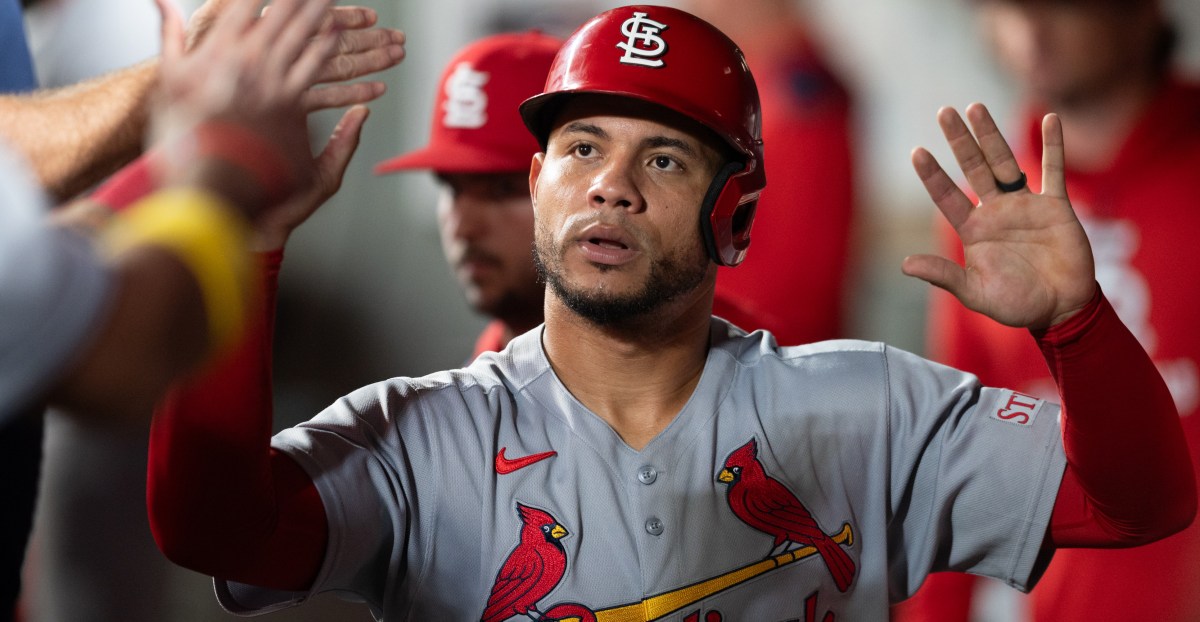
Yesterday the Cardinals made their second major trade of the offseason, this one much less shocking. It is maybe surprising that it also involves the Boston Red Sox, but after it was reported that Contreras would waive his no-trade clause for the right fit, it seemed inevitable that Contreras would be on the move. In return for Willson Contreras, his two guaranteed years and a team option for a third, the Cardinals received an MLB-ready starting pitcher and two pitching prospects a bit further away. Let’s look at the players involved.
First things first, how much was Contreras worth? If we’re going to judge a trade, it’s important to see what the Cardinals gave away. Earlier this month, I wrote an article looking at the value of Contreras. Despite the BTV calculation of $-8 million, I came away from the article thinking Contreras actually had surplus value. Can’t say I understand the BTV valuation. By my calculation, Contreras was worth $6 million in surplus value. The Cardinals threw in an additional $8 million, so all in all the Cardinals “should” have received the equivalent of $14 million in value in return.
2025 Stats: 13 G (11 GS), 61 IP, 17.6 K%, 6.6 BB%, 48.4 GB%, 4.13 ERA/3.87 FIP/4.11 xFIP
BP: Dobbins has, well, almost the exact same pitch mix as Fitts—a cut-and-carry mid-90s fastball, a new splitter (Dobbins’ is more of a splinker), and a multiple pitch mix in the cutter/slider continuum that plays off each other. Dobbins even has the same contact suppression-over-whiffs quality to him; the greatest difference between the two is that Fitts is half-a-year younger while having had some major-league success already.
Well that’s interesting. He appears to be a very similar pitcher to Richard Fitts. This little blurb was written prior to the 2025 season. Fitts was ranked 13th by Baseball Prospectus and Dobbins ranked 14th. You might be wondering “What is a splinker?” Well I’m sure you can guess it’s in between a sinker and a splitter. On the Fangraphs writeup of Dobbins back in July (he ranked 18th), they said the splinker was the key variable in determining his future. But he can probably still fall back to being an effective long reliever if the splinker ends up being more ineffective than expected.
What is Dobbins value? He came into the season as a 40+ FV pitcher, but he was reasonably effective in his 61 innings, so he’s certainly more valuable than a 40+ FV pitcher. If he was eligible to be a prospect right now, which is he isn’t, I’m guessing he’d be ranked as a 45 FV pitcher, maybe a 45+ FV pitcher. I’m willing to bump up his value a tad based on his MLB success (1 fWAR in 61 innings), but the sample size isn’t strong enough to use his MLB performance as a baseline unfortunately.
Dobbins is a bit of a tricky pitcher to value in a trade purely because say he is a 1 WAR pitcher – that’s not valuable in a trade, but as a guy making league minimum and probably in his Super Two arbitration year – that would exceed $14 million in surplus value pretty easily. That said, I feel reasonably comfortable valuing his trade value as if he were a 45+ future value prospect when I throw in his MLB success: $6 million.
Yhoiker Fajardo, 19 – RHP
CPX: 6 G (4 GS), 20.2 IP, 31.6 K%, 9.2 BB%, 51.2 GB%, .205 BABIP, 0.44 ERA/2.41 FIP/3.19 xFIP
Low A: 13 GS, 51.1 IP, 27.8 K%, 9.4 BB%, 50 GB%, .326 BABIP, 2.98 ERA/2.50 FIP/.314 xFIP
All due respect to Dobbins, who will probably be a decent enough pitcher and certainly adds immediate depth to a pitching staff that needed immediate depth, but Fajardo is the prize of the trade. Don’t be fooled by the low future value grade: this is the upside of the trade. Fajardo is a top 10 prospect in the Red Sox system according to Baseball America and will probably slot there in the Cardinals system as well. He excelled at just 18 years of age in Low A, seems well-positioned to start next year in High A, and if you look at his innings, he can probably throw 100+ innings.
He’s not considered the prospect Tink Hence was, but just to give you a frame of reference, when Tink Hence was 19-years-old, he dominated for 52 innings in Low A. Fajardo just turned 19 and will presumably play the majority of next season at High A and can double that innings total already. While he’s not as big of a prospect, I don’t think I’ve seen a Cardinals prospect so clearly positioned to become a top 100 prospect if he performs.
Seriously, don’t underrate Fajardo. He was well-regarded enough as an amateur that he signed for $400,000 by the White Sox. With the White Sox, he dominated the DSL with a 30% K rate and 3% BB rate, and then he got shipped to Boston last December. Then he posted the season you see above. Here is a quick scouting report from Chris Clegg of The Dynasty Duguout:
“The fastball has ticked up and now sits in the 93-95 range, but Fajardo has topped out at 97 mph. Reminder, he is 18-years-old with a projectable 6’3 frame. He will mix in a riding four-seam fastball and a running two-seam. While the fastball can be dead-zone at times, he actually leads with a slider and plays off his fastball well with his slider and changeup.
Leading with a slider that works 83-86 mph, it has strong traits and plays with a gyro shape. At times, it generates more depth, but it has been an effective bat-missing pitch. The changeup has taken a step forward this year as Fajardo has adjusted the grip of the pitch. It has shown good depth to it and has worked 86-88 mph. It still needs refinement, but it has made progress this year.“
He also notes that Fajardo ran a 39% K rate from August to the end of the year, so it sure seems like he’s ready for High A. This is the player I’m most excited about in this trade even though it may be a couple years. Really feels like he’s a future top 100 prospect in the waiting and to get him before he becomes that prospect may make him look like a real steal.
We do not have updated reports and Fajardo took such an enormous jump in 2025 in terms of how he’s viewed as a prospect, but it seems like he was considered a top 10 prospect in the Red Sox system. He will at least be close to that in the Cardinals system. I think it’s relatively safe to call him a 45 FV prospect for now though. This according to the Craig Edwards value chart, is just $4 million in value. But that’s why they were able to get him now. His value could very easily jump another time after a strong 2026.
Low A: 10 G (9 GS), 51 IP, 22 K%, 4.4 BB%, 49.3 GB%, .290 BABIP, 4.24 ERA/3.47 FIP/3.18 xFIP
High A: 13 G (10 GS), 64.1 IP, 20.9 K%, 8.1 BB%, 38.9 GB%, .209 BABIP, 3.78 ERA/4.61 FIP/3.95 xFIP
Apologies to Aita, but between the guy who can pitch in the MLB right now and the guy who shows signs of becoming an elite prospect, Aita can’t help but be overshadowed. A 6th round pick out of Kenesaw State, I’d be pretty enthused about his debut professional season, but as a return, it’s not terribly exciting. It’s easy to overlook how good he pitched in Low A – okay on strikeouts, elite on walks, lots of groundballs.
His High A performance wasn’t shabby either, though not a lot to get excited about from my perspective. He didn’t really strike out a lot, walked an average amount, and didn’t get groundballs. The ERA and xFIP ended up solid, but clearly the Cardinals’ brass is seeing something in his scouting more than his stats. And in fact, that is kind of the case. From Fangraphs, who did not rank him terribly high on the team list:
“He can really spin it, with some of his sliders rotating at more than 3,000 rpm. He’s a four-pitch righty with a slider-heavy approach and starter-quality fastball command. Aita overwhelmingly works with his slider and fastball, and his slider’s performance might be suffering from how heavily he’s leaning on it. He’ll mix in a cutter and an upper-80s changeup, both of which are currently below average, but of course the 2025 season is only Aita’s second as a starter. He looks like a spot starter who has backend upside if one of his tertiary offerings takes a step forward.”
Not a bad building block to work with honestly: He can spot his fastball wherever he wants and he has a strong slider. Certainly seems like you can make someone a reliever with this profile. That said, I suspect the Cardinals are hoping his ability to spin the slider translates into his ability to spin a different pitch. He clearly needs a third pitch, maybe a fourth one that he’s willing to throw more. His inexperience as a starter – he converted to starting pitcher in his last college season – may be a positive for the Cardinals as it shows he has room to grow.
With all of that said, he’s clearly throw-in and doesn’t actually add any value to this deal. The trade value chart that Craig made doesn’t give a monetary value to any prospect under a 40 FV and that would describe Aita.
So on paper, I have the Cardinals slightly “losing” this trade. I had Contreras as worth $6 million in surplus value, the Cardinals threw in $8 million, and the Cardinals received less than $14 million in value. And actually, now that I’m thinking of it, the Red Sox did throw an additional million to Contreras’ contract – this is the real value of a no-trade clause – so that does remove a million from the price. But still I have the return being worth $10 million, Contreras is worth $13 million.
However, while I have no personal objection to my methodology or even disagree with what it says on paper, summing a trade up by its monetary value certainly feels inadequate in this case. For one thing, the odds that the Cardinals get more than $10 million in value from these three players is quite high honestly. Like this is how you have to value it in a trade, but it still seems like $10 million is a rather easy bar for this trio to beat when one of them will be pitching in the MLB immediately, more or less.
The Cardinals have two pitchers in this trade, in my opinion, who you can’t say are more valuable than the price I’ve given them, but who do seem somewhat likely to exceed those values. Say that Fajardo does pitch well in High A, get a sampling of starts in AA, and then joins the top 100. That could all happen within the next calendar year. And the Cardinals don’t need to rely on him succeeding in the MLB – they could cash in before he reaches, use his $20 or so million in value to acquire an MLB outfielder. Then the Cardinals have turned Willson Contreras into… say Kyle Stowers. Or maybe someone who looks less fluky, but this hypothetical is a year from now and pretend Stowers comes close to repeating his 2025. If you can turn Willson Contreras into a 3 WAR outfielder with three years of control plus an MLB starter – who cares that this guy was originally only valued at $4 million.
Another point I have to make is that the only reason my figures come out with the Red Sox ahead is because the Cardinals threw in money. Who cares about that? If you remove money from the equation, the Cardinals came out ahead. It’s not like the Cardinals are prevented from doing a move because they threw in money, which is the only reason to care about such a thing.
So maybe not quite the effusive praise for the Sonny Gray deal, but kind of similar to the Gray deal in that the Cardinals got a MLB ready starter (who apparently is a direct comp to Dick Fitts in style too) and a high upside starting pitcher. That starting pitcher may be a year away from being the kind of prospect Brandon Clarke is and obviously he’s not guaranteed to take the next step, but it’s kind of the same kind of trade, but this is the lite version of that almost.