
The Kansas City Royals’ offseason strategy is not drifting through this winter. They are moving with purpose, sequencing decisions that point toward something larger than a single season. Roster construction, competitive window, and stadium pressure are now running on the same clock. What Kansas City has already done stabilizes the organization. But what they have not done yet determines whether this era truly matters.
The Royals’ Offseason Strategy Defines the Competitive Window
 Jul 22, 2023; Bronx, New York, USA; Kansas City Royals third baseman Maikel Garcia (11) follows through on an RBI single against the New York Yankees during the fifth inning at Yankee Stadium. Mandatory Credit: Brad Penner-USA TODAY Sports
That kind of continuity changes behavior. It allows patience with pitching, discipline in trades, and confidence in payroll planning. It also matters beyond baseball because long-term competitiveness strengthens every argument for a future stadium.
Quatraro’s Admission Clarified the Infield
At the Winter Meetings, manager Matt Quatraro publicly discussed how the Royals mishandled Jonathan India last season. He cited the difficulty of a new city, a new organization, and moving him around defensively.
Managers do not make statements like that unless they believe the player is still part of the solution. That comment reframed the discussion about second base. While Michael Massey remains an option, Quatraro’s words strongly suggest the Royals are banking on India rebounding in 2026 with stability.
Evaluation is over. Execution is next.
The First Roster Moves Focused on Flexibility
This move was about flexibility. Collins adds left-handed outfield depth and defensive options. Mears adds a controllable bullpen arm with strikeout ability. These are the types of moves that stabilize a roster over 162 games.
The Brewers-Royals trade does not raise the fountains at Kauffman Stadium. Acquiring Collins and Mears will not return the crown to Kansas City. The acquisitions are part of the supporting cast for a long season. They are not going to define one.
Lane Thomas Raised the Floor
Three days later, on December 17, the Royals signed free agent outfielder Lane Thomas.
Thomas gives Kansas City professional at-bats, experience, and coverage in an outfield that struggled for consistency in 2025. Based on recent performance and projection models, Thomas profiles as a roughly just below 1 WAR over a full season, which raises the floor and reduces volatility but does not materially change the postseason outlook. According to FanGraphs’ positional WAR data, playoff-caliber teams typically generate 5–7 WAR from their outfield, meaning the Royals would still need approximately 3–5 additional WAR of outfield production to compete consistently with October-level opponents.
The ceiling still requires more.
Picollo Told You What Was Coming
Before the next move happened, the plan was already public. Royals broadcaster Rex Hudler discussed Kansas City’s needs during an appearance on Foul Territory. He stated he had a direct conversation with Royals President of Baseball Operations J.J. Picollo, who told him the club would acquire a left-handed reliever.
On December 19, that was precisely what happened.
This move did not shake the league. But it confirmed something more critical. The Royals identified a need, communicated it publicly, and executed without hesitation.
That is organizational clarity.
Why the Outfield Still Caps the Ceiling
Kansas City finished 82–80 in 2025. The Cleveland Guardians won the American League Central with 88 wins. The Detroit Tigers finished a heartbeat behind with 87.
The division is competitive. It is not forgiving.
Beyond it sits the AL East, where the real knife fight happens. The Toronto Blue Jays and the New York Yankees both won 94 games. The Boston Red Sox won 89. The Baltimore Orioles are also entering the race and winning this offseason, sending serious signals about where they see their chances.
Those hedge fund teams punish weak lineup segments, and they will spend to acquire the missing pieces to keep October alive. In 2025, Kansas City’s outfield ranked near the bottom of baseball in offensive production. That reality allows elite pitching staffs to pitch around the infield and dictate matchups in a short series. Depth keeps you respectable. Impact changes outcomes.
The Duran Noise Shows the Line
Trade chatter involving Boston outfielder Jarren Duran matters even if no deal happens.
That tells you how the league values Kansas City’s pitching. It also explains the Royals’ caution. A mid-market team does not trade a Game 1 starter lightly. If Kansas City makes a move of that magnitude, it will be because the return changes the postseason equation.
The Stadium Clock Is Real
Stadium discussions are accelerating. Kansas leadership is involved. Ownership has publicly acknowledged the Kansas side of the metro as a serious relocation option, then softened its language as negotiations continue. Regional reporting confirms growing urgency.
Winning now matters. Not symbolically. Practically.
A competitive team strengthens public support, corporate investment, and political confidence. The four-year competitive window aligns with a stadium transition timeline.
That alignment is not accidental.
What Still Has to Happen
The Royals have built the frame. The infield is locked in. The bullpen has improved. The rotation is deep. Payroll remains manageable with some upswing.
One move remains.
Kansas City is defining who it wants to be, not just who it wants to sign, and every move this offseason has reflected that standard.
This is the final test of the Kansas City Royals’ offseason strategy.
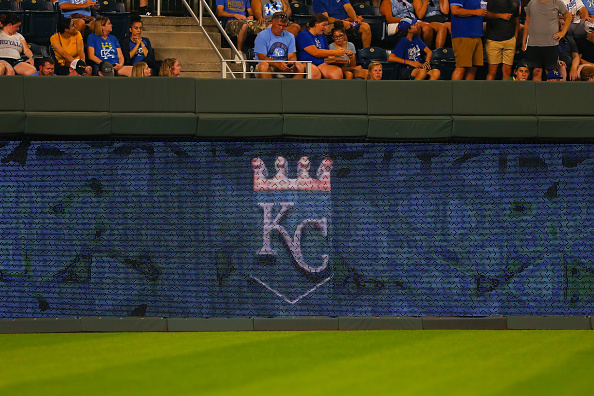
The ball club still needs an impact outfield bat that forces pitchers to change their plan and that raises the October ceiling. That move does not need fireworks over the Crown Scoreboard in center field at Kauffman. It just needs a bat that gets results.
The Royals are no longer operating season to season. They are operating franchise to franchise. Kansas City is the third-smallest media market and second-smallest metropolitan area among all MLB cities. They are the last small-market team to win a World Series, and they are hunting for another crown this offseason.
The window is open.
The clock is real.
The foundation is set.
Now they have to finish it with one final piece.
Main Photo Credit: Scott Winters/Icon Sportswire via Getty Images