

The St. Louis Cardinals stand at a crossroads following the MLB Winter Meetings, with an All-Star infielder whose prime has arrived but whose timeline no longer aligns with the organization’s competitive window. Brendan Donovan, coming off a breakout 2025 season in which he earned his first All-Star nod with a .287/.353/.422 slash line, 10 home runs, and 50 RBIs, represents the most valuable trade asset the franchise could deploy to accelerate its rebuild.
The Cardinals’ front office has already made aggressive moves this offseason, shipping out Willson Contreras and Sonny Gray to Boston, signaling a clear pivot toward the future. Now they should complete the transformation by moving the 28-year-old Donovan to a contender, specifically the Seattle Mariners, in a package that would bring back elite youth the Cardinals desperately need.
This isn’t about dumping salary or admitting defeat—Donovan, set to earn a reasonable $5.75 million in 2026 with one remaining year of arbitration eligibility, is precisely the kind of productive, cost-controlled asset that contenders covet. The problem is one of timeline. St. Louis is aiming for sustained contention beginning in 2027 and beyond, which means the team’s window for making deep playoff runs with Donovan doesn’t align with the Cardinals’ rebuild trajectory.
Donovan’s versatility — capable of playing second base, third base, and even left field while maintaining Gold Glove-caliber defense — makes him the exact offensive ingredient Seattle needs.
What makes this deal compelling isn’t just Donovan’s proven All-Star production. It’s the prospect haul the Cardinals could return from a Mariners organization that, under the direction of general manager Justin Hollander, has stockpiled young talent like few other franchises. Jarrangelo Cijntje and Lázaro Montes represent the kind of controllable future assets the Cardinals need if they’re serious about building a long-term contender.
The Case for Trading Brendan Donovan Now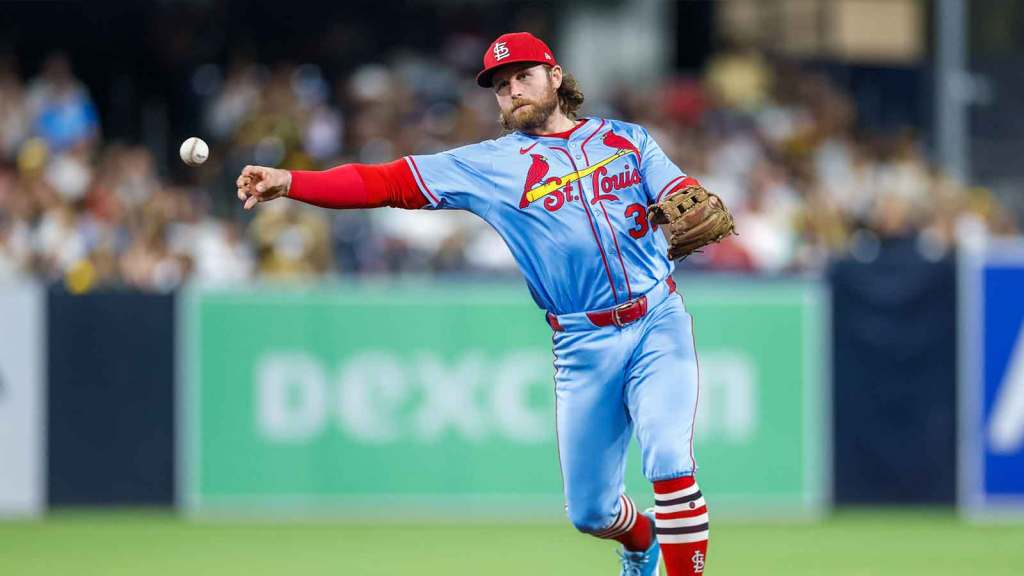 David Frerker-Imagn Images
Donovan’s 2025 season sent a clear message: the player is in his prime and ready to contribute at the highest level. His All-Star selection wasn’t a fluke — it was the culmination of steady improvement across five MLB seasons, transforming from a 2022 minor league prospect ranked No. 13 in the Cardinals system to a proven major league performer capable of posting an OPS north of .775.
He hit 32 doubles, demonstrating his ability to drive the baseball consistently from the left side. But here’s the reality: Donovan is 28 years old, and the Cardinals aren’t close to being World Series contenders in 2026. By the time St. Louis emerges as a true playoff force in 2027 or 2028, Donovan will be at an age where his contract will become less attractive in an open market, and his trade value will have diminished.
The Giants, Guardians, and other contenders have already circled Donovan’s name, recognizing his value as a utility player who can also hold down an everyday position. The Cardinals must capitalize on this heightened market interest now, before the trade deadline chatter fades and Donovan’s perceived value softens. This is the moment to strike.
The Mariners Trade Framework
The Cardinals Receive:
RHP Jarrangelo Cijntje
OF Lázaro Montes
The Mariners Receive:
This framework represents a rare opportunity for the Cardinals to acquire two prospects with legitimate ceiling potential. Cijntje, ranked No. 90 in MLB Pipeline’s top 100 prospects, brings the toolset of a back-of-the-rotation starter with switch-pitching capabilities that, while unconventional, have shown promise.
Lázaro Montes, ranked the Mariners’ third-best prospect and No. 42 overall by MLB.com before the 2025 season, is a physical specimen with 30-plus home run upside and the kind of explosive power that scouts covet. Though Montes struck out at a high rate (38% miss rate) during his 2025 campaign across High-A and Double-A, his highest 90th percentile exit velocity among all Mariners minor leaguers signals that the hit tool and power will eventually connect at the major league level.
The Cardinals get younger, the Mariners get immediate offensive reinforcement, and both teams address pressing organizational needs. For St. Louis, this isn’t a panic move — it’s a strategic repositioning that honors Donovan’s excellence while investing in the future. The time to make this move is now.