

The Toronto Blue Jays entered the 2025 offseason with championship aspirations after their World Series run captured the hearts of their fanbase. General Manager Ross Atkins has been methodical — perhaps too cautious — in assembling the final pieces to push Toronto over the top. While the acquisition of Dylan Cease represents a significant move, the most glaring weakness remains the middle of the infield, a critical gap that could determine whether this team wins championships or merely competes for the next three seasons.
Enter Ketel Marte.
The Arizona Diamondbacks’ All-Star second baseman represents the missing link Toronto desperately needs. At 32 years old, Marte isn’t a long-term solution, but neither is he a rental. He’s signed through 2030 with a reasonable average annual value of roughly $19 million when accounting for deferrals — a bargain for a player who just finished third in NL MVP voting. For the Blue Jays, acquiring Marte transforms a good team into a legitimate World Series threat. It’s the kind of statement move that separates contenders from pretenders, and it’s exactly what Toronto needs to do after the Winter Meetings concluded without addressing the elephant in the room.
The Blue Jays have the prospect capital to make this happen. Yes, they’ve spent aggressively on free agents, but their minor league system still possesses multiple tradeable assets. This isn’t about stripping the farm—it’s about being smart with depth pieces and younger arms that, while promising, don’t crack the organization’s tightest roster parameters. Atkins and his front office have shown patience and prudence. Now they need to show boldness.
Why Ketel Marte Changes Everything for Toronto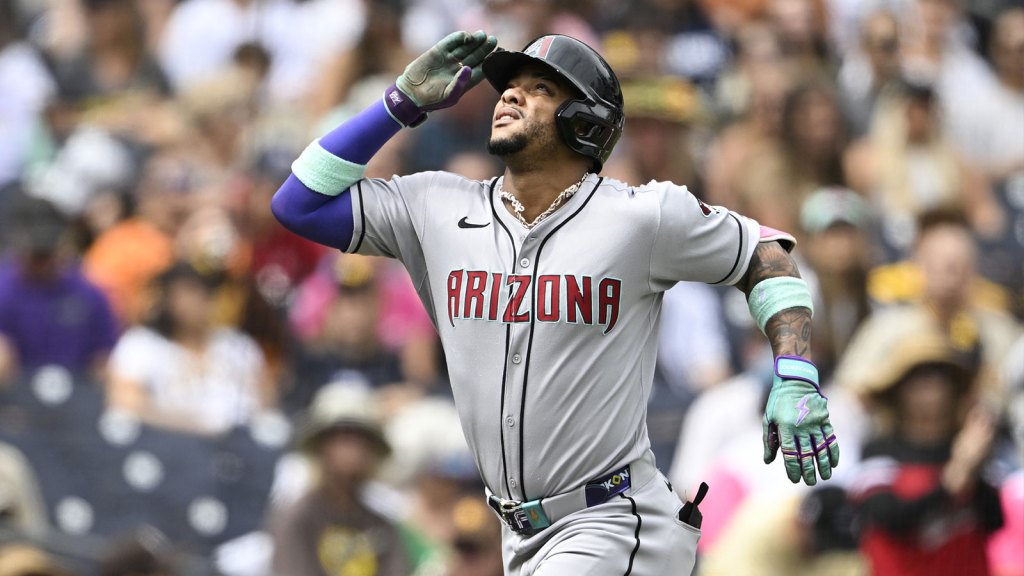 Denis Poroy-Imagn Images
The numbers don’t lie. Marte slashed .292/.363/.569 in 2025 with 36 home runs, 95 RBIs, and 23 doubles across 583 plate appearances. That’s an elite .932 OPS in a league where the average hovers around .700. He finished fourth in the AL in wRC+ and provided plus defense at a premium position. In Toronto’s lineup, sandwiched between Bo Bichette (if they re-sign him) or potentially Kyle Tucker (if they sign him) and Vladimir Guerrero Jr., Marte becomes the orchestrator of run production that the Blue Jays have lacked since Bo left the organization years ago.
The Diamondbacks aren’t eager to move Marte — they’ve invested heavily in him with a contract extension worth $116.5 million through 2031. But here’s the reality: Arizona is in a transition period. While they have young talent in the system, they’re acknowledging that Marte’s age (turning 32) makes this the prime window to flip him for controllable, cost-effective arms. The Diamondbacks front office has quietly indicated they’d listen if the return sufficiently upgrades their pitching rotation for the next four-to-five seasons.
Toronto can provide exactly that.
The Trade Framework: Young Pitching for a Star Bat
Here’s what the Blue Jays should propose to Arizona:
Arizona Receives:
LHP Ricky Tiedemann
RHP Jake Bloss
Toronto Receives:
The framework makes sense for both organizations. Tiedemann is an intriguing talent with legitimate ceiling potential — he possesses a plus fastball that touched 98 mph pre-injury and a devastating sweeper. However, his trajectory has been complicated by elbow issues and Tommy John surgery in July 2024, meaning he won’t throw meaningful innings until mid-2026 at the earliest. For a Diamondbacks organization looking to restock its farm system with high-upside arms, Tiedemann represents that prospect with ceiling potential that excites scouts despite the durability concerns.
Bloss, acquired from Houston in the Yusei Kikuchi deal, struggled in his MLB debut with a 6.94 ERA, but his minor league track record suggests he’s a legitimate prospect with a mid-rotation ceiling. At 23 with multiple years of contractual control, he provides Arizona organizational depth and another arm that could develop into a solid back-end starter.
The beauty of this deal is that it doesn’t gut Toronto’s established big-league roster or completely strip the organization of its best young arms. The Blue Jays would retain prospects like Arjun Nimmala and Trey Yesavage, who represent the true cornerstones of their future. They’d be trading prospects with injury history and developmental uncertainty for a certified, high-impact major league player in his prime.
For the Diamondbacks, this move isn’t about financial relief — it’s about recalibration. Entering Marte’s age-32 season with significant pitching injuries (Burnes missing a good chunk of 2026 to Tommy John recovery), Arizona makes the pragmatic choice: cash in on a declining asset while he still possesses superstar-caliber value, and invest those assets in young, controllable arms that align with the team’s next competitive window.
The Blue Jays haven’t made a blockbuster trade since midseason acquisitions in 2025. They’ve been methodical, they’ve been patient, and they’ve been smart. But sometimes, winning championships requires conviction. Ketel Marte is that move. He’s the exclamation point that transforms this Toronto roster from promising to dangerous. The Winter Meetings are behind them, the free agency market is settling, and the window for making a major trade is narrowing. Now is the time for Atkins and the Blue Jays front office to act boldly and pursue the one player who can move the needle: Ketel Marte.