
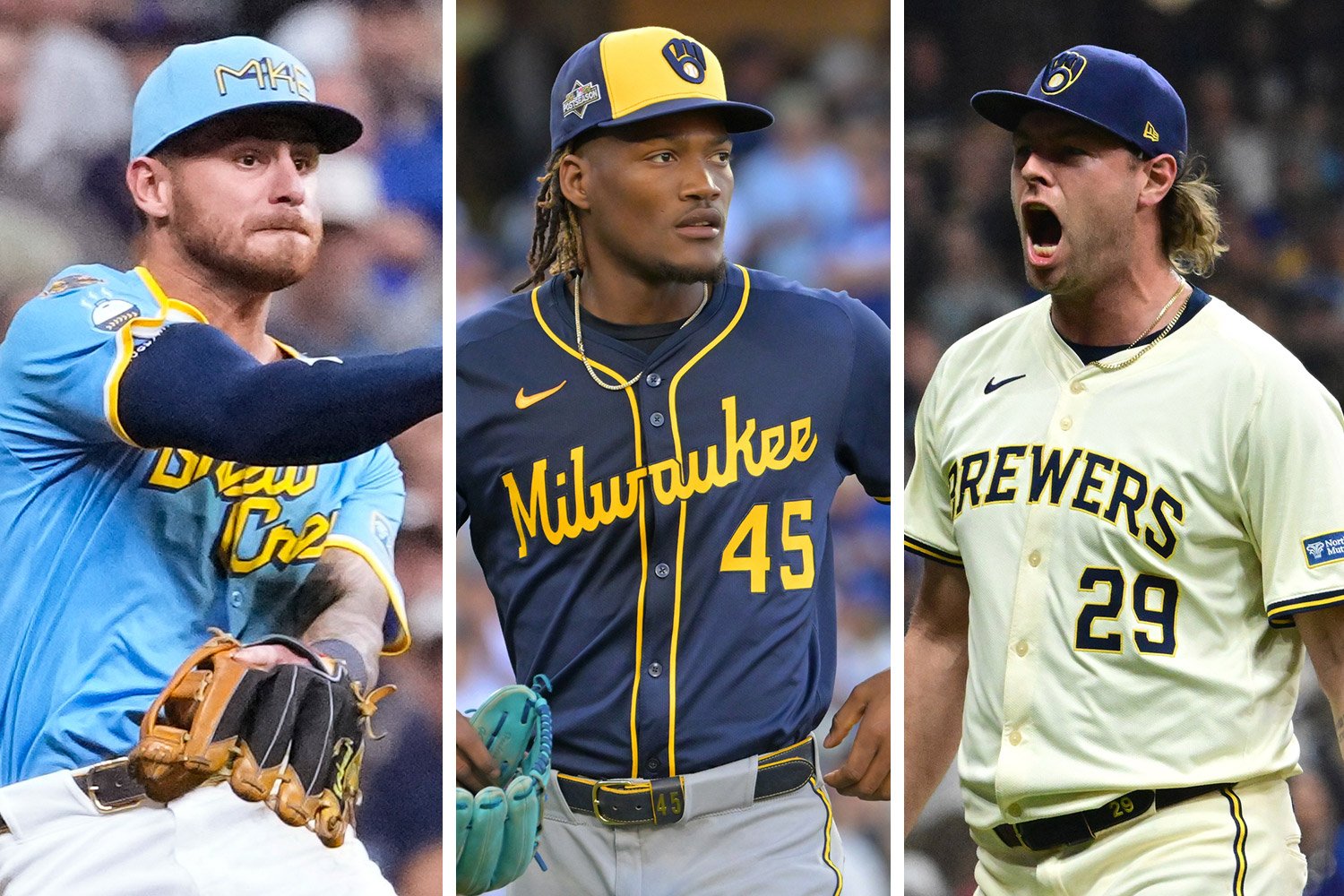
2026 Season Age: 27
Controlled through: 2029
Jason’s Rank: 19 | Michael’s Rank: 10 | Steve’s Rank: 20
Although Ortiz wasn’t quite able to fill the shoes of Willy Adames as the Brewers’ starting shortstop, he still has considerable potential as a player. As you recall, he came over to Milwaukee along with DL Hall from Baltimore in exchange for Corbin Burnes and carried high expectations as Baltimore’s eighth-ranked prospect in 2023. His rookie year lived up to the hype, posting 3.2 fWAR across 142 games while playing third base.
Unfortunately, the sophomore slump was absolutely real for Ortiz. Depending on which defensive metric you look at, he was either outstanding (12 OAA, 10 FRV) or slightly below average (-2 DRS). His offensive production was less debatable with his 67 wRC+, the third-lowest mark of qualified MLB players.
It would be surprising if his offensive struggles became a long-term issue, but it’d absolutely be a question mark for any teams that would consider acquiring him. He’s young, has plenty of team control left, and is capable of playing great defense, but the uncertainty surrounding his bat prevents him from being more valuable than some of the other young talents in Milwaukee’s system.
2026 Season Age: 27
Controlled through: 2031
Jason’s Rank: 13 | Michael’s Rank: 14 | Steve’s Rank: 14
Patrick may have exceeded your expectations in his rookie year. He was the return package from the Athletics in exchange for Abraham Toro, and his 2025 numbers alone might have been enough to classify that deal as a resounding success. He pitched to a 3.53 ERA with a 3.53 FIP over 119 ⅔ innings and placed seventh in NL ROY voting.
He found immense success using a variety of fastballs but struggled to be as effective with his breaking or offspeed offerings. However, Stuff+ does grade his slider and changeup very highly. In fact, he had the highest Stuff+ (105) of any pitcher on the team with more than 100 innings. This may be surprising as his fastball velocity is average, but with tricky shapes and movement, he’s able to get by just fine.
He’d be a strong addition to the rotations of most teams, but because of his inexperience, he may not be as compelling a frontline starter as some other arms on the Brewers’ pitching staff. At the very least, he should see an elevated role with the team in 2026, where he could continue to increase his player stock.
2026 Season Age: 25
Controlled through: 2030
Jason’s Rank: 7 | Michael’s Rank: 19 | Steve’s Rank: 12
Over the past few years, whispers have spoken of top-secret human experiments being conducted in Milwaukee to produce elite catching and pitching talent. This has been used to explain the sudden and unexpected turnarounds for defensively deficient catchers and down-on-their-luck pitchers. I can’t personally speak to the existence of such labbut it’s getting harder to deny that if nothing else, the Brewers sure know how to make a closer.
Trevor Megill, Devin Williams, Josh Hader, heck, even Corey Knebel had a 1.78 ERA and 39 saves in 2017. It’s a suspiciously long run of high-leverage dominance from the bullpen, and Abner Uribe is the lab’s most recent product. After a shaky 2024 marred by injury and poor on-field antics, he locked back in by replicating his rookie year numbers over a larger sample size of 75 ⅓ innings.
His peripherals are absolutely off the charts. The only Statcast metrics in which he doesn’t rank in the top decile of qualified pitchers are chase rate (28.3%), walk rate (9.1%), and extension (6.4). He only accumulated a few saves, but he primarily pitched in high leverage, and the Brewers are clearly grooming him to eventually take the ball in the ninth inning. He might need a little more time before he’s ready to join the current inner circle of elite closers, but he’d be worth quite a bit to many teams around MLB today. It also helps that he has one of the best save celebrations around.
2026 Season Age: 34
Controlled through: 2028
Jason’s Rank: N/A | Michael’s Rank: 8 | Steve’s Rank: 4
He’s far from being the MVP finalist he was in the late 2010s, but Yelich has been consistent over the past four years. He continues to be one of the more productive bats on the team, and 2025 seems like he was able to carry over some of the success he had in 2024 before being sidelined by injury.
The most encouraging sign from this past season was his increase in power. His slugging percentage of .452 is the highest mark since 2019, albeit not by much. What’s more exciting is the 29 home runs he hit in 2025, the first time he’s crossed the 20-homer mark since 2019.
Despite this small but important career resurgence, Yelich’s position as a trade asset is complicated by his age and remaining value on his contract. According to Cot’s Contracts, he’s still owed ~$72 million over the next three years, which is a hefty sum for any player, let alone one that is clearly past his prime. Nonetheless, he probably has a few more productive seasons left in him.
2026 Season Age: 32
Controlled through: 2027
Jason’s Rank: 9 | Michael’s Rank: 18 | Steve’s Rank: 10
It’s not easy being 6’8″, or so I’ve heard. Megill makes it work somehow, and as a guy who regularly throws more than 100 mph with a hammer knuckle curve, it probably works to his advantage. After two rough years with the Cubs and Twins, Megill was acquired for a player to be named later and cash in April 2023. It took some time to figure it out, but after Devin Williams sustained an injury in 2024 and left for the Yankees in 2025, he stepped into the closer role, where he has done a great job.
Unlike the younger pitching assets Milwaukee seems to have an excess of, Megill already has four years of service time, which means he has fewer years of team control but also has a good amount of big-league innings under his belt. Additionally, he was paid just under $2 million in 2025, a very team-friendly price for what they got out of him. He’ll earn more as he heads into his second year of arbitration, but he’ll still come cheaper than the other closer options of his caliber.
Teams wanting a high-leverage arm out of the box could look at a Trevor Megill as a plug-and-play option that may not need the same development resources as someone less tenured. He may not be a totally baked cake at this point, but he knows what he’s capable of and what he needs to do to get there.