
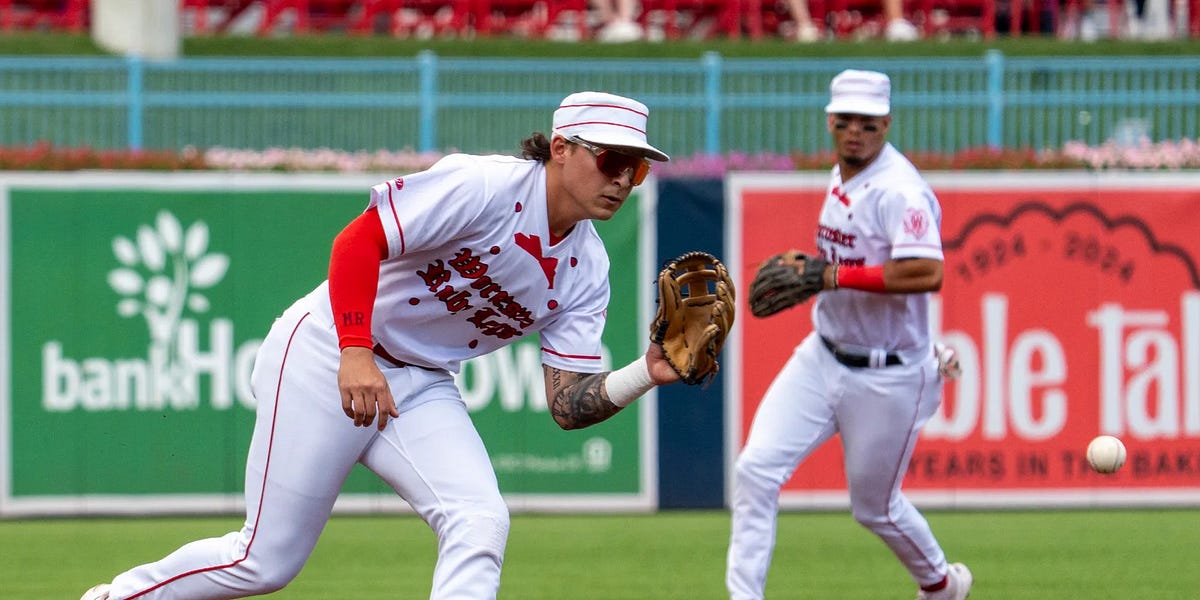
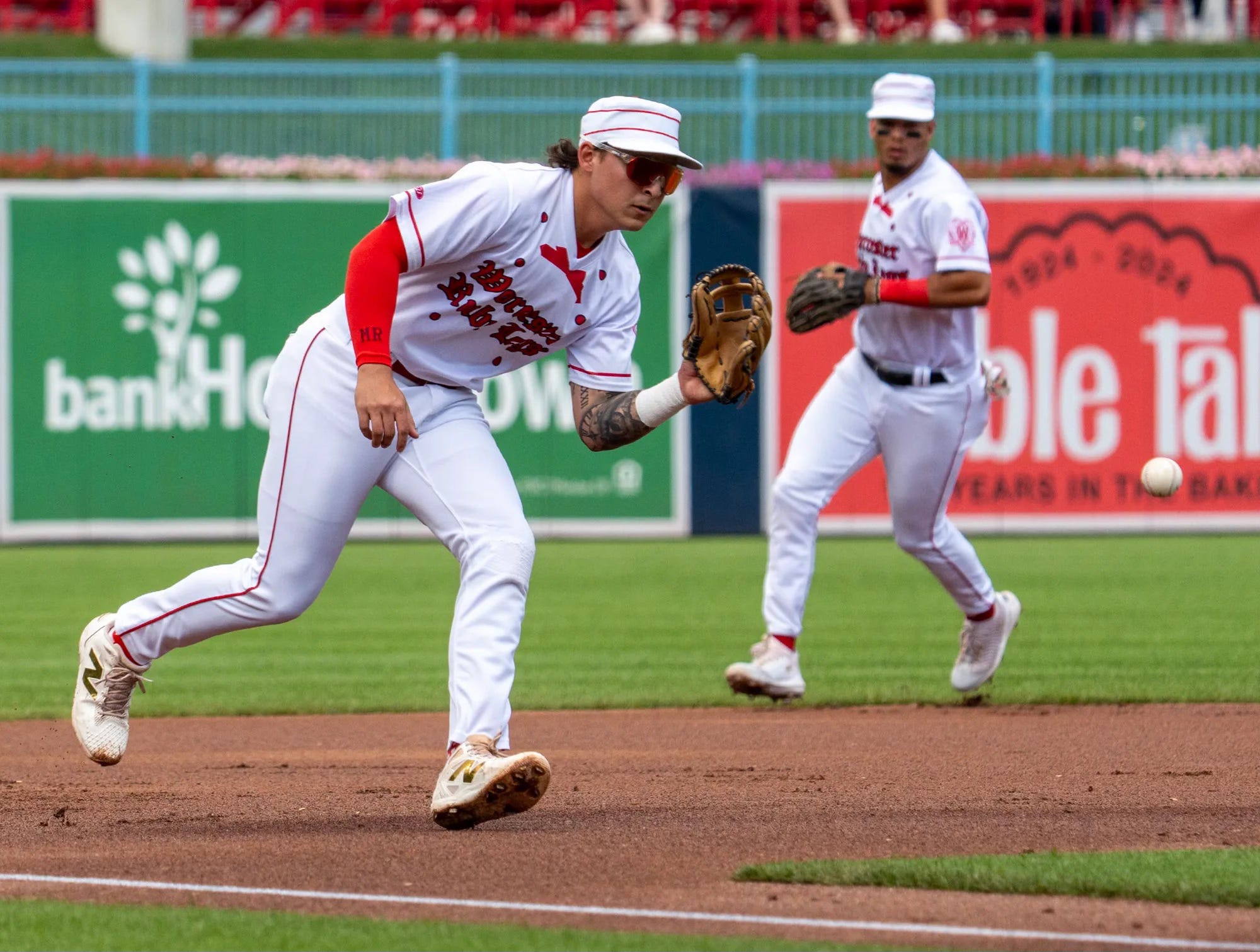
 WooSox infielder and former Red Sox first-round pick Mikey Romero fielding a grounder at Polar Park. (Image courtesy of the Worcester Telegram & Gazette)
The Boston Red Sox spent three consecutive first-round picks on California prep middle infielders — Nick Yorke in 2020, Marcelo Mayer in 2021, and Mikey Romero in 2022. Romero, selected 24th overall, signed for a well-below-slot $2.3 million bonus, a move that reflected both Boston’s belief in his bat and the inherent risk that came with a hitter-first profile still waiting on physical maturity.
From the start, the organization believed in Romero’s baseball IQ — his left-handed swing, his feel for contact, and the idea that power would come with time. What they didn’t get early on was time.
Romero’s professional career was interrupted almost immediately. Persistent back issues, including a stress fracture, cost him large chunks of both his 2022 and 2023 seasons and limited him to just 34 games in his first full year. Development stalled. Momentum never had a chance to build.
Then, in February 2024, Romero lost his father.
For a young player still trying to establish himself in pro ball, the combination of physical setbacks and personal loss could have been overwhelming. Instead, once healthy and back on the field later that spring, Romero began to reassert himself. At just 21 years old, he finally stayed on the field long enough to gain traction — and hit his way to Double-A.
 Four Items on the Red Sox Christmas List That Actually Matter
Coming out of high school, Romero was known as one of the best pure hitters in the 2022 class. His game was built on a quick, compact left-handed stroke designed to spray hard contact from gap to gap.
That hitter still exists — but it no longer defines him.
Since turning pro, Romero has added roughly 20 pounds of strength, and with it came a philosophical shift. Beginning in 2024 and becoming more pronounced in 2025, he traded some strike-zone control for a more aggressive, pull-side approach designed to do damage. The swing decisions changed. Strikeouts climbed. But the contact got louder.
Rather than chasing batting average, Romero began hunting pitches he could drive.
That internal recalibration mattered more to him than surface results. Speaking with Andrew Parker on the To the Show Baseball Podcast, Romero framed 2025 as a year defined by health, process, and underlying growth.
 Red Sox’ Kristian Campbell wraps up Winter Ball while refining his skill set for 2026
“I felt like I improved on a lot of things,” Romero said. “After ’24, I went into the offseason wanting to improve certain underlying stuff, and I felt like I did that. You look at the stat line and say it was just okay, but if you look at the underlying things — the stuff I needed to improve on — it was a lot better. For me, it was a really good year, especially just health-wise.”
That progress was tested almost immediately.
Romero’s promotion to Triple-A Worcester came with a harsh adjustment period — one he recognized in real time.
“I was hitting a couple things hard, but I was striking out a lot. It was just bad,” Romero said. “I was playing really good defense, which was great, but it felt like my welcome-to-Triple-A moment.”
The difference wasn’t just velocity or stuff — it was intent.
“I was facing big league guys — guys who had showtime — and they were exploiting things I kept chasing or not swinging at,” he said. “Once I got going, I got going. But early on, they exposed things.”
What helped Romero stabilize wasn’t just more at-bats — it was the clubhouse.
In Worcester, Romero suddenly found himself surrounded by players who had lived the grind he was just entering. He noticed their routines, preparation, professionalism, and in the process, every day became a lesson.
“If the game’s at seven, they’re there at 11,” Romero said. “They’re getting their routines in, lunch, body work with the trainers. Just watching that every day is huge.”
Some of those lessons came from proximity. Romero’s locker sat next to MLB journeyman Trace Thompson, and the daily exposure mattered.
“The guy next to me was Trace Thompson, and it was really cool just talking to him,” Romero said. “He’s been in the game for a while and had a lot of good stuff to share with me about playing the game and playing it the right way. Seeing how he showed up and did his routine every day — that sticks with you.”
 Blake Aita heads to St. Louis as a developmental bet for the Cardinals
For Romero, there was pride in that space, too.
“It was cool being the youngest guy in the locker room,” he said. “Knowing I worked hard to get to that point.”
Romero also gravitated toward players whose value showed up over time, not in flashes. One of them was Nick Sogard, before his recall to Boston.
“Guys like Nick Sogard, I loved watching them play because they play the game really hard,” Romero said. “He had a quote I loved: ‘If you watch me for one game, you might not think I’m great. But if you watch me for a month, you might leave thinking I’m a pretty damn good player.’”
The longer Romero watched, the clearer it became.
“You watch him for a stretch and you realize how polished he is. Seeing what he does day to day to get that good — that’s fun to learn from.”
In 2025, he split the year between Double-A and Triple-A, appearing in 111 games and hitting .245/.300/.452 with 17 home runs and 33 doubles. The strikeouts remained elevated, but the power held as the competition improved — a meaningful sign that his damage-oriented approach could survive at higher levels.
The early Triple-A struggles didn’t derail him. They clarified what still needs tightening as the margin for error narrows.
 The White Sox are taking a smart gamble on Sean Newcomb — and the pitch data explains why
Romero’s development hasn’t followed the clean arc often expected of first-round picks. Injuries cost him years. Loss tested his resolve. Triple-A exposed his flaws — and introduced him to models of what longevity actually looks like.
And yet, three years after being drafted 24th overall in 2022, he’s reached Triple-A.
The bat is louder than it was on draft day. Health and approach will determine how far he goes from here, but Romero is no longer just a projection.
He’s a player who’s learned how to watch, how to adjust, and how to survive the steps in between — which, at this stage, may matter just as much as the tools.